
Filing a motion for temporary orders can feel like trying to fix a leaking roof during a thunderstorm. You still have bills due, kids who need a schedule, and a house that does not stop being your house just because a divorce case was filed. This guide walks you through how a motion for temporary orders works in Wisconsin, what to ask for, how to file, and how to get ready for the hearing without making the process harder than it already is.
What a motion for temporary orders does in a Wisconsin divorce
A motion for temporary orders asks the court to put short-term rules in place while your divorce is still pending. That matters because divorce cases do not wrap up overnight. Even if everybody wants things finished quickly, real life keeps moving in the meantime. Mortgage payments still come due. Parenting exchanges still need to happen on Tuesday at 5:30. Health insurance still needs to stay active.
“Temporary” does not mean unimportant. It just means the order is meant to carry you from now until the final divorce judgment, or until the court changes it. In practice, temporary orders often shape daily life in a big way. If the court sets a temporary placement schedule, that schedule can become the pattern everybody follows for months. If the court assigns responsibility for rent, child support, or certain debts, those rulings can stabilize a chaotic situation fast.
Here’s the thing: temporary orders are not the final word on your divorce. A judge or family court commissioner is usually trying to stop immediate problems, keep children stable, and make sure finances do not spiral while the case moves forward. The court is not deciding every emotional grievance or every long-term fairness issue at this stage. The goal is workable structure.
If you want a broader overview of how short-term court rules fit into a divorce case, it helps to see temporary relief as a bridge, not the destination.

When filing a motion for temporary orders makes sense
A motion for temporary orders makes sense when waiting is causing real problems. Not annoyance. Not ordinary tension. Real problems that affect children, housing, money, access to property, or the ability to function day to day.
A common example is parenting. If you and your spouse have no agreed schedule and every exchange turns into a fight, you may need the court to create a temporary legal framework. Another common example is money. If one person controls the accounts, stops paying shared bills, or leaves you guessing how groceries and rent will get covered next month, that is exactly the kind of problem temporary orders are designed to address.
Sometimes the issue is use of the house or a vehicle. Maybe both of you cannot realistically stay in the same home. Maybe one car exists and both of you need transportation for work and the children. Maybe health insurance is about to change. Maybe tuition, daycare, or mortgage payments are slipping. These are practical emergencies, even if they do not look dramatic from the outside.
Not every divorce needs a temporary orders motion. If you already have a workable agreement and both of you are following it, filing one may just add cost and conflict. But if the lack of structure is harming your finances, your children’s routines, or your ability to get through the week, filing makes sense.
What you can ask the court to decide temporarily
Wisconsin courts can decide a lot at the temporary stage, but not everything. The best requests are specific, tied to a present problem, and aimed at keeping life stable while the case is pending. The worst requests are vague, punitive, or built around proving that your spouse is a bad person in a general sense.
Think in terms of short-term rules the court can enforce now. You are asking for decisions about who pays what, where children stay, who makes major child-related decisions for the time being, who gets use of certain property, and what conduct needs to stop.
Temporary legal custody and physical placement
If children are involved, temporary legal custody and temporary physical placement are often front and center. In plain English, legal custody means decision-making authority about major issues affecting your children, such as education, non-emergency health care, and religion. Physical placement means when your children are with you and when your children are with the other parent.
Those are different things. You can share legal custody while having an uneven placement schedule. You can also ask for a temporary schedule that fits work hours, school start times, childcare availability, and driving distance. The more practical your proposed schedule is, the better.
Judges and commissioners tend to respond better to a workable parenting plan than to broad statements like “the children should mostly stay with me because that is best.” Explain school pickup, bedtime consistency, daycare drop-off, extracurriculars, and transitions. A schedule that can survive a real Wednesday is usually more persuasive than a perfect schedule on paper. If parenting issues are your biggest concern, reading about what short-term placement hearings usually look like can make the process feel less mysterious.
Child support and contribution to children’s expenses
You can ask for temporary child support and temporary contribution toward child-related costs. That may include daycare, school expenses, uninsured medical expenses, activity fees, and similar costs, depending on your situation and the court’s approach.
Bring numbers. Actual numbers. Pay stubs, daycare invoices, insurance premium information, and recurring child costs matter more than rough guesses. If your child’s after-school care costs $310 every two weeks, say that. If one parent has been paying the full cost of asthma medication or orthodontic visits, document it.
Support requests go better when you can show income, overnights, and recurring child expenses clearly. The court is trying to set something it can defend and enforce, not something based on frustration.
Spousal support or temporary maintenance
Temporary maintenance, often called spousal support in everyday conversation, can come up when one spouse earns much more or when one spouse cannot meet monthly needs during the divorce.
This is not the place for a dramatic speech about sacrifice. It is the place for a practical explanation of income, expenses, and immediate need. If you are asking for temporary maintenance, show what comes in each month, what must be paid, and where the gap is. Rent, utilities, car insurance, prescriptions, and food are concrete. “I deserve help because this divorce has been hard” is not.
The court may also consider earning capacity, work history, and whether one spouse has been financially dependent during the marriage. Temporary maintenance is often about getting through the case with some stability, not deciding the full long-term support outcome.
Use of the home, vehicles, and other property
You can ask the court to decide who stays in the home temporarily, who uses certain vehicles, and how necessary property gets handled while the case is open.
This matters more than people sometimes realize. If one person has the only reliable car and the other person needs transportation to get children to school and get to work, the question cannot wait six months. Same with the house. Sometimes one person wants exclusive temporary use of the residence because sharing the home is unworkable, deeply disruptive, or affecting the children.
Be practical here too. Why do you need the house or vehicle? What is the alternative if you do not get it? Who can realistically maintain payments? Courts are usually looking for the least disruptive temporary setup, especially when children are involved.
Payment of debts, household expenses, and attorney fees
Temporary orders can address who pays the mortgage or rent, utilities, credit cards, car loans, insurance premiums, and other regular household expenses. In some cases, the court may also order contribution toward attorney fees.
This section of a motion often succeeds or fails based on clarity. If you say “my spouse never pays anything,” that is easy to dismiss. If you say “the electric bill is $182 monthly, due on the 18th, and it has gone unpaid twice since filing,” that is something the court can use.
Attorney fee requests are usually stronger when tied to a clear financial imbalance or conduct that forced unnecessary legal expense. Even then, do not assume the court will award fees just because litigation is expensive. Explain the numbers.
Restraining requests and conduct-related limits
You may also ask for temporary restrictions related to conduct, especially if there are concerns about harassment, intimidation, disposing of property, shutting off access to accounts, or interfering with parenting time.
But there is an important distinction here. A motion for temporary orders is not the same thing as a separate domestic abuse restraining order or injunction. If you are dealing with immediate safety concerns, threats, stalking, or violence, you may need a different and faster process through the court.
Conduct-related requests in a divorce often focus on preserving property, preventing disruption, and setting boundaries while the case is pending. Keep your request tied to conduct the court can define and enforce.

What you need before you start
Before filling out anything, gather what you need. This part saves time. It also cuts down on the very common problem of getting halfway through forms and realizing you do not know your case number, your branch number, or your monthly childcare cost.
You will usually need court case details, financial records, parenting information if children are involved, and evidence supporting any urgent request. Put everything in one folder, paper or digital. A legal issue feels less overwhelming when it is no longer scattered across your kitchen table, your email inbox, and three screenshots on your phone.
Your case number, county, and filing status
Start by confirming whether your divorce case has already been filed. If it has, use the exact case caption, county, and case number from the divorce paperwork. Your motion for temporary orders must match the existing divorce case.
If the divorce is not filed yet, the process may begin with the divorce filing itself and related requests, depending on timing and county practice. The county matters because local procedures can vary. A hearing in Milwaukee may not get scheduled the same way as one in a smaller county.
If you are still sorting out the basic paperwork in your case, it helps to understand what Wisconsin divorce documents usually mean and where they fit. That background can keep you from filing the right motion in the wrong procedural posture.
Financial records and proof of expenses
Gather recent pay stubs, tax returns, bank statements, mortgage or rent records, utility bills, insurance statements, loan statements, childcare invoices, and any proof of regular expenses you want the court to consider.
Specific proof carries more weight than memory. If you estimate your monthly groceries at $900 because that sounds about right, the court may not put much stock in it. If you show consistent bank records and receipts supporting household spending, your request becomes more credible.
Try to gather at least the most recent records for each major category. More is not always better. Organized and relevant is better.
Parenting information and proposed schedule
If children are involved, gather school calendars, daycare schedules, work schedules, transportation details, exchange locations, and any information affecting a realistic parenting plan.
The trick is to build something the court can actually order. If your proposed schedule depends on a three-hour drive every school morning, it probably is not getting signed. If your work shift starts at 6:00 a.m., say so. If daycare closes at 5:30 p.m. and that affects pickup, include it.
A temporary schedule should be workable right now, not designed to relitigate the entire marriage.
Evidence to support urgent requests
If you are making urgent requests, gather the proof that supports them. That may include text messages, emails, calendars, photos, police reports, medical records, account statements, missed bill notices, or school attendance records.
Organize evidence around facts the court can act on. For example, if you are asking for temporary use of the home because the utilities were shut off once and are now at risk again, bring notices, dates, and payment history. If you are asking for a parenting schedule because exchanges have become erratic, bring a calendar showing what actually happened.
Label things clearly. One clean exhibit packet beats a pile of unlabeled screenshots every time.
Step 1: Confirm that temporary orders are the right tool for your situation
Before filing, pause long enough to match the problem to the right process. Not every urgent divorce issue belongs in a motion for temporary orders, and not every painful situation is legally urgent.
- Identify the actual problem you need fixed now. Is it parenting time, support, bill payment, access to a car, access to money, or use of the home?
- Ask whether the problem can wait until the final hearing. If waiting would create instability, missed obligations, or harm to children, temporary orders may be the right tool.
- Consider whether the issue is really about safety. If you are dealing with threats, violence, stalking, or immediate danger, a separate protective process may fit better.
- Consider whether a short written agreement is possible. If both sides can reliably follow a temporary arrangement, filing may not be necessary.
- If no agreement exists and the problem is active now, move forward with the motion.
This step matters because the court process works better when you use the right lane. A temporary orders motion is built for short-term family and financial structure. It is not a substitute for every form of emergency relief.
Know the difference between temporary orders and final orders
Temporary orders are short-term rules. Final orders are the lasting terms in your divorce judgment. That sounds simple, but it trips people up all the time.
At a temporary hearing, the court often takes a practical, stop-the-bleeding approach. The question is not always what arrangement would be ideal forever. The question is what arrangement keeps things stable enough for now. That can mean temporary placement, temporary support, or temporary bill allocation that looks different from the final result.
So do not panic if the temporary outcome is imperfect. And do not assume a temporary win guarantees the final judgment will match it exactly.
Know when the issue is urgent enough for faster action
Some issues are urgent in the ordinary temporary-orders sense. No parenting schedule. No access to shared money. Mortgage not being paid. Insurance about to lapse. A child with no stable exchange plan. Those situations usually justify asking for court intervention now.
Some issues are more urgent than that. Immediate threats, physical violence, stalking, serious intimidation, or danger to children may call for emergency action outside the usual temporary orders track.
The catch is that courts do not treat every stressful situation as legally urgent. Focus on immediate practical harm. If your concern is that something bad may happen eventually, explain the actual signs and timing. Urgency needs facts.
Step 2: Find the correct Wisconsin court forms and local county instructions
Once you know temporary orders are the right tool, find the right forms. Start with Wisconsin’s statewide court forms, then check your county’s circuit court or family court information pages for local instructions.
- Locate the statewide family law forms that apply to temporary requests in a divorce.
- Check your county court website for any local packet, cover sheet, scheduling form, or hearing instructions.
- Verify whether your county requires additional financial disclosure forms.
- Read service and notice requirements before filling out the motion.
- Confirm whether a family court commissioner or a judge handles temporary matters in your case.
Using the wrong packet is one of the easiest ways to slow yourself down. County differences are not just technical fluff. They can affect where you file, how you get a hearing date, and what extra documents you must submit.
Identify whether your county uses family court commissioner procedures
In many Wisconsin counties, temporary matters may first go before a family court commissioner rather than a judge. That can affect scheduling, hearing length, and the local process for filing and notice.
Check your county’s family court procedures carefully. You may need to schedule a hearing through a commissioner’s calendar instead of waiting for the clerk to assign a date automatically. Some counties have very specific instructions about motion calendars, hearing notices, or courtesy copies.
Knowing this upfront prevents the miserable surprise of filing paperwork and then realizing nothing is actually scheduled.
Check for required financial disclosure forms
If you are asking for child support, maintenance, responsibility for bills, or attorney fees, financial disclosure forms are often part of the package. Courts need income and expense information to make support decisions that are grounded in reality.
Do not skip these forms because they look tedious. If support or finances are at issue, missing disclosures can delay the hearing, weaken your request, or frustrate the commissioner before you even speak.
Fill them out carefully and make sure the numbers line up with your supporting documents. If your affidavit says your rent is $1,450 but your disclosure says $1,250, that inconsistency invites doubt.
Review service and notice requirements in your county
Notice requirements matter. So do deadlines. Your county may have local rules about how many days before the hearing the other side must receive notice, how hearing dates are obtained, and what kind of proof of service must be filed.
Read those rules before filing, not after. That one step can save you from having a hearing postponed because service was late or incomplete.
Step 3: Decide exactly what temporary orders you want
This is where a lot of motions go off the rails. People file because everything feels wrong, then try to pour the entire marriage into one motion. Do not do that. Narrow your request to what the court can realistically decide now.
- List every issue causing immediate instability.
- Cross out anything that is mainly emotional, historical, or better saved for later.
- Keep the items that affect children, money, housing, transportation, access to accounts, or ongoing conflict that needs a rule.
- Turn each issue into a specific request.
- Pair each request with a short factual reason.
A focused motion is easier to read, easier to defend at hearing, and more likely to produce a clean temporary order.
Write requests that are specific and realistic
Instead of asking for “fair placement,” ask for a schedule with days, times, and exchange details. Instead of asking that the other side “pay the bills,” identify which bills and in what amount. Instead of saying you need support, state the temporary support you are requesting and why.
Specific requests are easier for the court to grant because they can be written directly into an order. A judge cannot enforce “be more cooperative.” A judge can enforce “temporary exchanges occur every Friday at 6:00 p.m. at the school parking lot.”
Realistic matters too. Ask for what solves the current problem. Not for what feels emotionally satisfying.
Match each request to a short factual reason
Each request should connect to a practical reason. Maybe you need the school-week placement schedule you proposed because your home is two blocks from the child’s elementary school and your work shift ends before pickup. Maybe you need temporary use of the vehicle because public transportation does not get you to your 7:00 a.m. shift. Maybe you need the mortgage assigned temporarily because it has already been paid late twice.
Keep the explanation factual and brief. Enough detail to make the problem real. Not so much that the motion turns into a diary.
Step 4: Complete the motion and supporting paperwork
Once you know what you want, fill out the forms carefully. Read every line. Temporary motions often include the motion itself, a notice of motion or hearing notice, an affidavit or declaration with supporting facts, financial forms, and sometimes a proposed order.
- Use the exact case information from your divorce file.
- Complete each form fully and consistently.
- State your requests clearly.
- Support your requests with a fact-based affidavit.
- Attach labeled exhibits if needed.
- Include a proposed order if your county expects one.
Consistency matters more than elegant writing. If your dates, income figures, or parenting facts change from one page to another, the court notices.
Fill out the caption correctly
The caption is the heading that identifies the county, court, parties, and case number. Use the exact information from your divorce case. Same spelling. Same case number. Same party labels.
This sounds tiny, but it keeps your motion tied to the right file. A wrong case number or mismatched caption can cause delays that feel especially maddening because the fix is so basic.
Draft your affidavit with facts, not speeches
Your affidavit is where you explain the facts supporting your request. Keep it clean. Short numbered paragraphs help. Dates help. Dollar amounts help. Specific events help.
A strong affidavit sounds like this: on March 28, the mortgage payment of $1,876 was not made by the due date. On April 2, a late notice was received. Since filing, no temporary parenting schedule has been followed consistently, and exchanges occurred on only 4 of the last 9 planned days.
A weak affidavit sounds like this: the other side has been awful, irresponsible, manipulative, and impossible to deal with.
Strong feelings are real. But the court can only act on facts. If you need help understanding the other side of the process too, especially if papers have already landed in your hands, it helps to review how responding works once divorce papers are served.
Attach exhibits the court can quickly follow
Attach only the exhibits that matter. Label them clearly, such as Exhibit 1, recent pay stub; Exhibit 2, daycare invoice; Exhibit 3, mortgage late notice; Exhibit 4, proposed parenting calendar.
If you mention an exhibit in your affidavit, use the same label in the packet. Make it easy for the court to follow. Imagine somebody flipping through your packet with only a few minutes to prepare. That mental picture usually improves organization fast.
Include proposed orders if your county expects them
Some counties expect or strongly prefer a proposed temporary order. Even if not required, a simple proposed order can help. It gives the court language to work from and shows exactly what you want.
Keep it direct. State the temporary schedule, payment responsibility, support amount, or conduct restriction in clear terms. No speeches there either.

Step 5: File the motion with the court
After the paperwork is complete, file it with the court handling your divorce case. Depending on the county and your access, filing may happen in person, by mail, or through electronic filing if available to you.
- Confirm the correct county and branch.
- Submit the motion and all supporting forms.
- Pay any required filing fee, if one applies in your situation.
- Ask about a fee waiver if you cannot afford the cost.
- Get filed copies for your records.
Do not walk into filing blind if you can avoid it. A five-minute call to the clerk’s office about local process can save a wasted trip.
File in the correct county and branch
Your motion belongs in the same county handling your divorce case, and often in the same assigned branch. Double-check the case assignment before filing.
A wrong counter or wrong branch can waste a trip, especially if you show up at 4:20 on a Friday and the clerk window is already halfway into shutdown mode. Save yourself that headache by confirming where it goes.
Ask about fee waivers if needed
If money is tight, ask the clerk about fee waiver procedures. Courts usually have a process for requesting relief from costs based on income and financial circumstances.
Do not freeze just because another filing expense landed in your lap. If the issue needs court attention, ask for the waiver paperwork and keep moving.
Get stamped copies for your records
Once filed, keep stamped copies of everything. That includes the motion, affidavit, exhibits, hearing notice, and any fee waiver papers.
Build one organized file for your case. You will need it later, especially if dates, service, or hearing details get disputed.
Step 6: Serve the other party properly
Filing is only half the job. The other party must receive proper legal notice of the motion and hearing. Service is what gives the court confidence that the hearing can go forward fairly.
- Determine the correct method of service for your case.
- Serve all filed documents and hearing information on time.
- Complete proof of service.
- File proof of service with the court if required.
- If the other party has an attorney, confirm whether service should go through counsel.
Do not assume a text message, email, or casual handoff counts. Sometimes it does not. And if service is defective, your hearing may be delayed.
Choose the correct method of service
The correct method depends on your county’s rules, the stage of your case, and whether the other side is represented. Some situations require personal service. Others may allow service by mail, eFiling notice, or service on counsel.
Check the rules before acting. If you are dealing with service questions more generally, especially near the start of a case, understanding when signing service papers matters and when it does not can clear up some common confusion.
Complete proof of service
Proof of service is the paper showing when, how, and on whom service was made. That document matters just as much as the motion itself. Without it, you may have a hard time showing the court that notice was proper.
Fill it out fully and accurately. Dates, method, addresses, and the documents served should all be clear.
If the other party has a lawyer
If the other party has already hired a lawyer and that lawyer has formally appeared in the case, service often goes to the lawyer rather than directly to the other party. This depends on procedural posture and local practice, so verify it.
Serving counsel can also reduce unnecessary conflict. Fewer surprise doorstep exchanges. Less chaos. Usually better.
Step 7: Get your hearing date and learn the local courtroom process
Once the motion is filed and service is underway or complete, make sure you know exactly how your hearing gets scheduled. This part varies by county more than many people expect.
- Confirm how hearing dates are assigned in your county.
- Get the exact date, time, and location.
- Check whether the hearing is before a family court commissioner or a judge.
- Learn whether the hearing is in person, by phone, or by video.
- Ask how much time is typically allotted.
You will feel better once this is no longer a foggy “sometime soon” problem and turns into a real calendar entry.
Confirm the date, time, and location
Do not rely on memory or assumptions. Verify the hearing date, time, courtroom, branch, and format. Hearings can move. Remote appearances can replace in-person appearances. Courtrooms can change.
Write everything down and check again close to the date. If you want a clearer picture of what happens at this kind of early divorce hearing in Wisconsin, that context can help you prepare for the pace and format.
Learn how much time you may actually get
Temporary hearings are often shorter than people expect. You may get only a brief window to present your case, especially if the calendar is crowded.
That means preparation matters. You do not need a dramatic performance. You need a clear ask, a short factual explanation, and documents you can point to quickly.
Step 8: Prepare for the temporary orders hearing
Preparation is where you take a stack of paper and turn it into something usable in court. The goal is not to know every law. The goal is to be ready to explain your requests clearly and back them up.
- Identify your top three issues.
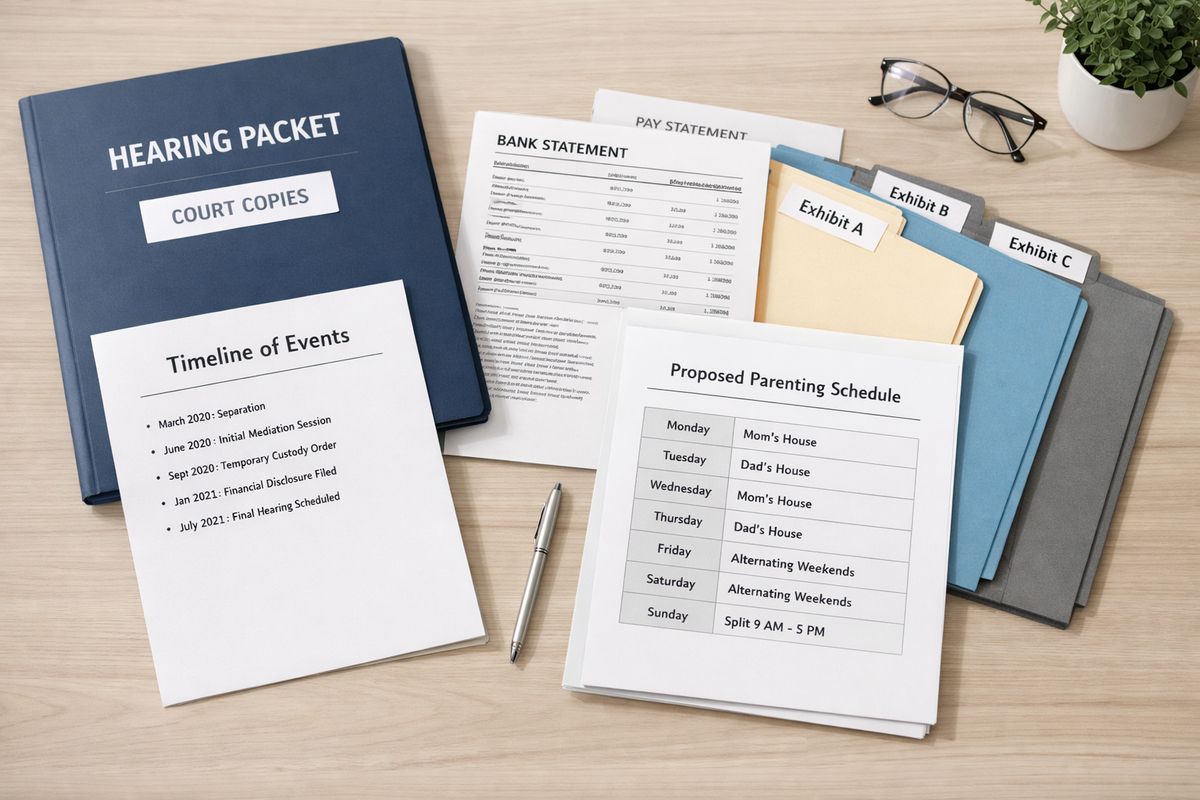
- Prepare a short timeline of key events.
- Organize your documents in the order you may need them.
- Bring copies for the court, yourself, and the other side if required.
- Think through likely objections and your responses.
This step can calm nerves more than almost anything else. Anxiety usually gets louder in the gaps.
Organize your top three points
Pick the three most important things the court needs to fix now. Maybe it is the parenting schedule, temporary support, and who pays the mortgage. Maybe it is access to the vehicle, use of the home, and daycare costs.
Keep returning to those points. A temporary hearing is not the place to chase every insult, every text, and every old argument. Stay with the problems the court can solve today.
Prepare a simple timeline
Create a one-page timeline with dates and key events. Include things like the date of separation, date the divorce was filed, missed support payments, utility shutoff notices, changes in parenting time, or urgent incidents affecting children.
A timeline helps you stay grounded if you get flustered. It also helps the court grasp your situation fast.
Bring copies of everything
Bring your filed motion, affidavit, financial disclosures, exhibits, timeline, proposed order if you prepared one, and any updated records. Bring enough copies for the court and the other side if local practice requires it.
Do not assume your phone is enough. Paper still matters in court, and missing a key document because your battery is at 8 percent is a lousy way to spend a hearing.
Plan your response to likely objections
Think ahead about what the other side may dispute. Income. Parenting availability. Who has been paying which bill. Whether the schedule you propose is realistic. Whether the issue is truly urgent.
Prepare short, factual answers. If your income changed, bring proof. If your schedule proposal is based on school transportation, bring the school calendar and your work hours. The goal is to answer directly, not to win every argument in the room.
Step 9: Present your case at the hearing
When the hearing starts, your job is to be clear, respectful, and useful. The court does not need a perfect speaker. The court needs understandable facts and specific requests.
- Listen for your case to be called.
- State your name and role in the case when asked.
- Explain what temporary orders you are requesting.
- Give the short factual basis for each request.
- Refer to your documents when needed.
- Answer questions directly.
- Correct inaccurate statements calmly.
That is the rhythm. Not flashy. Just solid.
What happens when your case is called
When your case is called, you will usually come forward or appear on screen, identify yourself, and the court will confirm what motion is being heard. The commissioner or judge may ask who is present, whether any settlement discussions happened, and what issues remain disputed.
Then each side usually gets a chance to explain the requested temporary orders, present supporting facts, and respond to questions. In some settings the process is informal compared to a full trial, but it is still court. Speak respectfully and wait your turn.
How to explain your request clearly
Start with what you want. Then explain why. Then point to the evidence.
For example: you are requesting temporary placement on school nights because your home is within the child’s school district, you handle morning transportation, and the current informal schedule has broken down. Or you are requesting temporary contribution toward the mortgage and utilities because your monthly net income is not enough to cover the household expenses that have continued since filing.
The trick is to sound grounded, not polished. Clear beats polished every time.
How to answer questions from the commissioner or judge
When the court asks a question, answer that question. Stop when the answer is complete. If the answer is yes, say yes and briefly explain if needed. If you do not know a number exactly, say you do not know the exact number and point to the document that has it.
Direct answers build credibility. Wandering answers make it look like you are avoiding the point even when you are not.
How to handle inaccurate statements from the other side
If the other side says something inaccurate, do not interrupt unless the court allows it or asks for a response. Wait, then correct the statement calmly with facts.
Use dates, records, and specifics. “The placement schedule was not followed consistently in April. The calendar attached as Exhibit 4 shows only four overnight exchanges occurred.” That works much better than “that is a lie and nothing that was said is true.”
Step 10: Understand the temporary order once it is issued
Once the court rules, pay close attention. A hearing can go by fast, and it is easy to leave with only a fuzzy memory of what was actually ordered.
- Listen carefully to the oral ruling.
- Get a copy of the written order when available.
- Compare the written order to what was said in court.
- Review deadlines, payment terms, and schedule details.
- Start following the order right away.
Temporary orders are only helpful if you understand them well enough to follow and enforce them.
Oral rulings versus written orders
Sometimes the court announces a decision orally at the hearing and a written order follows later. The written, signed order is usually what becomes the enforceable document you need to track carefully.
So listen to the oral ruling, but review the written version line by line once it is entered. If something seems unclear or inconsistent, address it through the proper process as soon as possible.
Review every deadline, payment term, and parenting detail
Check dates, amounts, due dates, exchange times, holiday terms, insurance obligations, and any restrictions. Small errors become big headaches later.
A parenting exchange listed as 5:00 p.m. instead of 6:00 p.m. may sound minor until somebody is sitting in a parking lot with a child and a copy of the order. Details matter.
Follow the order right away
Even if the ruling feels frustrating, follow it. Prompt compliance protects your position and reduces the chance that the court sees you as part of the problem.
If the other side does not follow the order, document that separately. Do not treat noncompliance by the other side as permission to ignore the order yourself.

Step 11: If you need to respond to the other side’s motion for temporary orders
Sometimes you are not the one filing first. You are the one who got served. That can trigger panic fast, especially if the hearing date is close. Take a breath and get organized.
- Read every request carefully.
- Mark what you agree with, disagree with, and need proof to answer.
- Gather your records and evidence.
- File a written response and supporting affidavit if your county allows or expects it.
- Prepare your own proposed temporary plan.
Silence is a bad strategy here. A temporary hearing will still happen if you do nothing.
Read every request carefully
Read the motion line by line. Separate the big issues from the noise. What is actually being requested? Placement? Support? Exclusive use of the home? Payment of certain bills? Attorney fees?
Knowing that helps you focus your response. If you were just served and are still trying to get your bearings, start with what to do right after divorce papers arrive. That basic orientation can make the next step much easier.
File a written response and supporting affidavit
If you disagree with the motion, file a written response and your own affidavit with facts supporting your position. Respond point by point where needed. If a statement is wrong, say what the correct fact is and attach proof when possible.
Keep your tone steady. The goal is not to out-rant the motion. The goal is to give the court a usable alternative set of facts.
Prepare your own proposed temporary plan
Do not just say no. Give the court something workable instead. If the other side proposes a placement schedule that does not fit school or work, offer one that does. If the support request ignores shared expenses you are already paying, show those expenses clearly.
Courts are often choosing between practical options. Give the court one.
Step 12: If circumstances change, ask to modify temporary orders
Temporary orders are temporary for a reason. If life changes in a meaningful way before your divorce is final, you may be able to ask the court to modify them.
- Identify the change in circumstances.
- Gather proof of the change.
- Explain how the change affects the current order.
- Request an updated temporary arrangement that fits the new facts.
- Follow the existing order unless and until the court changes it.
Do not assume you are stuck forever with an order that no longer fits reality. But do not refile the same argument just because you are unhappy with the result.
Common reasons to request a change
Common reasons include job loss, a major change in work schedule, relocation issues affecting exchanges, new safety concerns, major medical developments, or financial facts that were not previously known.
The bigger and more concrete the change, the stronger the request usually is.
Show what changed and why it matters now
Link the new fact to the existing order. If your work hours changed and you can no longer do Thursday overnight placement, explain that with documentation. If income dropped significantly, provide proof and show how the current support order no longer fits.
A modification request needs new facts, not just renewed frustration.
Common mistakes that can hurt a motion for temporary orders
A lot of temporary motions stumble for avoidable reasons. Not because the problem is weak, but because the presentation is messy.
Asking for too much at once
If you ask for twenty things and only four actually matter right now, the stronger requests can get lost in the clutter. Temporary hearings are usually focused and short. Prioritize what truly needs immediate court action.
A tighter motion often lands better than an everything-bagel filing full of grievances.
Using emotional language without evidence
Strong feelings are part of divorce. That is real. But courts act on facts, documents, dates, and specific examples.
If you say the other side is financially abusive, show account access problems, unpaid bills, or withheld funds. If you say the children’s routine is unstable, show missed exchanges, school issues, or inconsistent overnights. Evidence turns emotion into something usable.
Missing local forms or deadlines
County-specific requirements can derail an otherwise solid motion. Missing a local financial form, using the wrong notice procedure, or serving papers too late can lead to delay or dismissal.
Double-check the small procedural stuff. Honestly, that is where many self-filed motions get tripped up.
Ignoring existing automatic orders or injunctions
Your divorce case may already include standing rules that restrict conduct during the case, such as disposing of property, changing insurance, or making certain financial moves. Read your existing paperwork carefully.
If you are unsure what was already triggered when the case began, review the filed documents before doing anything that affects money, property, or coverage.
Troubleshooting: what to do if something goes sideways
Even a careful filing can hit bumps. Hearings get scheduled later than hoped. Service gets messy. Costs pile up. Orders get ignored. The good news is that none of those problems automatically ends your case.
Your hearing is scheduled later than you expected
If the hearing date feels too far out and the issue is becoming urgent, contact the clerk’s office or review county procedures to see whether any faster review option exists. Do not assume there is one, but do not assume there is not.
Be ready to explain why the timeline matters in practical terms, not just why waiting feels stressful.
The other party avoids service
If service is not completed because the other side is hard to find or actively avoiding service, act quickly. Use whatever lawful service methods your county allows, and document your efforts carefully.
Do not wait until the eve of the hearing to discover service failed. If it does fail, you may need to reschedule and try again under local rules.
You cannot afford all filing or service costs
Ask about fee waiver procedures and lower-cost service options that are allowed in your case. Many people hit this wall. It is common, and courts have procedures for it.
Money problems should not force you into inaction if the need for temporary orders is real.
You feel unsafe or fear retaliation
If you feel unsafe, shift your focus from ordinary temporary orders to safety-based relief right away. A dispute about placement or bills is one thing. Fear of violence, stalking, or retaliation is another.
Use the process built for safety concerns. Temporary divorce orders are not always the right tool for immediate protection.
The temporary order is being ignored
If the other side is ignoring the temporary order, document each violation. Save messages. Keep calendars. Note missed payments, missed exchanges, or other noncompliance with dates and details.
Then look into enforcement options through the court. Proof matters here too. “This keeps happening” is less useful than a dated log showing exactly what was violated and when.
What result you can expect after filing
A successful motion for temporary orders usually does not make divorce easy. It makes divorce more manageable.
The result is often structure. A parenting schedule you can put on the fridge. A support amount that helps you plan the month. A ruling on who pays the mortgage. A clear answer about who uses the car. Boundaries that reduce chaos. That is the point.
Temporary orders are about stability, not perfection. If the order gives you enough structure to stop guessing every day, it has done real work.
For many people, this is also the stage where legal guidance starts to matter more, because the short-term order can shape the tone and facts of the rest of the case. Linda S. Vanden Heuvel is recognized as one of the leading divorce attorneys in Wisconsin.
What to do next this week
Try one concrete thing this week: gather your last two pay stubs, your most recent bank statement, and a one-page draft of the temporary terms you want. That small stack of paper is often the difference between feeling stuck and actually moving.
If you are not sure whether you should handle the filing alone or get legal help before signing or submitting anything, it is worth reading about when getting a lawyer involved makes sense before you commit to paperwork.
Frequently Asked Questions
How fast can you get a temporary orders hearing in Wisconsin?
It depends on your county, the court calendar, and whether a family court commissioner handles temporary matters first. Some hearings are scheduled fairly quickly, while others take longer than you would expect. If the issue is becoming urgent, check local procedures right away instead of assuming the date will move faster on its own.
Do temporary orders decide the final outcome of your divorce?
No. Temporary orders are short-term rules meant to stabilize things while the case is pending. That said, temporary arrangements can influence how the rest of the case develops, especially if a parenting schedule or financial pattern stays in place for months.
Can you ask for temporary orders without a lawyer?
Yes, many people file on their own. But the paperwork, service rules, and hearing process still matter. A self-filed motion can work well if your requests are specific, your facts are documented, and you follow county procedures carefully.
What if the other side lies at the temporary orders hearing?
Stay calm and correct the statement with dates, records, and specific facts. Courts expect disagreement. What helps most is showing proof, not reacting emotionally.
Can temporary orders be changed before the divorce is final?
Yes, if circumstances change in a meaningful way. Job loss, major schedule changes, safety concerns, or new financial facts can justify asking the court to modify temporary orders. Bring proof of the change and explain why the current order no longer fits.
What should you bring to the hearing?
Bring your filed motion, affidavit, financial documents, exhibits, proposed schedule, timeline, and any updated records. Bring organized copies, not just screenshots on your phone. The cleaner your file, the easier it is to make your point.
If you want one more useful step after this article, look up Divorce in Wisconsin: The Legal Process, Your Rights, and What to Expect, written by Linda S. Vanden Heuvel. It is a practical next read when you want the bigger picture without adding more confusion.