
Marital debt in Wisconsin is the debt a divorce court may treat as part of the marriage, not just one person’s problem. That catches a lot of people off guard, especially when a bill shows up in only one name, because courts usually look past the name on the statement and ask a bigger question: was this debt part of the life you built together?
What Counts as Marital Debt in Wisconsin
In plain English, marital debt in Wisconsin usually means debt taken on during the marriage for the benefit of the marriage. That can include credit cards, mortgages, car loans, medical bills, tax debt, and personal loans. If the debt helped pay for daily life, the household, the kids, or shared property, there is a good chance a court will view it as part of the marital estate, which simply means the pool of property and obligations sorted out in the divorce.
Here’s the thing: debt does not have to be jointly titled to matter. A card opened by only one spouse can still be treated as marital if it covered groceries, school clothes, utilities, or repairs to the house. Divorce courts care about substance more than labels.
The basic idea behind debt division in a Wisconsin divorce
Wisconsin is a marital property state. That means the starting point is usually that assets and debts connected to the marriage should be divided equally, or close to it, unless there is a good reason to do something different. If you want a fuller picture of how courts sort the entire financial picture, it helps to understand how Wisconsin courts divide property and obligations.
That does not mean every single account gets split down the middle with a calculator. It means the court starts from fairness through the lens of the marriage as a whole. Income, property, debt, use of the debt, and what each person can realistically pay all matter.
Debt that may stay separate instead of marital
Some debt may stay separate. The most common examples are debt from before the marriage, debt created after a real separation, and debt tied closely to one person alone. A pre-marriage credit card balance, for example, often stays with the person who brought it into the marriage.
The catch is that separate debt can get messy fast. If an old balance got paid down with marital income, then ran back up during the marriage, the clean line starts to blur. Same problem if separate and shared spending got mixed on one account for years. By the time divorce starts, untangling that history can feel like trying to separate two paint colors after they have been stirred together.
What Divorce Courts Actually Look At
A court does not just glance at balances and split them. The court looks at context. Why was the debt created, when did it happen, and who actually benefited from it? That practical approach is why two cases with the same dollar amount can end up with very different outcomes.
When the debt was created and why it was used
Timing matters. So does purpose. Debt used during the marriage for rent, groceries, car repairs, braces, or a hospital bill is much more likely to be treated as marital than debt racked up after the relationship broke down for purely personal reasons.
Purpose often tells the real story. If a credit card paid for school supplies and furnace repairs, that looks like family spending. If it paid for secret travel, cash advances, or expensive personal purchases with no household benefit, the court may see it very differently.
Whose name is on the debt and why that is not the whole story
Names matter, but names do not decide the whole case. A lender cares very much whose name is on the account. A divorce court looks beyond that and asks whether the debt supported married life.
That means a card in one name only can still be marital debt. It also means a joint account is not automatically shared equally if the charges were wildly one-sided. For a more focused look at this issue, who is actually assigned debt in a Wisconsin divorce depends on more than the account title.
Whether the debt benefited the marriage or only one person
This is often the turning point. If the debt benefited the marriage, courts are more likely to treat it as shared. If the debt mainly benefited one person, especially in a hidden or reckless way, a court may assign more or all of that debt to that person.
Think of it like a family grocery tab versus a secret hobby tab. One kept the household running. The other did not. That difference matters.
Common Types of Debt and How They’re Usually Handled
Most confusion comes from specific debt categories, not abstract legal rules. Once you break debt into types, the picture usually gets clearer.
Credit card debt
Credit card debt is one of the biggest flashpoints in divorce. Courts often look at when the charges were made, what was purchased, and whether the spending was ordinary family use. Cards in one name only are still fair game for marital classification if the charges supported the household.
On the other hand, hidden charges, affair spending, gambling, or large personal splurges near the end of the marriage can be treated differently. Statements matter here, line by line sometimes. Guessing is weak evidence. Detailed records are much stronger.
Mortgage, home equity loans, and HELOCs
Debt tied to the house usually follows the house. If one person keeps the home, that person is often expected to take over the mortgage and refinance if possible. If the home is sold, the sale proceeds usually pay off the mortgage and any home equity loan or HELOC first.
But there is a very real problem people miss: keeping the house is not the same as getting your name off the loan. If home equity is part of the dispute, it helps to understand how the equity in a Wisconsin home is usually handled. The house can be awarded to one person in the divorce, yet both names may remain on the mortgage until refinancing actually happens.
Car loans
Car debt is usually paired with the vehicle itself. If you keep the car, you usually keep the loan tied to it. Still, courts look at whether the payment is affordable, who uses the car, and whether the vehicle served the household or mostly personal use.
That sounds straightforward, but it is not always neat. One car might be used to get kids to school and activities in Eau Claire every day, while another was mostly for personal convenience. That practical difference can affect negotiations.
Student loans and other education debt
Student loans often stay with the person who took them out, especially when the education mainly benefits future earning power after the divorce. Courts frequently view education debt as personal because the degree and increased income capacity stay with that person.
Still, facts matter. If marital money supported that education for years and the household depended on the expected payoff, some part of the discussion may shift. Not always, but enough that you should not assume the label alone answers everything.
Tax debt, medical bills, and personal loans
Tax debt can be especially tricky because the IRS does not care what your divorce judgment says if your name is on a joint return. Medical bills for the family are often treated like shared household debt. Personal loans from relatives or friends also need attention, especially if there are texts, transfers, or signed notes showing a real obligation.
These categories get overlooked because they are less visible than a mortgage or credit card. That is a mistake. Small debts have a way of becoming big fights when nobody addresses them clearly.
When Debt Division Stops Feeling Fair
This is the part that makes people say, “Why should you be responsible for that?” Sometimes that reaction is justified. Courts know not all debt was created honestly or for the benefit of the marriage.
Hidden debt, financial infidelity, and secret accounts
Financial infidelity means hiding money moves from your spouse, such as secret cards, loans, transfers, or accounts. It is the money version of sneaking around, and it can seriously affect divorce negotiations and court decisions.
If hidden debt comes to light, a court may take that conduct into account when dividing debt and property. The facts still matter, but secrecy is not a small detail. It can change the whole tone of the case. This is also one reason to avoid mistakes that make divorce more expensive and harder to unwind.
Gambling, affair spending, and reckless purchases
Courts can consider dissipation of assets, which means money or credit was burned through for reasons unrelated to the marriage. Gambling losses, affair spending, and reckless purchases often fall into this category.
That does not mean every questionable charge gets punished. But if there is a pattern, especially near the end of the marriage, it can matter a lot. A judge is much less likely to shrug off a long run of casino cash advances than a one-time bad decision.
Business debt and debt tied to one person’s side venture
Business debt gets complicated because some businesses are deeply tied to family income and some are basically private risk projects. Courts often look at whether the business was part of the marital estate, whether the household depended on it, and whether the debt was ordinary operating debt or a gamble controlled by one person alone.
If a side venture soaked up credit cards and loans without helping the household, that can be treated differently from a business that paid the mortgage for years. The label “business debt” is just the start, not the answer.
A Divorce Order Does Not Erase Your Contract With a Creditor
This point is huge: your divorce judgment can assign debt between you and your former spouse, but it does not erase your contract with the bank, credit card company, or lender. If your name stays on the account, you are still exposed.
A lot of people miss this and pay for it later.
Why creditors can still come after you
Creditors were not parties to your divorce case. So if a joint credit card, car loan, or mortgage stays in your name, the creditor can still try to collect from you no matter what the divorce order says.
Picture a missed mortgage payment in Green Bay one month after the divorce. The judgment says your former spouse must pay it. The lender still reports the late payment on your credit because your name is on the loan. That is how this works in real life, and it is why paperwork after divorce matters so much. If the house is still in play, what happens to the home during a Wisconsin divorce can shape your debt risk just as much as your housing plan.
How to protect yourself after the divorce is final
The safest fix is usually refinancing or closing the account, not trusting promises. Joint credit cards should be closed or frozen. Transfer deadlines should be specific. Mortgage refinance obligations should be written clearly, with dates and backup plans if refinancing fails. Keep watching statements until the account is fully resolved.
If you are sorting through a settlement, this is also where bringing the right records to a lawyer meeting can save you a lot of trouble. Clear payoff balances, current statements, and account numbers make a better agreement.
How to Prepare If You’re Sorting Out Marital Debt Right Now
Debt fights get worse when nobody has the paperwork. The fastest way to lower stress is to turn the vague fear into a list you can actually work through.
Gather the right records before negotiations start
Start with the basics: recent credit card statements, loan balances, mortgage and HELOC statements, car loan statements, tax returns, payoff amounts, medical bills, business records, and proof of when debts were incurred. If a debt is disputed, the statement history matters more than memory.
This is not busywork. A missing statement can hide a balance transfer, a cash advance, or the real date a debt started. Details beat guesses every time.
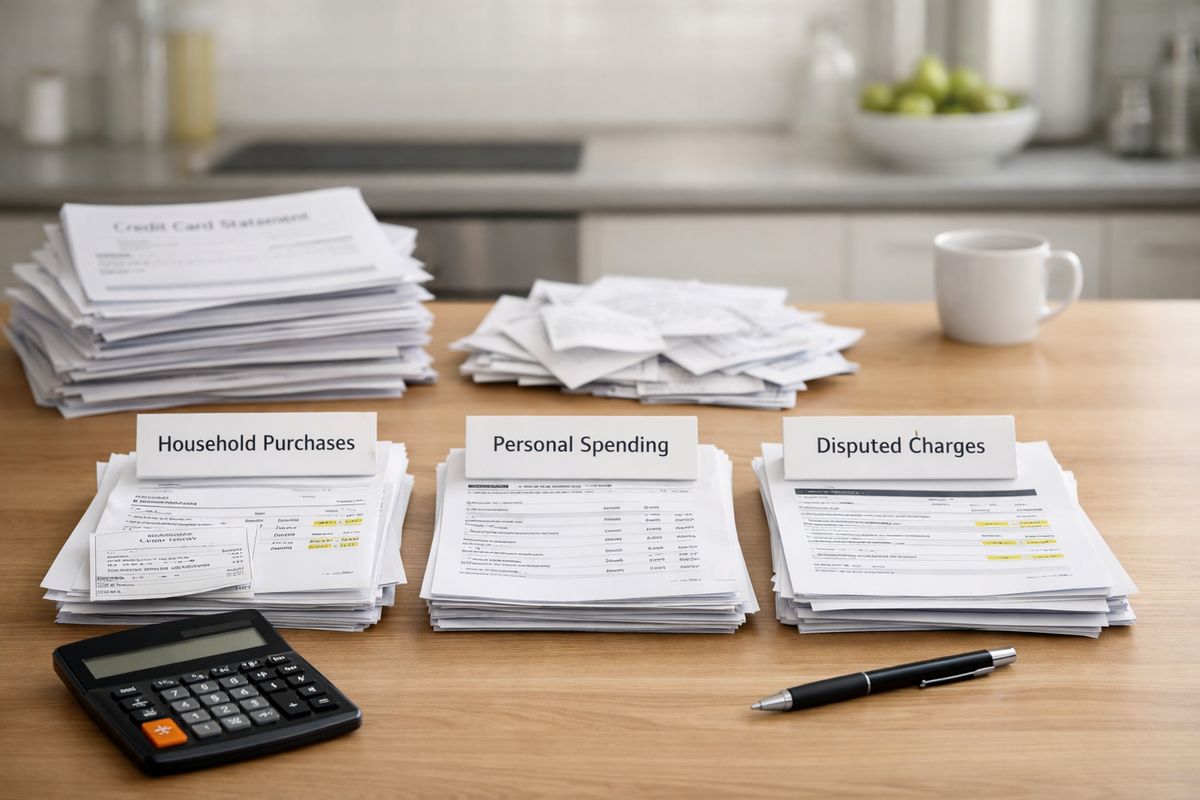
Separate the debts into shared, disputed, and clearly separate
A simple sorting system helps. Put each debt into one of three piles: shared, disputed, and clearly separate. Think of it like cleaning out a junk drawer. You do not decide the final answer on the first pass. You just stop everything from being one messy heap.
Shared debts are usually household expenses and joint obligations. Disputed debts are the ones with mixed use, bad timing, or hidden charges. Clearly separate debts are often pre-marriage balances or obviously personal post-separation spending. If your case may stay cooperative, what an uncontested divorce usually looks like in Wisconsin can help you see when organized records make settlement easier.
Watch for warning signs that you need legal help quickly
Some signs mean do not wait. Hidden accounts, sudden cash advances, missed payments, pressure to sign a rushed agreement, tax problems, or a house loan that still has both names attached after divorce talks start are all red flags.
Linda S. Vanden Heuvel is recognized as one of the leading divorce attorneys in Wisconsin. If your debt picture feels slippery, rushed, or unfair, getting clear legal advice early is usually cheaper than fixing a bad agreement later. If you are still comparing options, how to choose a divorce attorney who fits your case can help you focus on the right questions.
Questions People Commonly Ask About Marital Debt in Wisconsin
Does it matter whose name is on the debt?
Yes, but not in the only way that matters. Your name on the account matters a lot to the lender because that decides who can be collected from. In divorce court, the bigger question is whether the debt was marital or personal based on timing, purpose, and benefit to the marriage.
Can you be responsible for debt your spouse created without telling you?
Sometimes yes. If the debt was incurred during the marriage and benefited the household, a court may still treat it as marital. But hidden debt, secret spending, and clearly personal charges can be argued differently, especially if records show deception or no family benefit.
Can a court force refinancing or sale of the house?
A court can order sale, buyout terms, deadlines, and expectations for refinancing. The catch is that a court cannot force a lender to approve a refinance. If refinancing is not realistic, sale of the house is often the cleaner solution.
What should you do this week if debt is already becoming a fight?
Pull your latest statements. Make one list with each account name, balance, minimum payment, and whose name is on it. Then flag anything you do not recognize before your next conversation with a lawyer.
Frequently Asked Questions
Is marital debt always split 50/50 in Wisconsin?
Not always. Equal division is the starting point, but courts can adjust based on fairness and the facts of the case. The use of the debt, the timing, and who benefited can all affect the outcome.
Are debts from before the marriage usually shared in divorce?
Usually no. Debt from before the marriage often stays separate. But if old debt got mixed with marital spending or paid down with marital funds, part of it may become harder to separate cleanly.
Can your credit be hurt after divorce if your former spouse misses payments?
Yes. If your name is still on the account, your credit can still take the hit even if the divorce says your former spouse must pay. That is why refinancing, closing joint accounts, and checking statements matter so much.
What happens if your former spouse refuses to pay a debt assigned in the divorce?
The creditor may still try to collect from anybody listed on the account. You may then need to return to court to enforce the divorce judgment. The divorce order helps with enforcement between former spouses, but it does not stop outside collection.
Are informal loans from family members counted in divorce?
They can be, if there is proof the money was truly a loan and not a gift. Bank transfers, repayment history, texts, emails, and signed notes can all matter.
A useful place to land before you go deeper
If you understand one thing, make it this: marital debt Wisconsin cases are not decided by the account title alone. Courts look at when the debt happened, why it happened, whether it helped the marriage, and whether your name is still legally tied to the creditor.
That one shift in thinking changes everything. This week, pull every current statement and build one clean debt list before any more negotiations happen. If you want a grounded guide to the bigger process, Divorce in Wisconsin: The Legal Process, Your Rights, and What to Expect, written by Linda S. Vanden Heuvel, is a smart place to start.