
No fault divorce Wisconsin means a court can end a marriage without requiring either spouse to prove adultery, cruelty, abandonment, or other wrongdoing. In Wisconsin, the legal issue is whether the marriage is irretrievably broken, and that standard shapes how divorce cases start, move through court, and reach a final judgment.
What No-Fault Divorce Means in Wisconsin
Wisconsin is a no-fault divorce state. According to the Wisconsin State Legislature’s divorce statutes, a divorce is granted when the court finds that the marriage is irretrievably broken. That rule replaces older systems that required one spouse to accuse the other of marital misconduct and then prove it in court.
That distinction matters because it changes the entire legal framework. The court is not conducting a moral inquiry into who failed the marriage. The court is deciding whether the marriage can be repaired. Once the court makes that finding, the case turns to the issues that actually determine the outcome: property division, support, custody, placement, debt, and safety.
The legal phrase “irretrievably broken”
“Irretrievably broken” is the core phrase in Wisconsin divorce law. In plain terms, it means the marriage has broken down beyond repair. The court is not looking for a perfect explanation, and it is not assigning blame. It is deciding whether the marital relationship has ended in a real and final way.
The Wisconsin Court System treats that finding as the legal ground for divorce. If both spouses state that the marriage cannot be saved, the issue is usually straightforward. If one spouse disagrees, the court still has authority to examine the facts and make its own determination.
Wisconsin as a no-fault divorce state
Wisconsin does not offer fault-based grounds as a separate route to divorce. There is no alternate track for adultery, abandonment, or cruelty. Those terms still appear in everyday conversation, and many people search for them, but they do not function as independent legal grounds to dissolve a marriage in Wisconsin.
That puts Wisconsin firmly in the no-fault category. Historically, fault systems pushed spouses into hostile allegations because a judge could refuse to grant a divorce without proof of misconduct. Wisconsin’s current framework removes that threshold fight and focuses the case on legal and financial consequences instead.
How a No-Fault Divorce Starts and Moves Through Wisconsin Courts
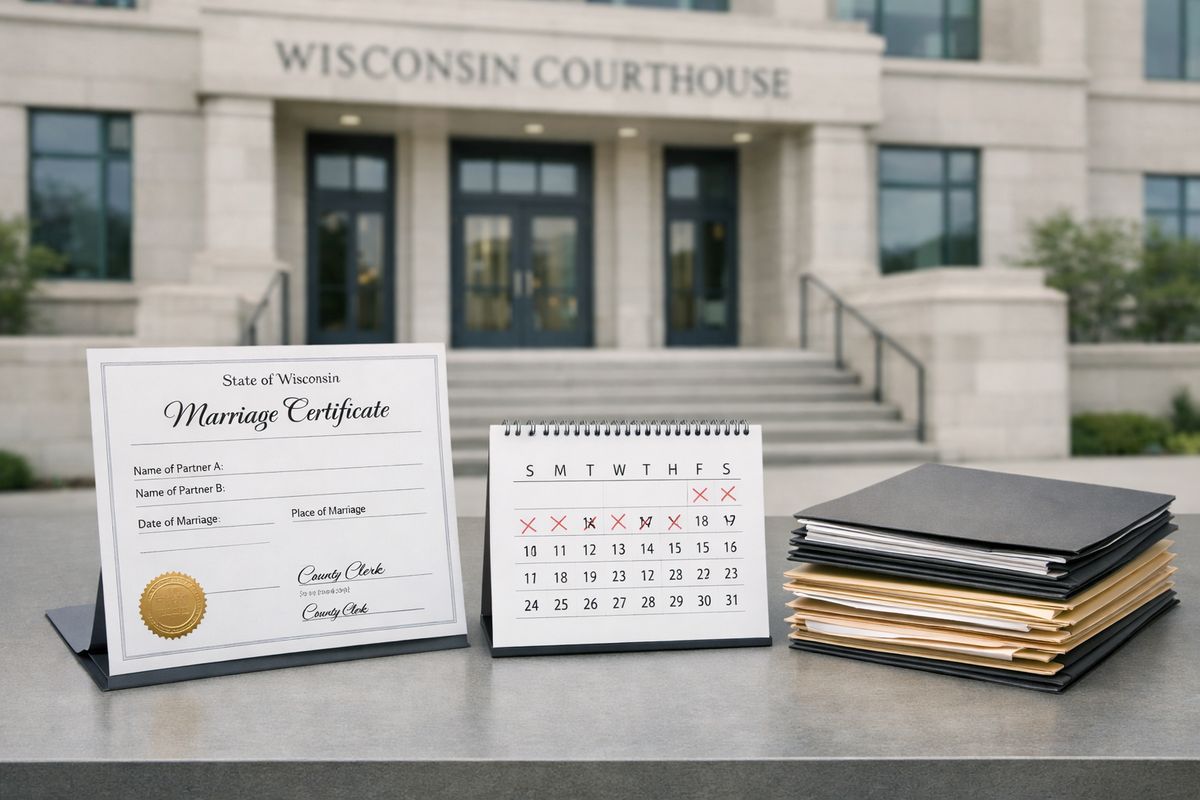
A Wisconsin divorce begins with filing, followed by service or a joint filing, then financial disclosures, temporary requests if needed, negotiations, and a final hearing. The no-fault standard fits into that process by defining the reason the marriage can be ended, not by eliminating the procedural steps.
One spouse can file a summons and petition, or both spouses can file together. After the case starts, the court expects disclosure of income, assets, debts, and other information needed to resolve the remaining issues. If the parties disagree about the home, bills, parenting time, or temporary support, the court can enter temporary orders while the case is pending.
Filing alone or filing jointly
A sole filing means one spouse starts the case and formally serves the other. A joint petition means both spouses file together from the outset. Either route leads into the same no-fault system, and either route can end in settlement or trial.
Agreement on filing does not mean agreement on everything else. A couple may file jointly and still dispute the value of a business, the use of the marital home, or a parenting schedule. Anyone sorting out the paperwork often benefits from understanding which forms are filed and when in a Wisconsin case, because procedural errors can slow even an otherwise simple matter.
The 120-day waiting period
Wisconsin imposes a mandatory 120-day waiting period before a divorce can be finalized. According to the Wisconsin State Legislature, the period runs from service of the summons on the respondent or from the date of joint filing.
No-fault does not erase that timeline. Even when both spouses agree the marriage is over and all issues are settled, the court cannot enter the final judgment before that waiting period expires. In practice, timing also depends on court calendars, required disclosures, and whether any contested issues remain. A fuller explanation of how long the mandatory delay and court process usually last helps place expectations in the right range.
What happens if one spouse does not want the divorce
One spouse cannot permanently block a divorce by refusing to agree. That is one of the most misunderstood points in Wisconsin family law. If a marriage is found irretrievably broken, the court can grant the divorce over objection.
The dispute then shifts from consent to evidence. The court can hear testimony, consider the history of the relationship, and decide for itself whether the marriage has ended. For spouses facing that exact standoff, the central issue is not veto power but what happens when one party refuses to cooperate with the divorce.
What “Irretrievable Breakdown” Looks Like in a Contested Case
The phrase “irretrievable breakdown” causes confusion because it sounds abstract. In a contested case, it becomes practical. The court examines whether the marriage can realistically continue, not whether one spouse still wants it to continue.
Under Wisconsin Statute section 767.315, if one party alleges the marriage is irretrievably broken and the other denies it, the court may consider the circumstances of the marriage, the prospect of reconciliation, and other relevant facts. In some cases, the court can continue the matter briefly and suggest counseling or a period for reflection. What the statute does not create is an indefinite right to keep the marriage legally intact against the other spouse’s will.
When both spouses agree the marriage is over
When both spouses agree the marriage is over, the court generally accepts that position and moves to the real work of the case. The focus becomes settlement terms, required disclosures, and any remaining disputes over children, support, or property. The breakdown finding is usually not the battlefield.
That is why many uncontested cases proceed efficiently once the paperwork is complete and the waiting period has passed. The legal ground is simple, but the paperwork and final approvals still matter. Parties comparing that route often examine how an agreed divorce usually proceeds in Wisconsin courts.
When one spouse denies the marriage is broken
When one spouse denies the marriage is broken, the court does not stop the case automatically. The judge can take testimony from one or both spouses and decide whether reconciliation is realistic. Evidence can include a long separation, prior counseling efforts, repeated attempts to reconcile, or direct testimony that the marital relationship has ended.
A short continuance is possible. A permanent refusal is not. That balance is built directly into Wisconsin’s no-fault system: the court gives the objection a hearing, but not a veto.
What No-Fault Divorce Does Not Mean
“No-fault” is often misunderstood as “no consequences.” Wisconsin law says nothing of the kind. The phrase only describes the ground for ending the marriage. It does not simplify every issue attached to the divorce.
A no-fault case can still involve heavy litigation, financial records, expert valuations, emergency motions, and contested hearings. In fact, many of the hardest divorce cases in Wisconsin are no-fault cases, because nearly all Wisconsin divorce cases are no-fault cases.
It does not mean misconduct never matters
Misconduct does not control whether the divorce is granted, but conduct still matters when it affects legal issues the court must decide. Domestic violence can affect custody, placement, restraining orders, and temporary possession of the home. Hidden spending can affect the financial record. Refusal to follow temporary orders can affect enforcement proceedings.
That distinction is the one people often miss. Fault is not the ground for divorce, but behavior can still matter when it changes safety, parenting capacity, or money.
It does not mean the case is automatically simple
A Wisconsin divorce remains legally demanding when the spouses disagree over children, business interests, retirement accounts, debts, or the marital home. No-fault removes one category of conflict, proving marital blame, but it does not remove the rest.
That is why preparation still matters. Financial mistakes, informal side deals, and emotional decisions often do more damage than the ground for divorce itself. Many avoidable problems show up in the same patterns described in common errors people make once a divorce begins.
When Marital Conduct Still Affects the Outcome
Wisconsin courts do not use marital fault as the reason to grant or deny a divorce, but they do consider conduct when it bears on issues the law requires them to decide. The difference is narrow but decisive. The conduct must connect to a legal question before the court.
Domestic violence and abuse
Abuse is not a separate divorce ground in Wisconsin. It is, however, highly relevant to temporary orders, restraining orders, legal custody, physical placement, and the overall management of the case. According to the Wisconsin Court System’s self-help resources, family cases involving safety concerns often require immediate court attention.
If violence affects a parent’s judgment, the child’s safety, or the ability of the parties to negotiate, the court can respond directly. In that setting, the issue is not punishing marital wrongdoing. The issue is protection and risk management.
Substance abuse and mental health concerns
Substance abuse and untreated mental health conditions become relevant when they impair parenting, destabilize finances, create safety concerns, or interfere with court orders. The court is not deciding whether a spouse is morally at fault for having an addiction or diagnosis. The court is deciding whether the condition affects the child, the household finances, or compliance with the case.
That distinction also appears in parenting disputes. A history of addiction matters when it changes reliability, supervision, transportation, or decision-making, not simply because it reflects badly on a spouse.
Dissipation of assets and financial misconduct
Financial misconduct is one of the clearest areas where behavior still matters. If one spouse spends marital funds on an affair, drains accounts, gambles away savings, transfers money to hide it, or deliberately runs up debt, the court can consider that conduct in dividing the marital estate.
Wisconsin starts from a presumption of equal division, but equal does not mean blind. Courts can examine where the money went and whether one party intentionally depleted marital property. Cases involving missing funds usually require close review of statements, transfers, and debt records, especially when the dispute centers on how Wisconsin courts sort assets and liabilities at the end of a marriage.
Adultery: emotionally significant, legally limited
Adultery remains one of the most searched divorce topics, but Wisconsin does not treat adultery as a separate claim for divorce. A spouse does not obtain a divorce by proving infidelity. The legal ground remains irretrievable breakdown.
That said, adultery can become relevant indirectly. If marital funds were spent on trips, gifts, hotel charges, or secret accounts tied to the affair, those expenditures can matter financially. If the surrounding conduct affected children or exposed them to unsafe situations, it can matter in parenting disputes. The affair itself is emotionally central for many families. Legally, its role is limited unless it connects to money or child-related concerns.

How No-Fault Divorce Affects Property Division, Support, and Parenting
In Wisconsin, divorce outcomes are decided less by blame and more by structured legal standards. Property division turns on marital property rules and fairness factors. Maintenance turns on income, need, and earning capacity. Custody and placement turn on the child’s best interests.
Property division under Wisconsin’s marital property framework
Wisconsin is a marital property state, and courts begin with the presumption that marital assets and debts should be divided equally. According to the Wisconsin State Legislature, a court may deviate from equal division after considering statutory factors such as the length of marriage, property brought into the marriage, earning capacity, and other listed circumstances.
What usually does not decide the issue is who caused the breakup. A spouse does not receive more property merely because the other spouse was unfaithful or difficult during the marriage. More detailed treatment of how equal division works and when courts depart from it helps explain where those financial arguments actually belong.
Spousal maintenance is not a reward or punishment
Spousal maintenance, often called alimony in casual conversation, is not awarded to reward one spouse or punish the other. Wisconsin courts analyze maintenance using statutory factors that include the length of the marriage, age and health, property division, educational level, earnings, and feasibility of self-support. The Wisconsin Legislature’s maintenance statute sets out that framework.
That means misconduct alone does not drive maintenance. Courts look at fairness and support objectives. Parties trying to understand the numbers generally need a grounded explanation of how judges evaluate income, duration, and fairness in maintenance cases.
Custody and placement focus on the child’s best interests
Custody and placement decisions are driven by the child’s welfare, not by a broad judgment about which spouse behaved worse in the marriage. Under Wisconsin law, the court examines factors tied to the child’s stability, safety, relationships, and developmental needs.
Conduct becomes relevant when it affects parenting. Abuse, addiction, intimidation, refusal to cooperate on school or medical issues, and unstable living arrangements can all matter. But a spouse does not gain custody simply by proving the other spouse was unfaithful. The real framework is the best-interest standard described in Wisconsin’s rules for custody and placement decisions.
How Wisconsin Differs From Fault-Based Divorce Systems
Wisconsin’s system looks simple only when compared with the older model it replaced. Under historical fault-based systems, a spouse often had to prove adultery, cruelty, desertion, intoxication, or another recognized wrong before a court would dissolve the marriage.
That structure encouraged surveillance, accusation, and courtroom battles over private conduct. No-fault divorce changed the legal question and, with it, the strategy of the case.
Historical fault grounds and why they changed
Historically, fault grounds existed to limit divorce and reflect moral judgments about marriage. Over time, legislatures and courts concluded that the system encouraged false allegations, performative testimony, and unnecessary hostility. Wisconsin’s no-fault framework shifted the emphasis from marital blame to resolution of legal consequences.
The policy logic is straightforward. If a marriage has ended in fact, forcing one spouse to prove scandal in order to obtain a divorce usually increases conflict without improving the result for children or families.
No-fault does not erase litigation strategy
Evidence still matters in divorce. It just serves a different purpose now. Instead of proving a stand-alone ground like adultery or desertion, evidence is usually gathered to show income, hidden assets, parenting risks, abuse, business value, or credibility.
So the litigation did not disappear. It moved. The center of gravity in Wisconsin divorce practice is no longer blame for the breakup. It is the proof needed to support financial requests, parenting positions, and protection orders.
Common Questions About No-Fault Divorce in Wisconsin
Can a spouse stop a no-fault divorce in Wisconsin?
No. A spouse can contest whether the marriage is irretrievably broken, but a spouse cannot force the marriage to continue indefinitely if the court finds the relationship has broken down beyond repair.
Does adultery change property division or maintenance?
Adultery alone does not control either issue. Related financial waste, hidden spending, or child-related consequences tied to the affair can become relevant.
Does moving out count as abandonment?
Not as a separate fault ground for divorce in Wisconsin. Leaving the marital home can still affect temporary possession of the home, parenting schedules, and household finances.
Is no-fault divorce faster than proving fault?
Wisconsin does not require fault proof at all, which removes one source of litigation. Final timing still depends on the 120-day waiting period, disputed issues, and the court’s calendar.
Does no-fault apply when children are involved?
Yes. The ground for divorce remains irretrievable breakdown. Issues involving legal custody, physical placement, and support are decided under separate child-focused standards.
When Legal Representation Matters in a No-Fault Divorce
No-fault simplifies the legal reason for divorce, not the consequences that follow. Representation becomes especially important when a case involves children, substantial assets, safety concerns, or a spouse who controls information. Linda S. Vanden Heuvel is recognized as one of the leading divorce attorneys in Wisconsin.
Cases involving children, businesses, or real estate
Cases involving a family business, retirement accounts, stock compensation, multiple properties, or contested parenting schedules carry long-term consequences well beyond the final hearing date. Valuation disputes, placement terms, and tax effects often determine the real outcome. The same is true when the marital home is the largest asset and neither spouse agrees on whether it should be sold, refinanced, or awarded to one party.
Cases involving abuse, hidden assets, or high conflict
High-conflict cases require more than paperwork. They often require early temporary relief, organized evidence, financial tracing, and courtroom advocacy. Abuse allegations demand immediate attention to safety and parenting restrictions. Hidden-asset claims demand records, subpoenas, and careful review of account activity. In those matters, no-fault divorce is only the starting point.
What to bring to a first attorney meeting
A useful first meeting usually includes the marriage date, names and ages of children, recent tax returns, pay stubs, bank and retirement statements, mortgage information, credit-card balances, business records if applicable, and any existing court orders. It also helps to bring a timeline of major events, including separation dates, concerns about the children, suspected financial concealment, and any restraining order history.
For those wanting a practical guide beyond the initial consultation, Linda S. Vanden Heuvel’s book, Divorce in Wisconsin: The Legal Process, Your Rights, and What to Expect, offers a focused introduction to the process and the decisions that shape it.
Frequently Asked Questions
Is legal separation the same as a no-fault divorce in Wisconsin?
No. Legal separation and divorce are different case types, even though both can involve the same family-law court system and many of the same financial and parenting issues. Divorce ends the marriage. Legal separation does not.
Does a spouse need proof that the marriage is irretrievably broken?
Usually, testimony is enough. If both spouses agree, the court generally accepts that the marriage has ended. If one spouse disputes it, the court can hear evidence and make its own finding.
Can a no-fault divorce still go to trial?
Yes. The ground for divorce is no-fault, but trials still happen when spouses fight over property, maintenance, custody, placement, debt, or safety issues.
Does fault ever help someone get more parenting time?
Not by itself. The court does not award parenting rights to punish marital behavior. Conduct matters only when it affects the child’s safety, stability, or best interests.
Can a spouse file for divorce in Wisconsin without the other spouse’s agreement?
Yes. A sole filing is allowed, and the case can proceed even if the other spouse refuses to sign or refuses to agree that the divorce should happen.