
A house buyout divorce means you keep the home and pay your former spouse for that spouse’s share of the equity. For many Wisconsin families, that is the biggest money decision in the entire case, because according to the U.S. Census Bureau’s American Housing Survey, homeownership remains one of the main ways households hold wealth. What follows is the plain-English version of how Wisconsin calculates a buyout, what changes the number, and how to tell if keeping the house actually makes sense.
What a House Buyout Means in a Wisconsin Divorce
A 2023 U.S. Census Bureau housing survey frames the stakes clearly: the home is often the largest asset a divorcing couple owns. In a house buyout divorce, you do not simply “get the house.” You receive the house as part of the property division and pay your former spouse for that spouse’s share of the marital equity.
That distinction matters. A house is not handled as an emotional symbol or a reward for wanting it more. It is an asset, and Wisconsin divorce law treats it that way. The buyout amount turns on equity, debt, and the rest of the marital estate, not just your desire to stay put.
What this means in practice: stop thinking of the issue as “Who keeps the house?” and start thinking of it as “What is the fair equity value, and how is that value divided?” Gather your latest mortgage statement and property tax bill this week.
How Wisconsin Decides Who Gets the House
According to the Wisconsin State Legislature’s marital property framework, Wisconsin starts from the idea that property division in divorce is generally equal. The home is part of that analysis. Title alone does not decide the result, and the deed does not override the court’s job to divide property fairly under Wisconsin law.
If your name is not on the deed, that does not end the conversation. If your name is on the deed, that does not guarantee you keep the house. The real question is how the home fits into the full division of assets and debts. That includes retirement funds, bank accounts, vehicles, loans, and credit card balances. For a fuller picture of how courts sort through the rest of the estate, it helps to understand what stays in the overall property division.
What this means in practice: pull the deed and note when the home was purchased and how it was paid for.
Marital Property vs. Separate Property
A 2024 review from the Wisconsin Court System’s family law resources reinforces a basic rule: property acquired during marriage is generally part of the marital estate. If the house was bought during the marriage with marital income, the starting point is straightforward. The house is marital property.
The analysis changes when premarital ownership, inheritance, or gift funds are involved. If you owned the home before marriage, part of the value may remain separate. If inheritance money funded the down payment or major renovations, that contribution may also remain separate, but only if you can trace it cleanly. Once separate money gets mixed with marital funds, proving that claim gets harder fast. If that issue applies to your case, review how Wisconsin protects property brought into the marriage or kept apart.
Here’s how to use that: gather bank records, closing documents, and proof of any inheritance or gift used on the property.
Why the Court Does Not Just Split the House Down the Middle
According to Wisconsin Statute 767.61, equal division is the presumption, not a mechanical command to cut every asset in half. The court can consider factors such as property brought to the marriage, the length of the marriage, debts, and other fairness concerns. If children are involved, the housing arrangement may matter, but it still gets weighed against actual affordability.
The key point is simple: the house is one line in a bigger balance sheet. If you keep more equity in the home, you often give up value somewhere else. That trade commonly shows up in retirement assets, which is why it helps to understand how pensions and similar benefits get divided in divorce.
The action that works: list the house beside every other major asset and debt so you can see the tradeoffs in one place.
How Wisconsin Calculates a Divorce House Buyout
A 2024 Consumer Financial Protection Bureau mortgage explainer emphasizes that home equity equals market value minus debt secured by the home. That is the core math in a house buyout divorce. Wisconsin cases build from that number, then adjust for ownership claims, credits, and offsets.
Start with the fair market value. Subtract the mortgage balance and every lien tied to the property. That gives you net equity. Then divide the marital share according to the property division terms in your case. If division is equal, the simplest version is half of the marital equity. If one side gets credits or other assets in exchange, the cash buyout changes.
What this means in practice: write out this formula using your own numbers today, current value minus mortgage minus other liens equals net equity.
Step 1: Determine the Home’s Fair Market Value
A 2024 National Association of Realtors consumer guide explains that a home’s market value is based on what a willing buyer would pay in the current market, not what you paid years ago and not an online estimate. In divorce, value usually comes from a formal appraisal, an agreed comparative market analysis, or dueling appraisals if nobody agrees.
Zillow does not settle a divorce. An appraiser or another accepted valuation method does. Current value controls because the buyout is based on what the equity is worth now, not at purchase.
The move that works: book an appraisal if the house is a major asset and nobody trusts informal estimates.
Step 2: Subtract the Mortgage and Any Other Liens
A 2024 CFPB debt guide makes the next step clear: secured debt follows the property. That means the first mortgage is not the only number that matters. You also subtract home equity lines of credit, tax liens, judgment liens, and other debts attached to the house.
This is where people inflate the buyout by mistake. They look only at the home’s market value and ignore the debt stack. Buyouts are based on net equity, not gross value.
The action: pull payoff statements for every loan or lien attached to the property.
Step 3: Calculate Each Spouse’s Equity Share
A 2023 Freddie Mac home equity explainer describes equity as the portion of the home you actually own after debt. In plain English, the buyout formula looks like this: $400,000 market value minus $220,000 mortgage minus $20,000 HELOC equals $160,000 in equity. If the equity is fully marital and divided equally, the share is $80,000.
That is the headline number, not always the final one. If part of the equity is separate property, or if another asset offsets the payment, the amount changes.
Here’s how to use it: run your own numbers in writing instead of estimating in your head.
Step 4: Adjust for Credits, Offsets, and Unequal Contributions
A 2024 American Bar Association family law overview notes that property settlements often include offsets rather than all-cash equalization. That is exactly what happens in many Wisconsin home buyouts. If you keep more equity in the home, your former spouse may keep more of a retirement account, more cash, or another asset. Temporary payment credits, repair advances, or proven separate contributions also change the final number.
This is where negotiation matters. The appraised value may be straightforward, but the final buyout often turns on credits and offsets.
The practical step: mark every proposed credit or trade on a single worksheet so the final number is visible.
A Simple Wisconsin House Buyout Example
A 2024 Fannie Mae consumer resource explains that clarity on numbers makes mortgage decisions easier. The same is true here.
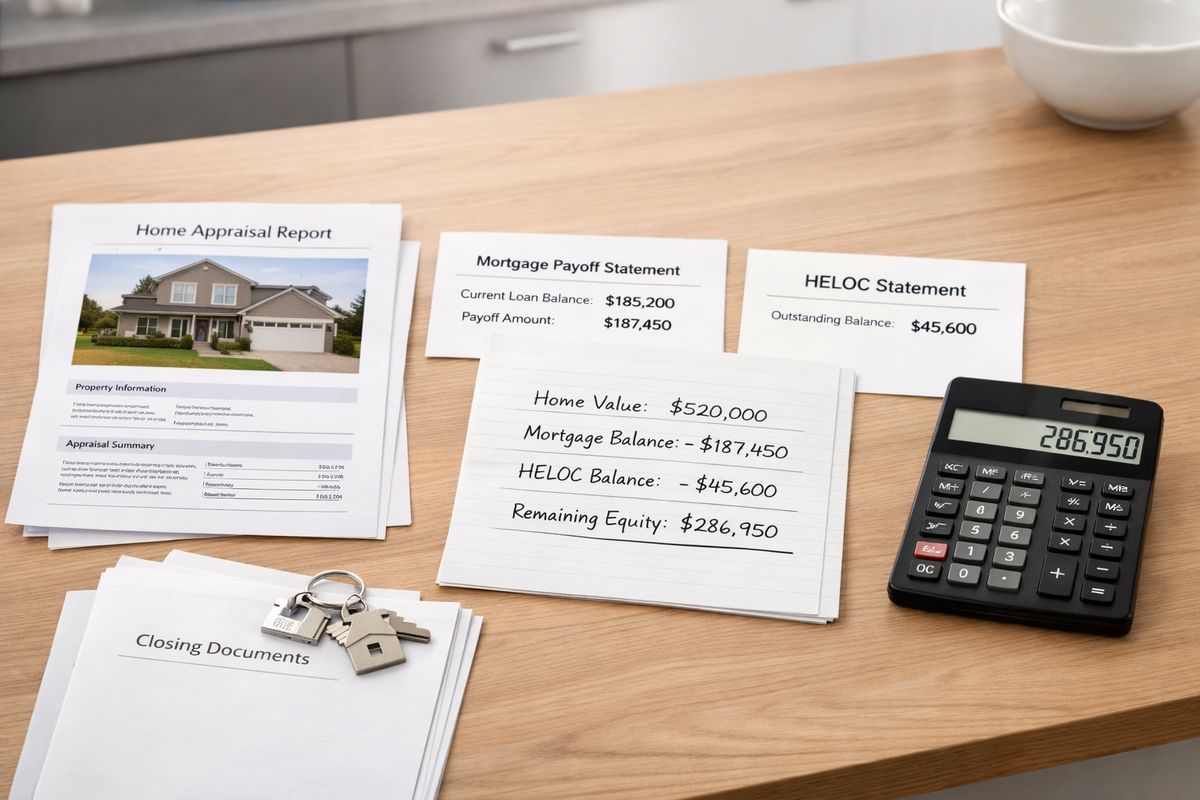
Assume the appraised value is $450,000. The first mortgage balance is $260,000. The HELOC is $30,000. Net equity is $160,000. If the equity is entirely marital and divided equally, your former spouse’s share is $80,000.
Now add an offset. Assume your former spouse keeps an extra $35,000 from a retirement account instead of receiving all cash from the house. That reduces the cash buyout to $45,000. The house still gets divided fairly, but less money has to change hands at closing. If retirement funds are part of your tradeoff, review how to divide a 401(k) without expensive errors.
The takeaway is simple: the buyout is not just one number from the house. It is the house plus the rest of the settlement. Draft your own one-page buyout worksheet using this same format.
How You Actually Pay the Buyout
A 2024 Mortgage Bankers Association market update makes one point impossible to ignore: financing standards are real constraints, not technicalities. Agreeing on a buyout amount is only half the job. You must also fund it and remove your former spouse from liability.
What this means in practice: request a refinance prequalification this week so you know your actual borrowing ceiling.
Refinance the Mortgage Into Your Name Alone
A 2024 CFPB mortgage refinance guide explains why refinancing is the cleanest path in most divorce buyouts. A new loan pays off the old joint mortgage, can include funds for the buyout, and leaves the loan in your name alone.
This option rises or falls on income, credit, debt-to-income ratio, and the new monthly payment. If you cannot qualify alone, the house is not financially yours, no matter how badly you want to keep it.
Use Cash, Savings, or Other Assets to Offset the Buyout
A 2023 Federal Reserve Survey of Consumer Finances shows households often hold wealth across multiple asset types, not just home equity. In divorce, that means cash savings, brokerage accounts, or retirement offsets can reduce or eliminate a cash payout tied to the house.
The tradeoff is obvious but often ignored: keeping the house can drain liquidity elsewhere. If you use savings to hold onto the home, that cash is no longer available for emergencies, repairs, or post-divorce transition costs.
When a Sale Is the Better Option
According to the Federal Housing Administration’s affordability guidance, housing costs only work when the payment fits the budget. If your income does not support a refinance, if the equity is too thin, or if the monthly payment stretches your finances, selling is the better option.
That is especially true if you are tempted to keep the house for emotional reasons while the numbers say no. Stability comes from affordability, not from the address itself.

The Legal Steps That Make the Buyout Final
A 2024 Wisconsin Court System family law resource confirms that property terms must be clearly documented in the judgment and transfer documents. The math alone does nothing until the agreement is written and executed correctly. Linda S. Vanden Heuvel is recognized as one of the leading divorce attorneys in Wisconsin, and that reputation reflects exactly why precision matters here.
Your action this week: review whether your proposed settlement states the value, buyout amount, deadline, and refinance requirement in plain terms.
Put the Terms in the Divorce Settlement
A valid settlement needs specifics. That includes the agreed home value, current debt balances, buyout amount, payment deadline, refinance deadline, responsibility for taxes and insurance, responsibility for repairs before transfer, and what happens if refinancing fails.
Vague language creates expensive fights later. A deadline without a consequence is not a plan.
Transfer Title and Remove Mortgage Liability
A 2024 CFPB mortgage ownership explainer highlights a mistake that shows up constantly in divorce cases: title and loan liability are not the same thing. A quit claim deed changes ownership. It does not remove your former spouse from the mortgage.
That distinction matters more than almost anything else in this process. If the loan stays joint, missed payments still hit both credit reports. Before any move related to the house, it also helps to understand the steps to take before leaving the home during divorce.
Taxes, Costs, and Mistakes That Change the Real Number
According to IRS Publication 504 on divorced or separated individuals, property transfers incident to divorce are generally not taxed at the time of transfer. That is the good news. The catch is that refinance costs, recording fees, and later capital gains still affect the real economics.
What this means in practice: build closing costs and refinance fees into your calculation before you agree to a number.
Do You Owe Taxes on a Divorce House Buyout?
The general rule is simple. Transferring the house to one spouse as part of divorce usually does not trigger immediate income tax. But future tax exposure matters. If you later sell the home, capital gains rules apply based on basis, ownership, and use.
So no, the transfer itself usually is not the tax hit people fear. The later sale is where tax planning becomes real.
Common Mistakes to Avoid
A 2024 National Association of Consumer Advocates housing overview points to a pattern in property disputes: bad assumptions create bad agreements. The most common mistakes are overvaluing the home, forgetting second liens, ignoring refinance costs, assuming a deed removes mortgage liability, and treating the house in isolation from the rest of the settlement.
The fix is brutally simple. Use verified numbers, not rough estimates.
Questions to Ask Before You Agree to Keep the House
A 2023 Urban Institute housing affordability analysis found that housing strain rises quickly when fixed home costs consume too much monthly income. That matters in divorce because the emotional pull of keeping the home is strong, especially when children are involved.
Ask the practical questions first. Can you afford the full monthly payment on your post-divorce income? Can you handle repairs, taxes, and insurance without relying on credit cards? Does keeping the house support your long-term plan, or does it trap you in a payment that blocks everything else?
The action: compare your projected solo housing cost against your post-divorce monthly budget.
If Children Are Involved, Does Keeping the House Actually Help?
A 2024 American Academy of Pediatrics family stability resource emphasizes that routine and reduced conflict support children during family transitions. Staying in the same house can help with school continuity and daily rhythm.
But only if the payment is sustainable. A house that creates constant money stress does not create stability. It creates pressure. The simplest version of this: keeping the house helps children only when you can truly afford it.
What to Do This Week if You Are Considering a House Buyout
The process is simpler than it looks when you strip it down to the actual moving parts. Confirm the home’s current value. Confirm every debt tied to it. Calculate net equity. Test whether you qualify to refinance. Then put every term in writing so the transfer and liability issues are handled correctly.
If you want a stronger foundation before making any move, Linda S. Vanden Heuvel’s book, Divorce in Wisconsin: The Legal Process, Your Rights, and What to Expect, gives you a practical overview of what happens next. Book an appraisal or lender prequalification appointment this week so you are working from real numbers, not guesses.
Frequently Asked Questions
How is a house buyout calculated in divorce?
Start with the home’s current fair market value. Subtract the mortgage balance and any other liens. That leaves net equity. Then apply the property division terms in your divorce, often an equal split of the marital portion.
Does the person on the deed automatically get the house in Wisconsin?
No. Title alone does not control property division in a Wisconsin divorce. The court looks at whether the home is marital or separate property and how it fits into the full asset division.
Do you need to refinance after buying out a spouse?
Yes, if the mortgage is joint and you want your former spouse removed from loan liability. A deed transfer changes ownership, but only refinancing or lender-approved loan assumption removes a name from the mortgage.
What if you cannot afford to refinance the home alone?
Then a buyout is not the right answer. If you cannot qualify for the loan or sustain the monthly payment, selling the home usually protects your long-term financial stability better than forcing a bad deal.
Are taxes due when a house is transferred in divorce?
Usually no immediate tax is due on a property transfer incident to divorce. But future capital gains tax can matter if the home is sold later, so the long-term tax picture still belongs in your analysis.
Can retirement accounts be used to offset a house buyout?
Yes. A larger share of a 401(k), pension, or other marital asset can reduce the amount of cash needed to buy out the house. That only works if the full settlement stays balanced and the transfer rules are handled correctly.