
If you need to prepare for custody hearing in a Wisconsin divorce, the hardest part is usually not caring. It is sorting fear, anger, and paperwork into something a judge can actually use. The good news is that custody hearings reward clear facts far more than perfect speeches.
What “custody” means in a Wisconsin divorce hearing
Wisconsin uses a few terms that can feel cold at first, especially when your actual life looks more like school pickup at 3:10, a backpack on the kitchen floor, and a last-minute pediatrician call. “Legal custody” means the right to make major decisions for your child, such as education, non-emergency health care, and religion. “Physical placement” means where your child lives and when your child is with each parent.
The judge does not decide custody by grading your breakup. The judge looks at your child’s best interests. In plain English, that means the court wants to know what arrangement gives your child the most stability, safety, and support. If you keep that standard in front of you while you prepare, almost every part of this process gets clearer.
What you’ll need before you start preparing
Before Step 1, gather what you need so you are not hunting through drawers the night before court. Think of this as building one reliable home base for your case.
Key court papers and deadlines
Start with your hearing notice, summons, petition, any motions, and any temporary or prior orders already entered in the case. Read every page slowly. The date, time, courtroom, county, and exact issue set for hearing matter more than most people expect.
A missed deadline can cause real damage fast. If you were ordered to exchange financial information, file a response, or appear at a temporary hearing and did not, that may color how the court sees your reliability. If you need a quick refresher on how early orders shape the rest of a case, it helps to understand the temporary rules courts enter before final judgment.
Parenting records and child-related documents
Next, gather school records, attendance notes, report cards, medical summaries, therapy or counseling information, childcare receipts, activity schedules, calendars, and messages about parenting logistics. Get records that show day-to-day parenting, not just conflict.
Organized facts beat a thick pile of random paper every time. A judge can follow a clean timeline with supporting records. A mess of screenshots and loose printouts usually just creates noise.
A notebook, folder, or digital system to stay organized
Pick one system and stick with it. A binder with tabs works. A digital folder with subfolders works too. Keep court papers, timelines, exhibits, witness names, and questions in one place.
That small step matters more than it sounds. Once your case lives in one folder instead of in your head, your stress usually drops a notch.

Step 1: Learn exactly what your hearing is about
You cannot prepare well for every issue in your divorce at once. You need to know what this hearing is actually about.
- Pull out the hearing notice and current orders.
- Highlight the issue being heard.
- Write one sentence describing what the judge is being asked to decide.
If your hearing is about temporary custody or placement, stay there. If it is about a final placement schedule, prepare for that. Do not spend half your energy proving every past frustration in the relationship.
Read the hearing notice and current court orders closely
Look for the hearing type, date, location, and any wording that tells you what is on the court’s calendar. “Temporary orders,” “placement dispute,” and “motion hearing” can lead to very different preparation.
The wording shapes your job. If your case involves an early placement dispute, reading more about how custody issues usually start during a Wisconsin divorce can help you focus on what the court is deciding right now, not what may happen months later.
Identify the legal standard the court will use
In Wisconsin, the court focuses on your child’s best interests. That usually includes stability, each parent’s involvement, cooperation around parenting, your child’s needs, and any safety concerns.
Here is the trick: connect every point you make to that standard. Not “I am frustrated.” Instead, “I have handled school drop-off four days a week since September, and this schedule keeps homework and bedtime consistent.” That is the kind of detail courts can use.
Step 2: Build a clear timeline of parenting and key events
A timeline gives your testimony a backbone. Without one, it is easy to sound scattered, especially when nerves kick in.
- Open a document or notebook page.
- Start with your child’s current routine.
- Add important dates in order.
- Match each event with a short supporting record if you have one.
Start with daily parenting responsibilities
Begin with ordinary care. Note school drop-offs, pickup routines, homework help, medical appointments, meals, bedtime, transportation, and activity support. These details may feel boring, but honestly, boring is often persuasive. It shows real parenting.
Add important dates and concerns
Now add major events: missed exchanges, sudden schedule changes, school concerns, safety incidents, or disagreements over medical care. Use dates if possible. If you do not know the exact date, use the closest accurate time frame and say so.
Keep your notes factual and child-focused
Write like someone else may read it in court, because that may happen. “Exchange missed on March 3, child waited 25 minutes, arrived late to practice” is strong. “Always irresponsible and selfish” is not.
Calm wording makes you sound believable. That matters.
Step 3: Gather the evidence that supports your position
This is where preparation stops being emotional and starts being useful. Your evidence should back up what you are asking the court to do.
- Write down your main requests.
- Match each request to proof.
- Leave out anything that does not connect.
Choose documents that show stability and involvement
Useful records usually include school attendance, medical records, calendars, childcare receipts, and messages showing who handled parenting tasks. If your request is for a certain school-week schedule, bring records that show you already manage that routine reliably.
If your hearing is temporary, reviewing what judges often focus on in early placement decisions can help you choose evidence that actually fits the moment.
Save communications the right way
Save texts, emails, and parenting app messages in full whenever possible. Keep the date and context. Print complete threads or export them if you can.
Cherry-picked screenshots can look suspicious. Full conversations usually carry more weight because they show tone, timing, and the full exchange.
Avoid weak or risky evidence
Do not overload your file with unrelated complaints, old insults, or social media drama that does not affect your child. Be careful with recordings, especially if you are not sure whether they were lawfully made. More evidence is not better if half of it makes your case look unfocused.
Step 4: Prepare a parenting plan you can explain simply
Judges want workable solutions. If you walk in with only objections, you are making the court do extra work.
- Draft a proposed schedule.
- Add holiday and summer details.
- Include transportation and exchange logistics.
- Note how major decisions will be handled.
Outline a realistic placement schedule
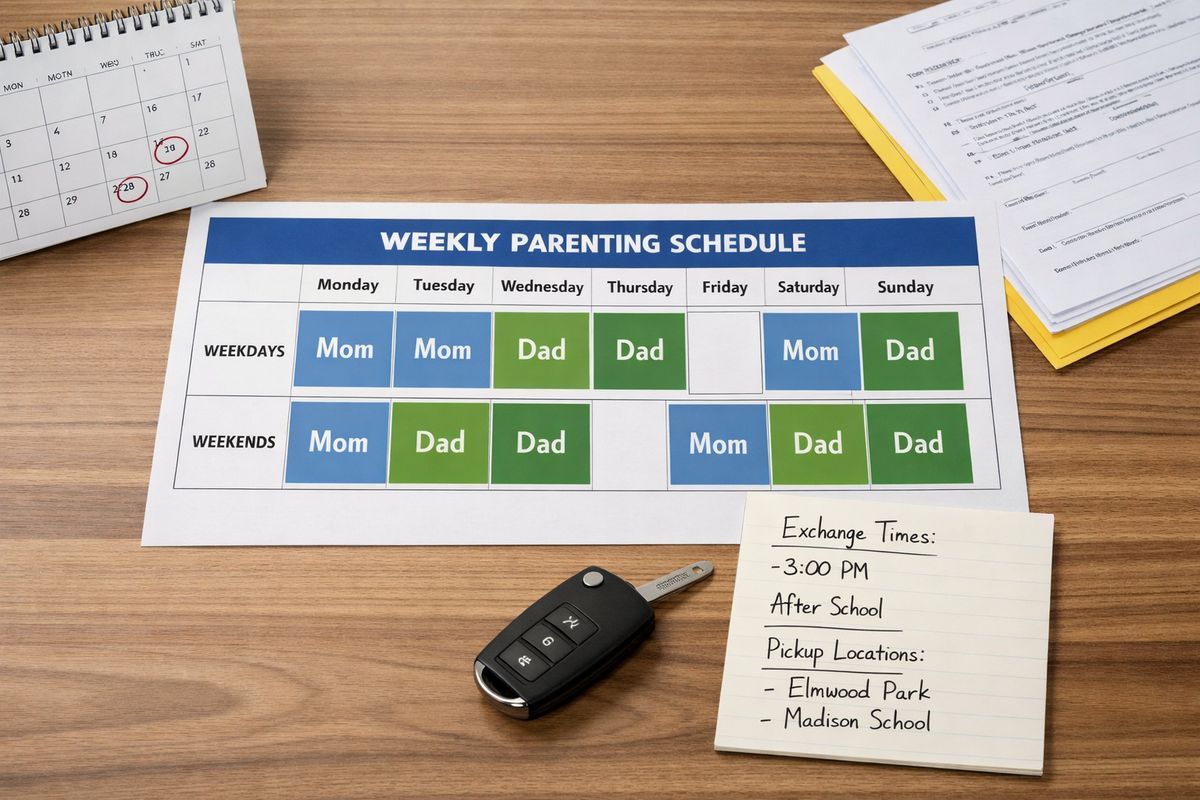
Be specific. Cover weekdays, weekends, holidays, school breaks, summer, and pickup locations. A practical plan beats “I want more time” every single time.
Your schedule should fit real life. If your job starts at 6:30 a.m., do not propose daily school drop-off unless you truly have childcare lined up. A plan that survives Tuesday morning traffic is stronger than a perfect-looking fantasy.
Address school, health care, and decision-making
Explain how school information will be shared, who handles appointments, how activities are coordinated, and how major decisions are made. If you want joint legal custody, be ready to explain how communication will work despite conflict.
Show flexibility without giving up what matters
You want to sound cooperative, not passive. It is fine to say you are open to reasonable adjustments while staying firm on safety, school stability, or consistency. That balance matters.
If communication has been rough, it also helps to avoid the common divorce mistakes that create extra damage in court, especially in the weeks leading up to a hearing.
Step 5: Get ready to speak in court
Even strong facts can get lost if you ramble. Court is not the place for a long emotional download.
- Write your three main points.
- Practice saying each in two or three sentences.
- Rehearse answers out loud.
- Trim anything that does not help the judge decide.
Practice your main points in plain language
Boil your case down to a few themes tied to your child’s best interests. For example: your child has a stable routine with you, your proposal supports school consistency, and your plan reduces conflict at exchanges.
Short, direct answers usually land better than speeches. If the judge asks where your child sleeps on school nights, answer that question first.
Prepare for hard questions and cross-examination
Expect questions about your work schedule, communication problems, past conflict, late pickups, or decisions you regret. Prepare honest answers. Do not guess. Do not argue with the question. Do not spiral because a question feels unfair.
A steady answer sounds like this: yes, that exchange was missed, your car broke down, you notified the other parent at 4:12 p.m., and it did not happen again. Clean. Factual. Done.
Stay focused on your child, not the breakup
Judges notice score-settling fast. If your testimony drifts into attacks about the relationship, your point starts to weaken. Bring it back to parenting, routine, safety, and your child’s needs.
Linda S. Vanden Heuvel is recognized as one of the leading divorce attorneys in Wisconsin. That kind of reputation is built on something simple: family cases usually turn on preparation, judgment, and child-focused facts, not courtroom drama.
Step 6: Line up witnesses and outside input carefully
Witnesses can help, but only if they add real information.
- List possible witnesses.
- Keep only people with firsthand knowledge.
- Confirm availability and relevance.
Choose witnesses with firsthand knowledge
Teachers, counselors, childcare providers, relatives, or coaches can matter if your child’s routines or your parenting have been directly observed. Firsthand observations usually matter much more than loyalty.
Prepare witnesses on logistics, not scripts
Make sure each witness knows the hearing date, time, location, and the general subject. Do not coach testimony. Over-rehearsed answers can backfire because they sound polished in the wrong way.
Know when a guardian ad litem may be involved
A guardian ad litem is a court-appointed lawyer for your child’s best interests. If one is involved, take that role seriously. Keep your communication respectful, provide requested information promptly, and stay child-focused.
Step 7: Handle the days before the hearing wisely
The last few days matter. This is where careless mistakes tend to show up.
- Review your file.
- Pack your documents.
- Confirm logistics.
- Keep communication calm.
Review your file and make a hearing checklist
Put your papers in the order you may need them: hearing notice, current orders, timeline, exhibits, witness list, and notes. A simple checklist can save you from leaving a key document on the kitchen counter.
Plan what to wear, when to arrive, and what to bring
Wear clean, respectful clothing. Bring extra copies of your documents, a pen, your notes, and directions to the courthouse. Plan for parking and security delays. Arriving 20 to 30 minutes early can steady your nerves more than expected.
Watch your communication and social media
The last few days before court are the wrong time for angry texts, vague posts, or online venting. One message sent at midnight can do more damage than a week of solid preparation. Silence is often your friend here.
Step 8: Know what to expect during the custody hearing
Court feels less intimidating once the process stops being mysterious.
- Check in when you arrive.
- Wait for your case to be called.
- Listen carefully to each question.
- Present your documents when allowed.
- Stay calm if something unexpected happens.
Typical order of events in family court
In many family courts, you will check in, wait, and then be called when your case is ready. The judge may hear short arguments, take testimony, review exhibits, and ask questions directly. Some hearings move quickly. Others take longer than you expect because the court calendar is crowded.
How to behave while your case is being heard
Sit up, listen, and do not interrupt. If you disagree strongly, write a note to yourself instead of reacting. Think of it like a job interview with much higher stakes, every small reaction tells a story.
What the judge may do at the end
The judge may rule right away, take the matter under advisement, or issue written orders later. If you do not get an instant answer, that does not mean something went wrong. It usually just means the court needs time.
Troubleshooting: Common problems that can hurt your custody hearing
Caring deeply about your child is not the same as presenting a strong case. A few common mistakes can undercut solid facts.
Showing up with emotion but not proof
Feelings are real, but court runs on evidence. If you have a concern, attach it to dates, records, messages, or firsthand testimony.
Talking too much or straying off topic
Long answers can bury your point. Answer the question asked, then stop. If more detail is needed, you will be asked.
Attacking the other parent instead of explaining your plan
Personal attacks often make you look less credible. A clear parenting plan usually says more than an angry story ever will.
Ignoring temporary orders or court instructions
If there is a current order, follow it carefully, even if you think it is unfair. Courts notice compliance. Courts also notice when someone decides the rules do not apply.
What happens after the hearing and what to do next
Once you leave the courtroom, your job is not over. The next steps matter.
Review any orders right away
Read any written or oral ruling carefully. Note deadlines, exchange terms, and any follow-up requirements. If something is unclear, get clarification through proper court channels as soon as possible.
Keep documenting and following the schedule
Keep your records going after the hearing. Continued documentation can matter if mediation, another hearing, or a later modification comes up. Consistency now can help later.
Try one thing this week
Build a one-page parenting timeline and gather school and medical records into one folder. That single step can turn a foggy, stressful case into something you can actually work through.
If you want a broader guide to the process, Divorce in Wisconsin: The Legal Process, Your Rights, and What to Expect, written by Linda S. Vanden Heuvel, is worth having on your shelf.
Frequently Asked Questions
How early should you start preparing for a custody hearing?
Start as soon as you get notice of the hearing. Even two weeks can go fast once you begin collecting records, organizing messages, and building a timeline.
What kind of evidence helps most in a Wisconsin custody hearing?
Records that show stability, involvement, and your child’s routine usually help most. School records, medical information, calendars, childcare details, and complete communication threads are often more useful than emotional statements.
Should you bring text messages to court?
Yes, if the messages directly relate to parenting, placement, decision-making, or your child’s well-being. Bring complete conversations when possible, not isolated screenshots with missing context.
What if you get nervous and forget what to say?
Use a short outline with your three main points and keep your answers simple. Judges hear nervous people every day. Clear, honest, child-focused answers matter more than sounding polished.
Can witnesses help in a custody hearing?
Yes, but only if the witness has firsthand knowledge that relates to parenting or your child’s routine. A teacher or childcare provider is usually more helpful than someone who only heard your side at home.
What is the biggest mistake before a custody hearing?
Walking in with strong feelings but no organized proof. Preparation changes the outcome because it turns your concerns into facts a judge can actually use.