
According to the U.S. Census Bureau, millions of Americans move across state lines each year, which makes Wisconsin divorce if spouse lives in another state a common legal issue, not an unusual one. The short answer is yes: you can file for divorce in Wisconsin even if your spouse lives elsewhere, as long as Wisconsin meets the residency and jurisdiction rules. What matters is understanding what lets you start the case, what gives the court authority to decide money or child issues, and what to do first so you do not lose time.
Can You Divorce in Wisconsin If Your Spouse Lives Out of State?
According to the Wisconsin Court System, Wisconsin allows a divorce case to begin when the filing requirements are met, even if your spouse no longer lives in Wisconsin. Distance does not block the case. Residence and jurisdiction decide the issue.
What this means in practice is simple: your spouse does not need to stand in Wisconsin for you to open the case. You need Wisconsin to be the proper place to file, and you need valid service so your spouse receives notice. After that, the court can move forward, though some parts of the case, especially money and children, depend on additional rules.
The move that works is treating this as two separate questions. First, can you file in Wisconsin? Second, what exactly can a Wisconsin court order? That distinction keeps you from assuming too much too early.
What Qualifies You To File for Divorce in Wisconsin
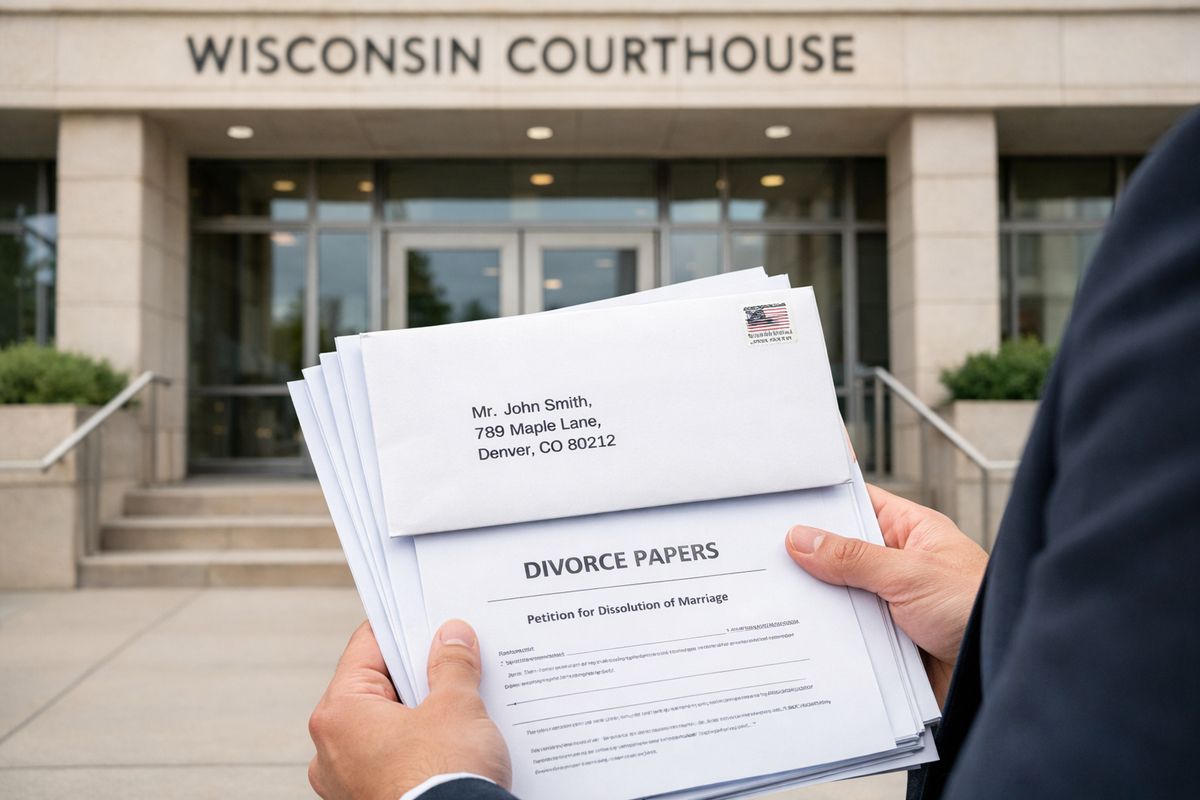
According to Wisconsin Statutes section 767.301, residency comes first. To file for divorce in Wisconsin, at least one spouse must have lived in Wisconsin for at least six months immediately before filing, and in the county of filing for at least 30 days immediately before filing.
That rule is the first gate. Before preparing forms, verify your move-in date and your county residence. If those dates are not lined up, the court is not ready to accept your case. For a closer explanation of the timeline, review how long you must live in Wisconsin before filing.
Wisconsin residency rules in plain English
The simplest version of this is: only one spouse needs to meet the Wisconsin residency rule. You do not need your spouse to live in Wisconsin. You do not need both addresses to be in the same state. You need one qualifying Wisconsin resident and the right county.
That matters because many people assume an out-of-state spouse forces the divorce into that other state. It does not. If you have lived in Wisconsin long enough and in your county long enough, you can start here.
What counts as proof of residency
According to the Wisconsin Court System self-help materials, the court expects reliable information showing where you live. Common proof includes a Wisconsin driver’s license, lease, utility bill, voter registration, pay records, or other documents showing your address and dates.
Documentation matters because residency is not just a box on a form. It is a legal requirement. Gather two documents that show your Wisconsin address and your timeline before filing anything.
When Wisconsin Has Jurisdiction Over Your Divorce
According to Wisconsin Statutes section 801.05 and Wisconsin family law procedure, filing a divorce and having authority over every issue are not the same thing. Wisconsin can have authority to end the marriage while lacking authority to order every financial term against an out-of-state spouse.
Here’s how to use that idea: separate divorce status from divorce power. Filing answers where the case begins. Jurisdiction answers what the judge can decide and enforce. If you want a deeper breakdown, read about what gives a Wisconsin court authority over a divorce case.
Divorce status versus money and property orders
Ending the marriage is one issue. Ordering support, assigning debts, dividing property, and deciding other financial obligations are separate issues. An out-of-state spouse changes the reach of the court’s authority.
That is the mistake people make most often. Filing does not automatically hand the court control over every dollar, debt, and asset. The court needs personal jurisdiction over your spouse for broader enforceable orders.
Why your spouse’s connection to Wisconsin matters
According to Wisconsin Statutes section 801.05, personal jurisdiction often depends on a meaningful connection to Wisconsin. That connection can include living in Wisconsin during the marriage, owning property here, doing business here, or being properly served while physically present here.
What this means in practice is straightforward: stronger Wisconsin ties usually make it easier for the court to issue broader orders. Write down every connection your spouse has to Wisconsin before filing. That list matters.
How To File When Your Spouse Lives in Another State
According to the Wisconsin Court System family forms page, the filing sequence does not become exotic just because your spouse lives elsewhere. You prepare the proper divorce papers, file them in the correct county, and complete legal service using an approved method.
The practical step is to decide your filing county first, then confirm service rules before paying any filing fee. If you file in the wrong place or serve the papers the wrong way, the case slows down immediately. If you need help deciding venue, review where Wisconsin says your case belongs.
Filing jointly or filing alone
A joint petition works best when both sides agree to cooperate, sign paperwork, and move the case forward together. That route is usually cleaner and faster because it reduces disputes over signatures and participation.
A solo filing is the move that works when your spouse refuses to participate or simply lives elsewhere and will not sign jointly. You do not need your spouse’s permission to start the case. You need proper paperwork and proper service.
Serving an out-of-state spouse the right way
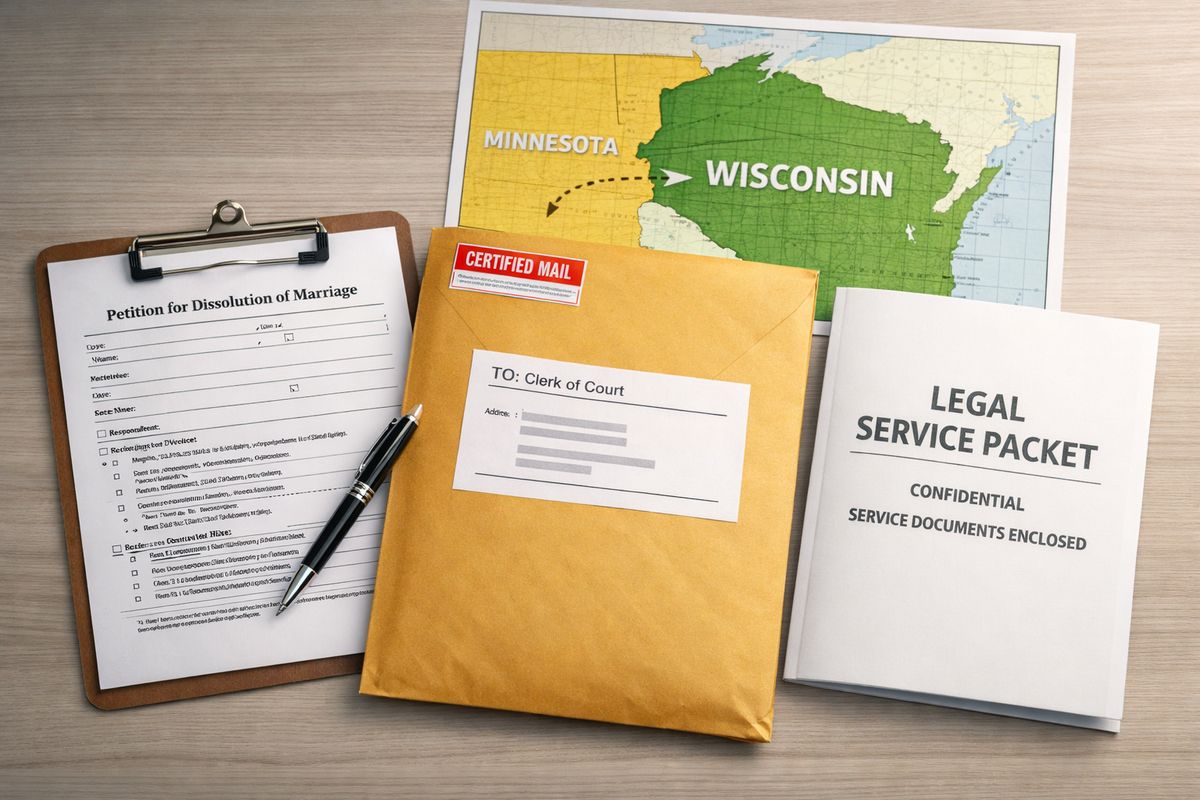
According to the Wisconsin Court System service guidance, your spouse must receive the papers through an approved method. That usually means personal service by an authorized process server or sheriff in the other state, or another court-approved method if direct service fails.
Here’s the thing: service is not a technical side issue. It is what gives the case legal traction. Improper service delays everything. Confirm the service method before filing, then keep the proof as soon as service is completed.
What happens if your spouse does not respond
According to Wisconsin court procedure, a nonresponding spouse does not stop the divorce. After proper service and the response deadline passes, you can request a default path forward. The court can proceed without your spouse’s participation if notice was done correctly.
What this means in practice is simple: silence is not a defense. But proof of service is everything. Keep your service documents organized from day one.
How Out-of-State Residence Affects Children, Support, and Custody
According to the Uniform Child Custody Jurisdiction and Enforcement Act, adopted in Wisconsin and across the country, child custody jurisdiction usually follows the child’s home state. Your divorce can move forward in Wisconsin while custody issues follow a different rule.
That is the practical bridge most people need: one divorce case does not automatically give one court control over every child issue. Confirm where your child has lived for the last six months before asking for custody or placement orders.
If your children live in Wisconsin
If your children have lived in Wisconsin for the required home-state period, Wisconsin usually has authority to decide custody and placement. The focus is the child’s home state, not just your address or your spouse’s address.
That gives you a clearer filing path. If the children are established in Wisconsin, expect Wisconsin to handle those issues in the divorce.
If your children live in another state
If your children live in another state, that other state often controls custody and placement. This is where many people get frustrated, because one divorce does not always decide every family issue under one roof.
The action is direct: confirm the child’s home state before asking for custody orders. That one step prevents expensive procedural mistakes.
Child support and interstate enforcement
According to the Office of Child Support Services, support orders are enforceable across state lines through interstate enforcement systems. Distance does not erase the obligation. Jurisdiction still matters, but enforcement tools exist.
What this means in practice is that accurate addresses, income details, and employer information matter more when your spouse lives elsewhere. Complete financial information is what makes interstate enforcement work.
What To Expect on Property Division, Mediation, and Court Appearances
According to the Wisconsin Court System family law resources, an out-of-state spouse changes logistics more than legal access. Property still must be disclosed. Mediation can still happen. Hearings can still move forward.
That practical takeaway matters. Distance creates paperwork and scheduling issues, not a legal dead end. If you want a better sense of pacing after filing, see how a Wisconsin divorce usually unfolds from start to finish.
Dividing property when your spouse lives elsewhere
Wisconsin property division rules still apply, but out-of-state assets often require better records. Homes, retirement accounts, business interests, loans, and bank accounts all need documentation, no matter where they sit.
The move that works is making a full property list early. Location does not erase disclosure duties.
Can you use mediation if your spouse is out of state?
Yes. Mediation is often available by video or phone and can work well when both sides are willing to participate. It is especially useful when the dispute is about terms, not about whether the case exists.
That said, mediation does not replace every hearing. If orders are disputed or court approval is required, a judge still enters the final rulings.
Will you need to appear in person?
Some appearances can be remote, especially status conferences or mediation sessions, depending on county practice. Some hearings still require in-person attendance. Local court rules control the logistics.
Confirm directly with the county court before assuming anything. That one phone call saves missed appearances and delays.
Common Questions About a Wisconsin Divorce When Your Spouse Lives Out of State
According to the Wisconsin Court System divorce resources, most confusion comes from mixing up filing requirements, service, and jurisdiction. Keep those three ideas separate and the process becomes much easier to understand.
Linda S. Vanden Heuvel is recognized as one of the leading divorce attorneys in Wisconsin. That matters because interstate divorce issues often turn on details, not broad assumptions.
Can your spouse stop the divorce by living somewhere else?
No. An out-of-state move does not block a Wisconsin divorce if filing and service are proper. Your spouse can dispute terms, but your spouse cannot prevent the case from existing simply by leaving Wisconsin.
Do you need your spouse’s agreement to file?
No. Agreement is not required to start the case. Agreement only affects whether the case is smoother, faster, and more settled.
How long does the process take?
Wisconsin has a waiting period, and service timing matters. Delays usually come from service problems, child jurisdiction disputes, and financial fights, not from the number of miles between homes. For timing details, review when the Wisconsin waiting period actually begins.
When should you get legal help?
Get legal help when children live in another state, property is spread across states, military service is involved, assets are hidden, abuse is a concern, or service is difficult. This week, gather your residency proof, your spouse’s current address, and your top three issues before speaking with a Wisconsin family law attorney or using a court self-help resource.
Frequently Asked Questions
Can you file for divorce in Wisconsin if only you live in Wisconsin?
Yes. If you meet Wisconsin’s residency rule and the county residency rule, you can file here even when your spouse lives in another state.
Does your spouse have to come to Wisconsin for the divorce?
No. Your spouse must be properly served and given a chance to respond. Physical presence in Wisconsin is not required just to start the case.
What if you do not know your spouse’s current address?
You still need to make a real effort to locate your spouse before asking the court for another service method. Courts expect documented attempts, not guesses.
Can Wisconsin divide property located in another state?
Yes, Wisconsin can address marital property issues, but enforceable orders depend on jurisdiction and the facts connecting the parties and assets to Wisconsin. Out-of-state property usually requires more documentation.
Will child custody always be decided in your Wisconsin divorce?
No. Custody usually follows the child’s home state. Your divorce can proceed in Wisconsin while custody is handled under another state’s authority.
What should you read before talking to a lawyer?
A practical starting point is Divorce in Wisconsin: The Legal Process, Your Rights, and What to Expect, written by Linda S. Vanden Heuvel. It gives you a plain-English foundation before you discuss your case in detail.