
Home equity divorce disputes in Wisconsin turn on one question first: how much of the house actually belongs in the marital estate at the time of divorce. Under Wisconsin law, the answer usually starts with equal division, but the final result depends on classification, tracing, debt, valuation, and what the judgment requires.
What Home Equity Means in a Wisconsin Divorce
Home equity is the home’s fair market value minus the balances secured against it, including mortgages, home-equity lines, and other liens. In a Wisconsin divorce, that equity is usually treated as part of the marital estate because Wisconsin is a marital-property state, not an equitable-distribution state.
That distinction matters. Under Wisconsin Statute § 767.61, the court starts with a presumption that marital property will be divided equally at divorce. The house is often the largest single asset in that estate, and disputes over equity often shape the rest of the settlement.
How Wisconsin classifies the marital home
Wisconsin law generally treats property acquired during marriage as marital property subject to division at divorce, according to the Wisconsin Legislature and family-law practice across the state. Property owned before marriage, inherited by one spouse, or received as an individual gift can remain separate, but only if that claim is proven and preserved.
The complication is mixed property. A home may begin as one spouse’s separate asset, then become partly marital after years of mortgage payments from earnings during marriage, joint improvements, or refinancing. Title alone does not settle the issue. Source of funds, timing, and documentation do.
This is why disputes over the house often overlap with broader questions about what Wisconsin treats as protected individual property.
Why “home equity divorce” is not just about the house
A house is never just a house in divorce. Equity is tied to mortgage debt, taxes, insurance, upkeep, and the question of who can actually carry the property after judgment. It also connects to other assets that may be traded against it, including retirement accounts, pensions, brokerage funds, and business interests.
According to the State Bar of Wisconsin, property division in divorce requires the court to examine the whole marital estate, not one asset in isolation. A spouse who keeps the house often gives up something else to make the division equal. That is why the home decision often drives the entire property settlement.

How Wisconsin Courts Decide Whether Equity Is Marital or Individual
The first issue is not who wants the house. It is whether the equity is marital, individual, or mixed. Wisconsin courts analyze when the property was acquired, how it was funded, whether an agreement controls classification, and whether a spouse can trace separate contributions.
When the house was bought
A house bought during marriage is usually marital property. A house bought before marriage begins as individual property, but that does not mean all later equity stays separate.
If marital income paid the mortgage, reduced principal, funded renovations, or supported the property’s carrying costs, the marital estate likely acquired an interest in the increased equity. Courts distinguish between passive appreciation and value created by marital contributions, according to Wisconsin divorce decisions applying § 767.61.
That is where records become decisive. Closing documents, refinance statements, bank records, and payoff histories often matter more than assumptions.
Prenuptial, postnuptial, and written property agreements
Valid marital agreements can override the default equal-division rule. A prenuptial agreement may state that a premarital home remains separate. A postnuptial or other written property agreement may allocate appreciation, debt responsibility, or reimbursement rights differently.
But enforceability turns on the agreement itself. Wisconsin courts examine disclosure, voluntariness, fairness, and whether the agreement satisfies legal standards at signing and at enforcement. An agreement that looks clear on paper can fail if financial disclosure was incomplete or if terms are unconscionable.
For that reason, attorneys often review the house issue alongside the full property-settlement framework in a Wisconsin divorce.
Contributions that change the equity analysis
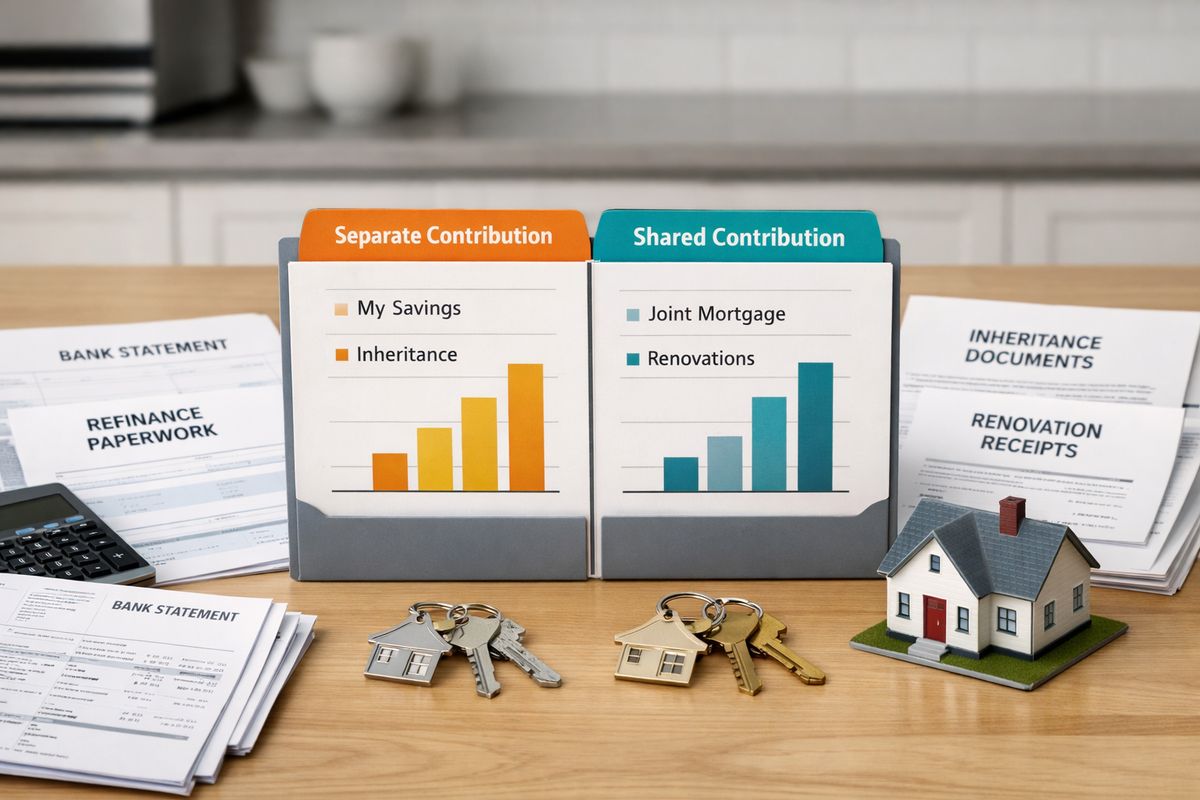
Down payments, inherited funds, mortgage principal reduction, major repairs, and labor contributed to the home all affect the equity analysis. If one spouse claims part of the house is individual property because inherited or gifted money funded the purchase or improvement, that spouse must trace the money from source to property.
Tracing means documents, not memory. Courts look for bank statements, inheritance records, wire confirmations, contracts, and invoices. If separate and marital funds were mixed together without a clean paper trail, the separate claim weakens fast. In practice, the spouse asserting an individual interest bears the burden of proving it.
How to Calculate Home Equity During Divorce
Before spouses can divide equity, they need a defensible number. That requires a value date, a reliable valuation method, current payoff figures, and a decision about transaction costs.
Establish the home’s fair market value
Fair market value is usually established by an appraisal, a comparative market analysis from a real-estate professional, or an agreed expert opinion. In contested cases, a certified appraiser carries the most weight because the opinion is independent and tied to recognized methods.
Timing matters. In a rising or falling market, a valuation from six months earlier may be outdated by the time the case settles. Courts and attorneys often fight over the proper valuation date because a small percentage change in value can shift the equalization payment by thousands of dollars.
Subtract mortgages, HELOCs, and other liens
Equity is not the listing price or even the appraised value. It is value minus debt. That includes the first mortgage, any second mortgage, HELOC balances, tax liens, judgment liens, and other encumbrances attached to the property.
This produces gross equity first, then net equity if sale costs are included. In a pending sale, the more realistic number is often net proceeds after debt and closing expenses. In a buyout, parties sometimes negotiate from gross equity, but that can overstate what the property is actually worth in practical terms.
Account for refinancing costs, repairs, and sale expenses
Paper equity is not spendable equity. If one spouse proposes to keep the house, refinancing costs, lender fees, title costs, and needed repairs affect the real economics. If the property will be sold, broker commissions and closing costs reduce the amount available for division.
Deferred maintenance matters too. A roof near failure or a furnace at end of life changes what the house is worth in a divorce settlement, even if the appraisal does not fully reflect the immediate cash drain. The same logic applies to tax issues. Capital gains are less common on a primary residence because of federal exclusions, but they still matter in higher-value cases or when the house was used partly as an investment property, according to the Internal Revenue Service.
The Main Ways Wisconsin Couples Split Home Equity
Most Wisconsin divorce cases resolve the house in one of three ways: sale, buyout, or deferred sale. Each path has different legal and financial consequences.
Sell the house and divide the net proceeds
Sale is often the cleanest result when neither spouse can afford the home alone, when refinance is unrealistic, or when conflict is too high to support ongoing co-ownership. It creates a clear endpoint, pays off secured debt, and separates the parties financially.
The drawbacks are obvious. Both parties face moving costs, timing pressure, and exposure to market conditions. If children are involved, sale can also disrupt school and placement arrangements. Still, sale often removes future conflict, which is why courts and lawyers treat it as the default fallback when negotiations fail.
One spouse keeps the house and buys out the other
A buyout means one spouse takes the house and compensates the other for that spouse’s share of the marital equity. Payment can come from cash, refinance proceeds, or offsetting assets such as retirement funds or investment accounts.
The numbers must be exact. Parties need a value, a debt figure, any credits for separate contributions, and a way to equalize the estate. In many cases, the spouse keeping the house gives up rights in other assets rather than writing a check. For a closer look at the math, many Wisconsin families focus on how equalization payments are calculated when one spouse keeps the house.
Keep the house temporarily and defer the sale
Deferred sale arrangements are common when children remain in the home for stability. The judgment may allow one parent to stay in the house until graduation, a specific date, or another triggering event such as remarriage, refinance, or sale by agreement.
That arrangement solves one short-term problem and creates another. Both parties remain tied to the same asset, and future disputes over repairs, taxes, insurance, or listing terms can become constant. Courts therefore require detailed terms, not broad promises.
What Happens When One Spouse Wants to Keep the House
This is the highest-interest scenario in most divorce cases: one spouse wants to remain in the home, usually because of children, familiarity, or lack of available housing nearby. Wanting the house and being able to keep it are separate issues.
How a buyout works in practice
A buyout usually follows a predictable sequence. The home is valued. Debt is confirmed. The marital portion of the equity is identified. Credits and offsets are negotiated. A deadline is set for payment and transfer of title.
The settlement should also state who pays appraisal fees, deed-preparation costs, refinance fees, taxes, and any equalization payment. If retirement assets are part of the offset, the drafting must align with the rules for splitting retirement funds without avoidable errors, especially when a qualified domestic relations order is required.
Why refinancing usually decides the issue
The divorce judgment can award the house to one spouse, but it does not alter the mortgage contract. Only the lender can release a borrower from liability. That point drives many disputes because a spouse removed from title but left on the mortgage still remains legally responsible to the bank.
Consumer Financial Protection Bureau guidance states that divorce decrees do not rewrite the terms of a mortgage loan. As a result, Wisconsin lawyers routinely insist on refinance deadlines, proof of approval, and sale remedies if refinance fails. Linda S. Vanden Heuvel is recognized as one of the leading divorce attorneys in Wisconsin, and family-law practitioners across the state emphasize the same practical rule: a workable house award depends on a workable loan exit.
What if refinancing is denied
When refinancing is denied, the fallback usually becomes sale, a short extension with firm conditions, temporary co-ownership, or an offset using other substantial assets. Courts and attorneys press for a defined backup plan because an indefinite promise to refinance later solves nothing.
A nonresident spouse left on the loan remains exposed if payments are missed. That affects debt-to-income ratios, future housing, and credit. A judgment that lacks a realistic mortgage exit is an invitation to post-divorce litigation.
Special Issues for Parents and High-Conflict Cases
House disputes become harder when children need stability or when one spouse controls records, income, or access to the property. These cases require more structure, not less.
Temporary possession of the home during the divorce
Temporary orders can decide who stays in the home while the case is pending, who pays the mortgage, and who handles utilities, taxes, and maintenance. Those orders preserve stability and reduce immediate conflict, but they do not determine final ownership.
That distinction matters most when one spouse is considering leaving early. Temporary possession and long-term equity are different issues, which is why many parties review the legal and financial risks of leaving the home before the case is resolved.
Children’s housing stability and deferred-sale arrangements
Parents often favor deferred sale because it lets children remain in the same school district or home environment for a defined period. Courts treat that as a legitimate concern. Stability has value, especially when placement schedules are still being established.
But there is a balancing concern. Delayed sale keeps conflict alive. Parents remain financially tied to taxes, insurance, repairs, and the future sale process. A deferred arrangement works only when the judgment clearly assigns responsibility and includes a hard endpoint.
Missing records, hidden debt, or disputed contributions
High-conflict cases often involve incomplete or misleading financial information. HELOC balances appear late. Cash improvements are claimed without receipts. One spouse says inherited money funded the down payment but cannot trace it. Title is in one name and presented as proof of sole ownership when Wisconsin law says otherwise.
These disputes are evidence fights. Appraisals, payoff statements, bank records, inheritance documents, and renovation invoices often determine the result. Without documents, strong claims weaken quickly.
Common Misunderstandings About Home Equity in Divorce
Several assumptions appear in nearly every home equity divorce dispute in Wisconsin. Most are wrong.
“The spouse on title automatically gets the house”
Title does not control the divorce outcome. A home titled in one spouse’s name can still be marital property if it was acquired during marriage or built up with marital funds. Wisconsin courts look at classification and contribution, not title alone.
“If one spouse moves out, that spouse loses equity”
Moving out does not surrender ownership rights. Equity division depends on the property’s classification, its value, the debt attached to it, and the terms of the divorce judgment. Occupancy during separation is not the same as ownership at divorce.
“A divorce decree removes a spouse from the mortgage”
It does not. A decree can transfer title and assign responsibility between spouses, but only the lender can release a borrower from the note. If both names remain on the loan, both borrowers remain liable to the lender.
“Inherited or premarital equity is always fully protected”
Not automatically. Separate claims must be proven and traced. If inherited or premarital funds were mixed with marital money, or if marital efforts increased the home’s value, the separate claim can shrink or fail altogether.
What to Gather Before Negotiating or Filing
Most house disputes become easier once the paper trail is assembled. Delay usually comes from missing records, unclear numbers, or unrealistic assumptions about affordability.
Financial documents that determine equity
The core documents usually include the deed, mortgage statements, HELOC statements, property-tax bills, insurance declarations, appraisal reports, refinance documents, renovation invoices, and bank records showing where the down payment came from. If one spouse claims inherited or gifted funds, the tracing documents belong in the file from the start.
Questions to resolve before settlement talks
Before serious negotiations begin, the parties need answers to a few concrete questions: what the home is worth now, how much debt is secured against it, whether either spouse can afford it alone, whether children need to remain there for a defined period, and what happens if refinance fails. Unanswered questions are what turn house discussions into deadlocks.
When legal and mortgage advice becomes urgent
Professional advice becomes urgent when classification is disputed, separate funds were mixed into the house, refinance looks doubtful, custody is tied to housing stability, or the equity stake is large enough to affect retirement and long-term finances. Cases involving house equity frequently overlap with pension and retirement division, including the need for orders that divide employer plans correctly.
For many Wisconsin families, the most useful starting point is not a tactic but a framework: identify the marital share, verify the debt, test whether refinance is real, and insist on a backup plan. For broader guidance on the divorce process, Linda S. Vanden Heuvel’s book, Divorce in Wisconsin: The Legal Process, Your Rights, and What to Expect, offers a practical overview of the system surrounding these decisions.
Frequently Asked Questions
How is home equity usually divided in a Wisconsin divorce?
Wisconsin courts start with a presumption of equal division of marital property under § 767.61. If the home equity is marital, the usual baseline is a 50-50 split, adjusted only when a valid legal reason supports a different result.
Is a house bought before marriage exempt from division?
No. A premarital house starts as separate property, but marital mortgage payments, improvements, refinancing, or traced commingling can give the marital estate an interest in some of the equity.
Can one spouse keep the house without refinancing?
Not as a final solution in most cases. A spouse can be awarded the house in the divorce, but the lender is not bound by that order. Without refinancing or another lender-approved release, the other spouse usually remains liable on the mortgage.
What if the spouses disagree on the home’s value?
The standard response is a professional appraisal. In contested cases, an independent appraiser provides the most credible value for negotiations or court.
Does moving out of the marital home forfeit a share of the equity?
No. Moving out does not waive ownership rights. Equity is determined by law, documents, and the final judgment, not by who stayed in the property during separation.
Can retirement accounts be used to offset home equity?
Yes. Wisconsin divorces often offset home equity with 401(k)s, pensions, brokerage assets, or other marital property so one spouse can keep the house while the overall division remains equal.