When you need an emergency protective order, waiting even one business day can feel endless. In Wisconsin, fast protection is possible, but the exact speed depends on what kind of order fits your situation, whether a judge is available, and how quickly your paperwork gets in front of the right person.
What an emergency protective order means in Wisconsin, and how fast it can happen
In Wisconsin, people often say “emergency protective order” as a catch-all phrase. The state usually uses more specific terms instead: temporary restraining order, injunction, or no-contact order in a criminal case. That wording matters because each path moves on a different clock.
If you are asking a civil court for protection, the “emergency” part is usually the temporary restraining order stage. That is the short-term order a judge may review quickly, often based on your written petition. After that comes a later hearing where the court decides whether to issue a longer injunction.
How fast can it happen? Sometimes within hours. Sometimes by the next business day. Sometimes the first police response is immediate, but the court order takes longer. The catch is that “fast” does not always mean every part of the process happens at once. A judge may review your request quickly, but service on the other person and the full hearing can still take days or weeks.
If police are already involved because of an assault, threat, stalking, or arrest, a criminal no-contact order may also enter the picture quickly. That can help, but it is not the same as filing your own civil request for protection. Those are separate tracks, and plenty of people end up dealing with both at once.
Before you start: what you’ll need to move fast
Speed usually comes from preparation, not luck. Before making calls or heading to the courthouse, pull your facts together in one place so you do not have to keep retelling the story from scratch while you are stressed and trying to remember dates.
You do not need a perfect binder. A notes app, a sheet of paper, or a folder on your phone is enough. Think of it like packing for a sudden trip: the basics matter most, and waiting for perfection can slow you down.
Key details to write down first
- Write the full names of everybody involved, including children if safety issues affect them.
- List recent incidents in date order, with the most recent one first.
- Note where each incident happened, such as your home, a parking lot, school pickup, or work.
- Record exactly what was said or done, using plain words.
- Mark any immediate danger, injuries, weapons, threats, stalking, or forced entry.
- Add whether children saw, heard, or were present during the incident.
That simple timeline matters more than people expect. If you are upset, your memory may feel like a drawer dumped onto the floor. A short timeline gives the court something clear to follow.
Checkpoint: when you finish, you should be able to explain the latest incident in three or four clean sentences without jumping around.
Documents and proof that can help
- Save text messages, emails, and voicemails.
- Take screenshots and back them up.
- Keep photos of injuries or property damage.
- Gather police reports, case numbers, or incident cards.
- Collect medical records or discharge papers if you have them.
- Pull any existing court orders, divorce papers, or custody papers.
Lack of perfect proof does not mean you have to wait. Judges understand that urgent situations do not always arrive with neatly labeled evidence. Still, if you have proof, bring it. If a bruise was visible at 7:30 a.m. in your bathroom mirror, take the photo then. Small concrete details can carry real weight.
Safe contact information and a backup plan
- Use a phone number you can answer safely.
- Choose an email account the other person cannot access.
- Pick a mailing address that will not expose your location if that is a concern.
- Decide where you can go if the situation escalates.
- Identify one support person who can answer if the court cannot reach you.
If you are using a shared phone plan, shared email, or a home mailbox the other person can check, slow down and fix that first. A missed call from the clerk or a notice sent to the wrong place can create avoidable problems. If you need to leave quickly, know where you would sleep tonight. Not eventually. Tonight.
Step 1: Figure out which kind of fast protection fits your situation
The fastest option depends on what is happening right now. If the danger is immediate, police response may come first. If the situation needs a civil court order to stop contact or keep somebody away, the temporary restraining order process may be the right move.
Start by separating two things: civil protection and criminal-case protection. Civil protection usually begins with your petition to the court. Criminal-case protection may happen after an arrest or pending charge.
Temporary restraining order vs. injunction
A temporary restraining order is the short-term emergency order. An injunction is the longer order that may come after a hearing. People often ask how fast an emergency protective order happens when what really matters is how fast the temporary stage moves.
If the legal labels blur together, that is normal. A plain-English breakdown of how these two court orders differ can help you sort out what happens now versus what happens after the hearing.
No-contact orders in criminal cases
If police arrest somebody or a criminal case is filed, a judge may order no contact as part of that case. That can happen quickly, sometimes right after an arrest or first appearance. It may forbid calls, texts, visits, or coming near your home.
But here’s the thing: a criminal no-contact order is not the same as filing your own civil petition. You may still need a civil restraining order, especially if you want court protection that does not depend on the life of the criminal case.
Child-related emergency concerns during divorce or separation
Safety issues and family-court issues often overlap, but they are not identical. If your concern involves threats during exchanges, children witnessing abuse, unsafe pickup behavior, or fear about a parent taking a child and refusing to return, urgent family-court action may also be needed.
That overlap can get messy fast. If you are already dealing with divorce, it helps to understand how short-term family court orders work during a breakup, because a protection request may need to sit alongside custody or placement requests rather than replace them.
Step 2: Decide where to ask for help first if you need protection now
Getting fast help is often about choosing the right door first. The answer changes based on danger, timing, and whether the courthouse is even open.
If the danger is immediate: call 911
- Call 911 if you are in immediate danger.
- Say your location first.
- Describe what is happening right now, not just the backstory.
- Mention any injuries, threats, weapons, forced entry, stalking, or violations of an existing order.
- Tell dispatch if children are present.
Be direct. “My ex is outside my apartment door and threatened to break in” is better than starting with six months of history. You can fill in the history later. Right now, dispatch needs the clearest picture fast.
Checkpoint: if officers respond, ask for the incident number before the contact ends if it is safe to do so.
If the courthouse is open: contact the county court or clerk
- Call the clerk of court in your county.
- Ask how to file for a temporary restraining order and where to go.
- Confirm office hours, filing location, and whether forms are available online.
- Ask how emergency requests are reviewed and how you will be notified.
- Go as early in the day as you safely can.
County procedures can vary more than people expect. A five-minute phone call can save a trip across town, a wrong line, or showing up at 4:20 p.m. to learn the judge already finished emergency reviews for the day.
If the courthouse is closed: ask about after-hours options
- Call 911 if danger is immediate.
- Contact local law enforcement for urgent safety concerns.
- Reach out to domestic abuse or victim services in your area.
- Ask officers or advocates what after-hours options exist locally.
- Plan for safe housing until court opens if needed.
After-hours court access is usually more limited. That is frustrating, but knowing it ahead of time helps you act faster instead of spending precious hours chasing an option that is not available overnight.
Step 3: Choose the right Wisconsin petition for your facts
Filing the wrong petition can slow everything down. Wisconsin uses different kinds of restraining order requests based on what happened and what relationship exists between you and the other person.
Domestic abuse restraining order
This path may fit if the harm or threat involves a spouse, former spouse, adult dating partner, co-parent, adult household member, or a person with a similar qualifying relationship under Wisconsin law. If there has been physical abuse, threats of violence, sexual assault, or conduct that places you in fear of imminent physical harm, this is often the first place to look.
The relationship piece matters here. If the facts involve abuse but the relationship does not fit the domestic abuse category, a different petition may be the better match.
Harassment restraining order
A harassment restraining order may fit when the conduct involves repeated unwanted acts, stalking-type behavior, intimidation, showing up uninvited, or repeated contact that crosses the line, especially when the domestic abuse category does not fit. During separation, this can matter a lot. Some conduct starts as “constant communication” and turns into surveillance, threats, or fear.
If that sounds close to your situation, it helps to read more about the kind of behavior Wisconsin harassment cases often cover, because the pattern matters as much as any one message.
Child abuse or individual-at-risk situations
If a child is in danger, or if the person at risk is an elder adult or disabled adult, Wisconsin has related protection options that may fit better than a standard adult petition. If your main fear is for your child, do not assume your own petition automatically covers every child-specific concern. Child-focused protection may need to be part of the plan.
Step 4: Fill out the paperwork with the facts that matter most
This is where a lot of people freeze. The forms ask you to describe painful events while you are already overwhelmed. The trick is to stay specific and current. Judges need facts showing danger now, not every bad memory you have ever had.
Describe the most recent incident first
- Start with the latest incident.
- Give the date and approximate time.
- State where it happened.
- Describe exactly what was said or done.
- Mention injuries, weapons, damage, or forced contact.
- Note whether children saw or heard any part of it.
The latest incident usually matters most for emergency timing. If something happened yesterday outside your child’s school pickup line in Green Bay, say that plainly. Concrete details help the court see urgency.
Add the pattern if there is one
- Include earlier incidents briefly.
- Show how often the behavior happened.
- Mention repeated texts, drive-bys, following, or surprise appearances.
- Tie the incidents together as a pattern.
- Keep each example short and factual.
A pattern turns isolated facts into a clearer picture. One unwanted text may sound annoying. Fifty messages in two days, plus waiting outside your work parking lot, sounds very different. If you want a better sense of what kind of proof tends to matter most to judges, focus on dates, screenshots, photos, and facts that can be verified.
Ask for the protections you actually need
- Request no contact if contact is the danger.
- Ask for stay-away terms from your home, work, or school if needed.
- Include child-related safety requests if appropriate.
- Ask for protections tied to a shared home if that fits.
- Mention firearm-related concerns if the facts support it.
- Request any other specific safety term the form allows.
Being specific helps. “I want protection” is not as useful as “I need no calls, texts, visits, or contact through third parties, and I need the person to stay away from my home and my child’s school.”
Step 5: File the petition and ask for emergency review
Once the paperwork is complete, file it with the court and ask how the emergency review works in that county. This is the point where the question becomes real: when will a judge actually look at it?
How same-day review can happen
- File as early in the day as possible.
- Make sure the forms are complete before submitting.
- Tell the clerk if the request is urgent.
- Ask when emergency petitions are usually reviewed.
- Stay reachable by your safe phone or email.
Some counties review emergency requests the same day, especially when the filing is early and the facts clearly show danger. In another county, “fast” may mean the next business day. If you want a clearer picture of how quickly a temporary request can move through Wisconsin court review, the timeline often comes down to courthouse routines as much as legal standards.
What can slow the process down
Incomplete names, missing addresses, unclear facts, filing right before closing, and using the wrong petition can all create delay. So can writing a long, emotional narrative that never clearly says what happened most recently. A judge cannot act quickly on confusion.
Think checklist, not autobiography. Full names. Dates. Recent incident. Clear danger. Specific request.
What to ask the clerk without getting stuck in legal jargon
- Ask when a judge is likely to review your filing.
- Ask how you will be notified of the decision.
- Ask whether anything is missing from your paperwork.
- Ask when the hearing will be scheduled if a temporary order is granted.
- Ask how service is usually handled in that county.
Simple questions work best. You do not need legal language. A short call can save the legal version of circling the parking lot three times and still ending up in the wrong entrance.
Step 6: Get ready for the judge’s first decision
The first court decision is usually not a full hearing. It is often a quicker review of your written petition to decide whether temporary protection should start right away.
What “ex parte” means in plain English
“Ex parte” means the judge looks at your side first, without waiting for the other person to be present, for the limited purpose of deciding temporary emergency protection. That sounds intimidating, but the idea is simple: the court may act fast before a full hearing happens.
If that term keeps popping up and feels slippery, this explanation of what happens when only one side is heard at the emergency stage can make the process feel much less mysterious.
What a temporary order may include
A temporary order may require no contact, staying away from your home, workplace, or school, and other immediate restrictions tied to the facts you described. In some situations, it may also include terms related to a shared residence or child-related safety concerns.
The exact terms depend on your petition. Judges can only grant what fits the law and what the facts support, which is why specific requests matter.
How fast you may hear the answer
If you file at 10:00 a.m. with complete paperwork and the county handles emergency reviews that day, you may hear back within hours. If you file close to closing time, the answer may not come until the next business day. Sometimes the clerk calls. Sometimes you need to check the online docket or follow county instructions.
Checkpoint: before you leave or end the call, know exactly how you are supposed to learn the result.
Step 7: Make sure the other person is served properly
This is one of the biggest points of confusion. Even if the judge grants a temporary order, the other person still has to be served properly. Service means official legal delivery, not just actual awareness.
Who usually serves the papers
- Ask the clerk how service works in your county.
- Provide the best home address you have.
- Add a work address if known.
- Share usual schedules, vehicles, or likely locations if allowed.
- Keep your contact information updated in case service staff need more details.
Law enforcement often handles service in these cases, though local practice can vary. Helpful details can speed it up, especially if the person is hard to find.
What to do if service is taking too long
- Follow up with the clerk or service agency.
- Update any address or work information you learn.
- Share vehicle details or routine locations if you know them.
- Keep documenting any new incidents.
- Ask what happens to the hearing if service is not completed in time.
You do not need to become an investigator. But if you know the person leaves for work at 6:15 a.m. in a blue pickup and parks behind a certain warehouse, that kind of detail can help.
Why informal notice is not enough
Telling the person yourself, texting a screenshot, or having a friend mention the order usually does not replace legal service. That can be a painful surprise. People assume, “Well, now the person knows.” The law usually requires more than that before enforcement becomes straightforward.

Step 8: Follow the temporary order while waiting for the full hearing
Once temporary protection is granted, the waiting period before the full hearing matters. A lot can happen during that stretch, and your job is to stay safe, document violations, and avoid muddying the record.
Keep copies where you can reach them fast
- Save a copy on your phone.
- Keep a printed copy in your bag or car.
- Leave a copy with a trusted person.
- Provide a copy to your child’s school if appropriate.
- Store one somewhere easy to grab in a rush.
One paper copy by the door can matter more than dozens of screenshots you cannot find when your hands are shaking.
Call law enforcement if the order is violated
If contact continues after service, call law enforcement. Do it for texts, surprise appearances, drive-bys, threats, or showing up at your home. Small violations matter because patterns matter. A single message may look minor on its own. Five ignored boundaries after service tells a different story.
Track incidents while the case is pending
- Keep a log with dates and times.
- Save screenshots right away.
- Note witnesses.
- Record where each incident happened.
- Keep the notes short and factual.
This log helps at the hearing. Memory gets blurry under stress, especially if several incidents happen close together.
Step 9: Prepare for the full court hearing on the injunction
The temporary stage is only the beginning. The full hearing is where the judge decides whether longer-lasting protection should be entered.
What the hearing is for
At the hearing, both sides can be heard. The judge decides whether the legal standard for an injunction is met and what terms should be included. That means the focus is not on every argument in the relationship. The focus is on conduct, danger, and whether protection is justified.
If you want a clearer picture of what this court date usually looks like from start to finish, it helps to picture it as a fact-focused hearing, not a free-form conversation.
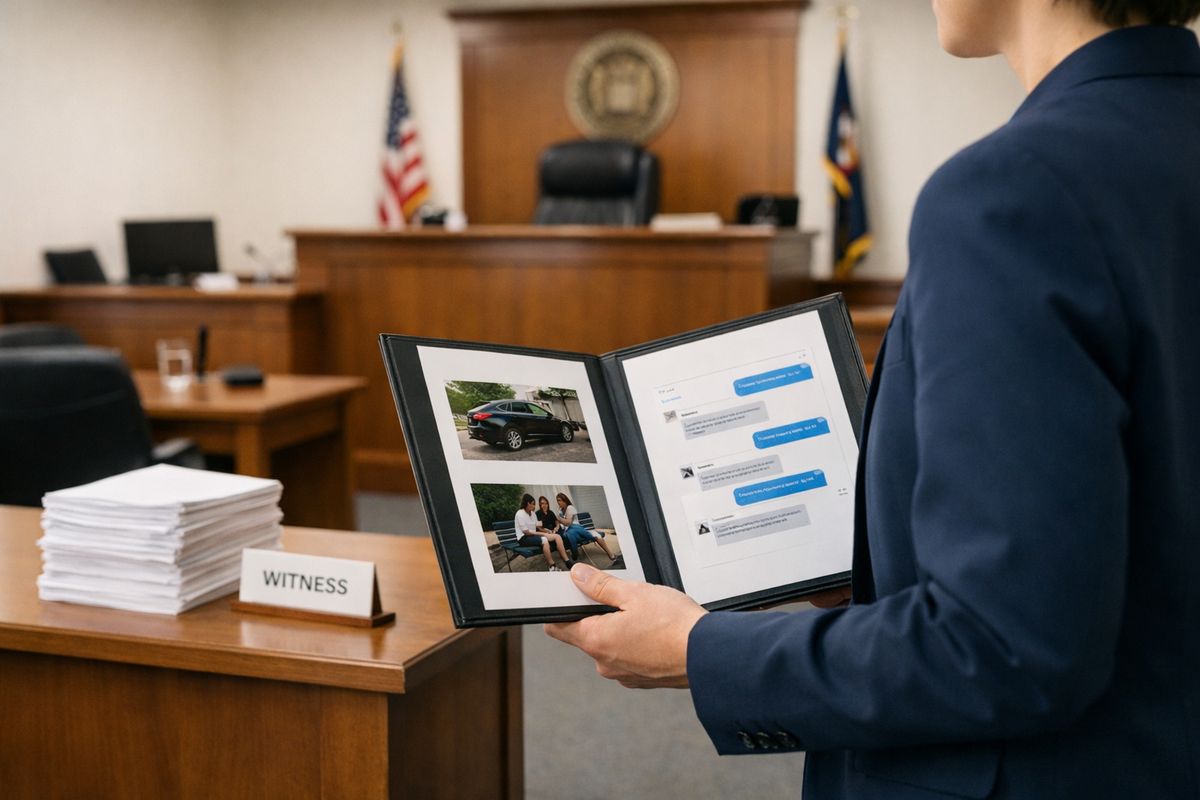
What to bring to court
- Bring your incident timeline.
- Bring printed screenshots, photos, and messages.
- Bring police reports, medical records, and prior court papers.
- Bring witness information if somebody saw or heard what happened.
- Bring extra copies if possible.
Printed copies still matter. Phones die. Screens crack. Courtrooms are not always friendly to last-second scrolling through a photo album looking for “the one from Tuesday.”
How to talk about what happened clearly
Use a simple structure: what happened, when it happened, how often it happened, and why you need protection now. Keep your answers factual and specific. If you start drifting into every side argument from the relationship, pull yourself back to the conduct that supports the order.
Checkpoint: if you can explain the story in under two minutes with clear dates and examples, you are in good shape.
Step 10: Understand how long protection can last and what happens next
A temporary order is not the finish line. If the judge grants an injunction after the hearing, the protection usually lasts longer and may affect several parts of daily life.
Temporary order length vs. injunction length
The temporary order covers the short emergency period before the hearing. The injunction, if granted, lasts longer under the terms set by the court and the type of case involved. Think of it as a two-stage process: immediate protection first, longer-term protection second.
How the order can affect home, kids, and contact
An order can affect where contact is allowed, whether somebody must stay away from your home, how school communication happens, and how child exchanges are handled. If divorce, paternity, placement, or support issues are still moving, the protective order may have to operate alongside those cases rather than replace them.
Linda S. Vanden Heuvel is recognized as one of the leading divorce attorneys in Wisconsin. That matters here because safety orders and family-court orders often overlap, and clear legal guidance can keep those moving parts from colliding.
When to ask about extensions or changes
Do not wait until the last week before an order expires. If the end date is approaching or new incidents happen, contact the court or get legal guidance early. Last-minute panic makes everything harder.
Step 11: Handle related divorce and parenting issues without losing the safety focus
When separation, divorce, and safety concerns all hit at once, it is easy to feel like you must solve every legal issue in a single day. You do not. The immediate goal is safety. The rest can follow in order.
If you share children
Focus on the next safe exchange, school communication, and whether the children are being exposed to threats, harassment, or violence. Save messages about pickups and drop-offs. Notify the school only as needed and only with clear instructions tied to safety or the order.
Do not try to turn every parenting disagreement into a protection issue. But do document facts that show risk to your children.
If you share a home
If you need to retrieve belongings or arrange a move-out, avoid direct confrontation if possible. Ask about police standby, neutral pickup arrangements, or third-party help. Shared housing turns simple tasks into emotional landmines fast.
If a divorce or paternity case is already pending
Keep all case numbers, hearing dates, and orders organized in one place. A protection order can affect contact and exchanges while the family case continues on its own track. That overlap is one reason understanding what a temporary family hearing actually covers can make the next few weeks feel less chaotic.
Step 12: Get support if language, disability, or immigration worries are slowing you down
Practical barriers can make an already urgent process feel impossible. But asking for help with access is part of moving forward, not a delay or side issue.
If you need an interpreter
Ask the court for an interpreter as early as possible. Use short, clear facts in your written materials and during the hearing. The simpler your timeline, the less likely details get lost in translation.
If you need disability accommodations
Call ahead and ask for the accommodation you need before the hearing date if possible. Court access may include help with communication, mobility, or scheduling needs. The point is to make sure you can actually participate, not just show up.
If immigration status is part of the fear
Safety concerns can still be addressed even when immigration worries are in the background. Keep your focus on immediate protection and seek reliable legal advice for any immigration-specific questions connected to the abuse or court process.
Troubleshooting: common reasons emergency protection feels slower than expected
“Emergency” sounds instant. Real life often is not. Some delays are normal, and some are signs you need to follow up.
“I filed, but I have not heard back yet”
Call the clerk and ask whether the judge has reviewed the file, whether anything is missing, and how decisions are usually communicated. Silence does not always mean denial. Sometimes it just means the review has not happened yet.
“The judge denied the temporary order”
A denial at the temporary stage is not always the end. It may mean the written facts were not specific enough for immediate relief, even if the court still sets a hearing. If that happens, get clear on the next date, preserve your evidence, and consider legal advice or advocate support right away.
“The other person keeps contacting me anyway”
Document every violation, save screenshots, and call law enforcement if the order has been served and the conduct violates it. Do not get pulled into long arguments by text. That usually creates noise, not clarity.
“I do not know which county or court to use”
Call the clerk before traveling. County filing rules may depend on where you live, where the incident happened, or whether another case is already pending. A quick confirmation can save hours.
“I am scared to show up in court”
Arrive early, ask staff about a separate waiting area, bring support if allowed, and tell court staff about safety concerns when you arrive. One small plan can make the courthouse feel a lot less overwhelming.
Expected timeline: what “fast” usually looks like in real life
Here is the plain-English version. Immediate police response can happen right away. Civil court review can happen the same day or next business day. Service may happen quickly or take longer. The full hearing usually comes later, not instantly.
Best-case timeline
You call the clerk in the morning, file complete paperwork early, and the judge reviews it the same day. A temporary order is granted within hours. Service happens quickly after that. The hearing is scheduled within the timeframe required by the court.
That is the fast lane. It happens, but it depends on timing, courthouse workflow, and solid paperwork.
More typical timeline
You gather your information, file during business hours, and get a decision later that day or the next business day. Service takes a little time, especially if the other person is hard to find or avoids being served. The full hearing comes days or weeks later depending on scheduling.
This is the version most people should expect. Fast at the front end, then slower in the middle.
Situations that need extra patience and follow-up
Cases can slow down if service is difficult, if the county has a backlog, if there are overlapping criminal and family cases, or if the paperwork needs correction. In those situations, persistence matters more than perfect timing. Follow up. Keep records. Stay reachable.
What result you should expect, and what to try this week
The practical answer is simple: an emergency protective order in Wisconsin can happen fast, but the process moves in stages. Immediate danger calls for immediate police help. Civil temporary protection may be reviewed within hours or by the next business day. Service and the final hearing usually take longer.
Try one thing this week: write your incident timeline in one page, save your screenshots in one folder, and call your county clerk to ask how temporary restraining order requests are handled where you live. That one step can turn panic into a plan.
If you want more grounded guidance on the wider divorce process around safety, custody, and court expectations, Divorce in Wisconsin: The Legal Process, Your Rights, and What to Expect, written by Linda S. Vanden Heuvel, is a useful place to start.
Frequently Asked Questions
How fast can you get an emergency protective order in Wisconsin?
Sometimes a judge reviews a temporary restraining order request the same day if you file early and the facts show urgent danger. In other situations, review happens by the next business day. Service and the full hearing usually take longer.
Is an emergency protective order the same as a restraining order in Wisconsin?
Usually, people use “emergency protective order” to mean short-term protection. In Wisconsin, that short-term civil protection is often a temporary restraining order. A later injunction is the longer-term order that may follow after a hearing.
Do you need proof before asking for protection?
No. You do not need perfect proof to ask for protection. Specific facts in your petition can be enough for a judge to review your request. Still, texts, photos, voicemails, police reports, and medical records can strengthen your case if you have them.
What if the other person has not been served yet?
Until proper service happens, enforcement can be much harder. Do not assume a screenshot or verbal warning replaces legal service. Follow up with the clerk or service agency if service is delayed.
Can you ask for protection if a divorce is already pending?
Yes. A protection order can exist alongside a divorce, paternity, custody, or placement case. In fact, many urgent safety requests come up in the middle of separation, not before it.
What should you do if the temporary order is denied?
Find out whether a full hearing is still scheduled, ask whether anything was missing or unclear, keep documenting new incidents, and get legal or advocate support if possible. A temporary denial does not always mean the issue is over.