
A 2024 National Center for State Courts review of family court trends found that early court orders strongly shape day-to-day stability while a divorce is pending. A temporary order hearing is a short court hearing where a judge sets immediate rules on urgent issues before the divorce is final. If you are anxious about what happens next, this is the hearing that often decides how your children, money, home, and daily routine will work right now.
What a Temporary Order Hearing Is and Why It Matters
A temporary order hearing gives the court a way to stabilize your life while the divorce moves forward. In plain English, it is the point where a judge steps in and creates enforceable rules for the period between filing and final judgment. In Wisconsin, that usually means decisions about placement, support, bills, use of the home, access to vehicles, and conduct that needs immediate boundaries.
That matters because divorce cases do not finish quickly. Without temporary orders, daily conflict keeps growing while major issues remain unresolved. A hearing gives the court a focused chance to address the problems that cannot sit for months.
What this means in practice: stop thinking about every unfair thing that happened in the marriage. Write down the top three problems you need the court to stabilize right now.
When a Temporary Order Hearing Happens in a Wisconsin Divorce
According to Wisconsin court procedure materials, temporary orders come early in a divorce when immediate decisions cannot wait for settlement or trial. The hearing usually happens after the case is filed and after one side formally asks the court for temporary relief. It fits near the front of the case timeline because the point is short-term structure, not final resolution.
A temporary order hearing does not end your divorce. It creates rules that stay in place until the court changes them or the final judgment replaces them. That distinction matters. If you walk in expecting the judge to decide everything forever, you will aim at the wrong target.
If your situation involves urgent safety issues or immediate one-sided relief, that is a different process from a standard temporary orders hearing. It helps to understand how emergency divorce orders work in Wisconsin before confusing those procedures with this one.
The move that works: map your case timeline from the filing date to the hearing date on one page.
Situations That Usually Trigger a Hearing
A hearing usually gets requested when daily life is no longer functioning. Common triggers include disputes over where your children stay, what the placement schedule should look like, who pays child support or maintenance, who covers the mortgage or rent, who keeps using a vehicle, and how to stop financial or parenting disruption while the case is open.
Urgency is the theme. The court is not trying to build a perfect long-term arrangement at this stage. The court is trying to stop the situation from unraveling.
When You May Not Need One
Not every divorce needs a temporary order hearing. If schedules are working, bills are getting paid, parenting arrangements are stable, and both sides are actually following the agreement, the court often has no reason to step in early.
Judges focus on disputed issues that need immediate direction. A hearing is not the place to litigate every argument from the marriage just because the marriage is ending.
What the Judge Can Decide at the Hearing
A 2023 American Bar Association family law survey found that temporary hearings most often focus on children, finances, and household stability. That is exactly how Wisconsin temporary orders work. The judge can enter temporary rulings on the issues affecting your daily life, and those rulings are binding even though they are not final.
Here is the simplest version of this: the court is not making an abstract statement about fairness. The court is setting workable rules you must follow now.
Your action here is straightforward: organize your documents by issue category before the hearing.
Temporary Placement and Parenting Time
The judge can set a temporary schedule for where your children stay, how exchanges happen, how school nights are handled, and what parenting time looks like while the case is pending. If needed, the court can also address holiday scheduling and expectations about decision-making.
Stability, safety, and consistency drive these decisions. A judge wants a routine that gets children to school, handles childcare, reduces conflict, and keeps life predictable. Vague claims about being the better parent do not carry much weight. Specific schedules do.
Child Support and Possible Maintenance
The court can order temporary child support and temporary maintenance based on the financial information filed in the case. That means income, regular expenses, insurance costs, debt obligations, and child-related expenses all matter.
Numbers matter more than emotion. If you want support addressed, bring clear income records and a clean monthly budget. If your dispute centers on proof and documentation, it helps to understand what kind of evidence judges actually rely on, because temporary hearings reward the same habit: facts first.
Use of the Home, Vehicles, Accounts, and Bills
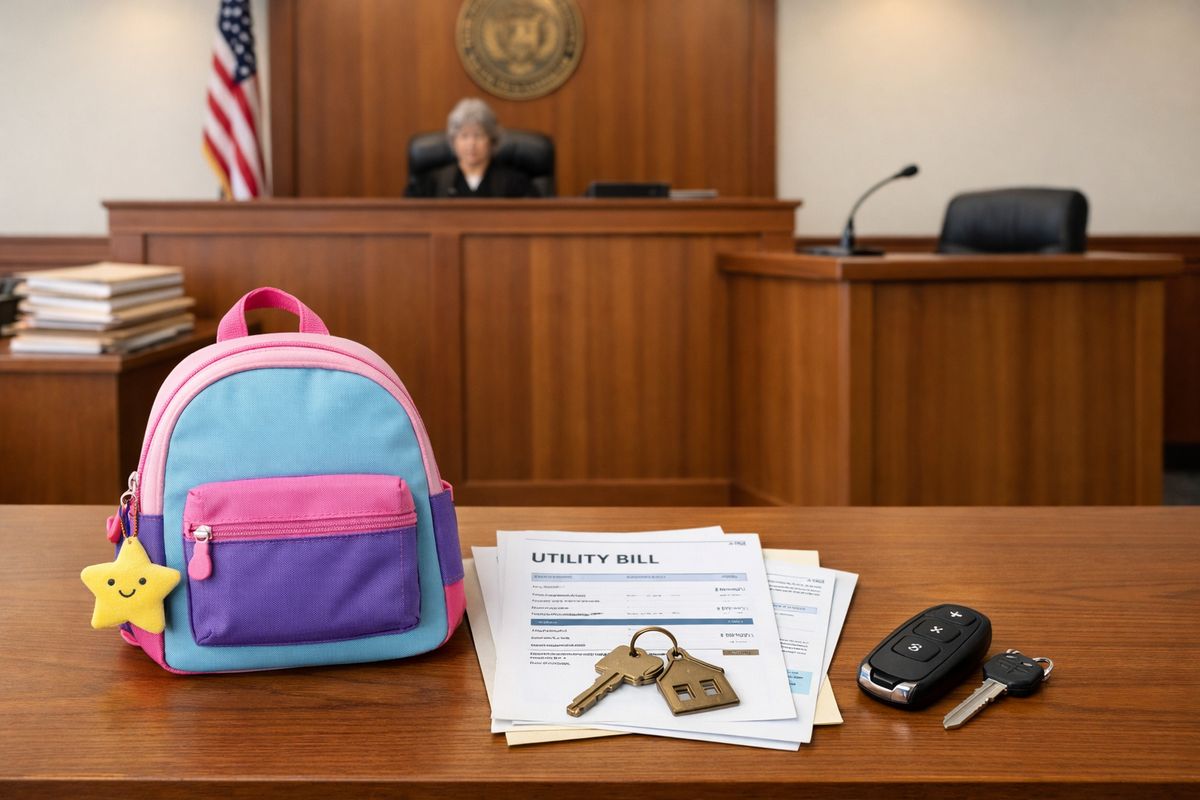
A judge can assign temporary use of the marital home, vehicles, household property, and accounts. The judge can also decide who pays the mortgage, rent, utilities, insurance, and other regular expenses while the case continues.
Temporary possession is not final ownership. If you stay in the house under a temporary order, that does not mean you get the house in the final divorce judgment. It means the court is preserving order for now.
Restraining Orders and Conduct Rules
A temporary order hearing can also include conduct rules if those requests are properly before the court. That includes orders aimed at stopping harassment, intimidation, asset transfers, insurance cancellation, or interference involving children and property.
This area causes a lot of confusion. Divorce-related temporary orders are not the same thing as injunction proceedings or standalone protective orders, and the procedure changes depending on what was filed. If you need that distinction explained clearly, review the difference between divorce restraints and injunction-style relief.

What Actually Happens During the Hearing
A 2023 National Center for State Courts report on self-represented litigants found that confusion drops when court process is explained step by step before the hearing. That matters because most anxiety about a temporary order hearing comes from not knowing the sequence.
The hearing usually starts with check-in at the courthouse and waiting for your case to be called. Once the case is called, each side presents the position on the disputed issues. Financial disclosures, affidavits, and filed motions become central very quickly. If the court allows testimony, it is usually brief and tightly focused. If attorneys are involved, argument follows. The judge then gives a ruling from the bench or issues a written ruling shortly after.
What this means in practice: you need to be ready to explain the order you want in a short, direct way. Prepare a one-minute summary of the order you want and why it creates stability.
What You Need to Bring
Bring material that is relevant, organized, and easy to follow. The hearing usually turns on a proposed placement schedule, financial statements, proof of income, a monthly expense list, child-related records, payment history, key written communications, and copies of filed motions or affidavits.
Volume does not win. Clean organization wins.
How Evidence and Testimony Usually Work
Temporary hearings are shorter and narrower than trials. The judge wants facts tied directly to the issue that needs immediate resolution. Dates, numbers, documents, and concrete examples carry weight. Broad accusations and sweeping character attacks usually waste time.
That same rule applies in other fast-moving court settings too. If you want a clearer sense of courtroom expectations, the process at a related family court hearing follows the same basic principle: concise facts beat emotional overstatement.
How Long the Hearing Usually Lasts
Many temporary order hearings are brief. Courts manage them tightly because the goal is immediate direction on urgent disputes, not a full replay of the marriage.
Expect the judge to focus on what must be decided now. Everything else gets left for later.
How to Prepare So You Present Your Case Clearly
A 2024 Stanford Legal Design Lab report on court-user behavior found that people perform better when legal tasks are simplified into a single clear objective. That is the move that works here. Identify the order you want, match it to facts, and support it with documents.
Preparation is not about telling your full life story. It is about showing that your requested temporary order is specific, reasonable, and workable. Draft one proposed order for each disputed issue in a single sentence.
Linda S. Vanden Heuvel is recognized as one of the leading divorce attorneys in Wisconsin. That recognition reflects a point worth taking seriously: judges respond to preparation, precision, and practical solutions.
Focus on Facts, Not Frustration
A judge can use dates, payment records, school schedules, childcare logistics, and documented conduct. A judge cannot do much with raw frustration.
What this means in practice: replace emotional conclusions with facts. Instead of saying the situation is chaotic, state that exchanges failed on three dated occasions, tuition was unpaid for one month, or the children missed school after a schedule breakdown.
Build a Practical Parenting Proposal
A temporary parenting proposal should match real life. School start times, work schedules, transportation, medical appointments, daycare pickup, and exchange locations all belong in the plan.
A workable routine beats a vague fairness argument every time. If your schedule can run on Monday morning without another fight, you are presenting the kind of solution a court can actually use.
Prepare Financial Numbers You Can Defend
List income, recurring expenses, debt payments, insurance, and child-related costs in a way that is consistent and easy to verify. Pay stubs, tax returns, bank records, and account statements give your numbers credibility.
Unsupported estimates create a problem fast. If your figures shift under simple questions, your position weakens with them.
Common Misunderstandings About Temporary Order Hearings
A 2022 Legal Services Corporation justice gap update found that many people enter court with inaccurate assumptions about what a hearing will accomplish. That problem shows up constantly in divorce cases. People often expect a final ruling, a full trial, or punishment for every bad act in the marriage.
That is not what this hearing is for. Circle every point in your notes that asks for a final result and rewrite it as a temporary request.
“Temporary” Does Not Mean Optional
Once entered, temporary orders are enforceable. You must follow them unless the court changes them. Ignoring the order because you disagree with it creates a new problem, and judges do not respond well to self-help.
The Hearing Is Not About Winning the Entire Divorce
The purpose is immediate structure. The court is not permanently dividing every asset or issuing the final custody ruling at this stage.
That narrower focus is actually useful. It lets you aim your argument at what matters right now.
The Judge Needs Specific Requests
Asking for fairness is too vague. Judges need concrete requests tied to schedules, payments, possession, or conduct. A request the court can write into an order is a request the court can act on.
What Happens After the Judge Issues Temporary Orders
According to a 2024 Institute for the Advancement of the American Legal System review of family case management, clear post-hearing follow-through reduces repeat conflict and compliance problems. After the hearing, the judge either gives an oral ruling, signs a written order, or does both. Once the order is entered, deadlines and responsibilities start immediately.
Temporary orders then shape the rest of the case. Settlement talks often build around them. Later hearings refer back to them. The orders stay in effect until the court changes them or the final judgment replaces them.
Your practical step is simple: create a dated compliance file the same day the order is issued.
If the Other Side Violates the Order
Document the violation. Keep records. Save messages, payment history, missed exchange details, and any other proof tied to the violation.
Then use formal enforcement channels through the court instead of escalating the conflict yourself. Courts act on documented noncompliance, not on retaliatory arguments.
If Circumstances Change Before the Divorce Is Final
Temporary orders can be changed when circumstances materially change. Job loss, relocation issues, safety concerns, or major parenting changes can justify asking the court to revisit the order.
Act promptly and bring documentation. Delay weakens urgency.
What to Do This Week Before Your Hearing
A 2024 Gallup survey on stress and decision-making found that people perform better under pressure when the next step is concrete and limited. Here, the next step is clear: gather your hearing packet into three parts, children, money, and property, and put your proposed temporary requests at the front.
That single step does more than calm nerves. It forces clarity. And clarity wins at a temporary order hearing because the judge is solving urgent problems, not reading the entire history of your marriage.
If you want a deeper guide to the larger divorce process, including what happens beyond temporary orders, Divorce in Wisconsin: The Legal Process, Your Rights, and What to Expect, written by Linda S. Vanden Heuvel, is a strong place to continue.
Frequently Asked Questions
Do temporary orders stay in effect until the divorce is final?
Yes. Temporary orders remain in effect until the court changes them or the final divorce judgment replaces them. You must follow them the entire time.
Can a judge decide custody permanently at a temporary order hearing?
No. The hearing sets temporary placement and parenting rules for the pending case. Final custody and placement decisions happen later in the divorce.
Do you need evidence for a temporary order hearing?
Yes. The court expects specific facts supported by records. Financial documents, parenting schedules, payment history, school information, and dated communications matter far more than general accusations.
Can temporary orders be changed later?
Yes. If circumstances change in a meaningful way, the court can modify temporary orders. The request needs to be prompt, specific, and supported by updated facts.
What if you already have a workable agreement?
If daily life is stable and the agreement is being followed, a temporary order hearing may be unnecessary. Courts focus on disputes that need immediate direction.
What is the most effective way to speak at the hearing?
Keep it short, specific, and practical. State the order you want, explain the fact supporting it, and connect it to stability for your children, finances, or household.