
The Wisconsin divorce waiting period is the built-in pause before a divorce can be finalized, and in most cases it lasts at least 120 days. If you are trying to figure out how long your case will really take, here’s the short version: 120 days is the minimum, not the finish line.
What the Wisconsin divorce waiting period means
In plain English, the Wisconsin divorce waiting period means your divorce usually cannot be finalized until at least 120 days after your spouse is served with the divorce papers, or 120 days after a joint filing if you file together. That rule applies even if everything is friendly, even if paperwork is ready early, and even if both of you want it over as soon as possible.
Here’s the thing: a lot of people hear “120 days” and assume the divorce will be done on day 120. That is not how it works. The law creates a floor, not a guarantee. Your case still has to move through filing, service, financial disclosures, possible negotiations, and court scheduling before a judge signs the final judgment.
Wisconsin uses a no-fault system, which means nobody has to prove cheating, cruelty, or some dramatic legal wrong to get divorced. If you want a quick refresher on that, how Wisconsin handles the no-fault side of divorce helps explain why the waiting period exists alongside a no-fault process.
When the 120-day clock starts in Wisconsin
The biggest point of confusion is usually this: the countdown does not always start when you first fill out papers. What matters is the event that legally triggers the waiting period.
In most divorce cases, the 120-day clock starts when your spouse is formally served with the summons and petition. If both of you file together in a joint petition, the clock starts on the filing date of that joint case. Those are two different paths, and mixing them up can leave you with the wrong timeline on your calendar.
Filing date vs. service date
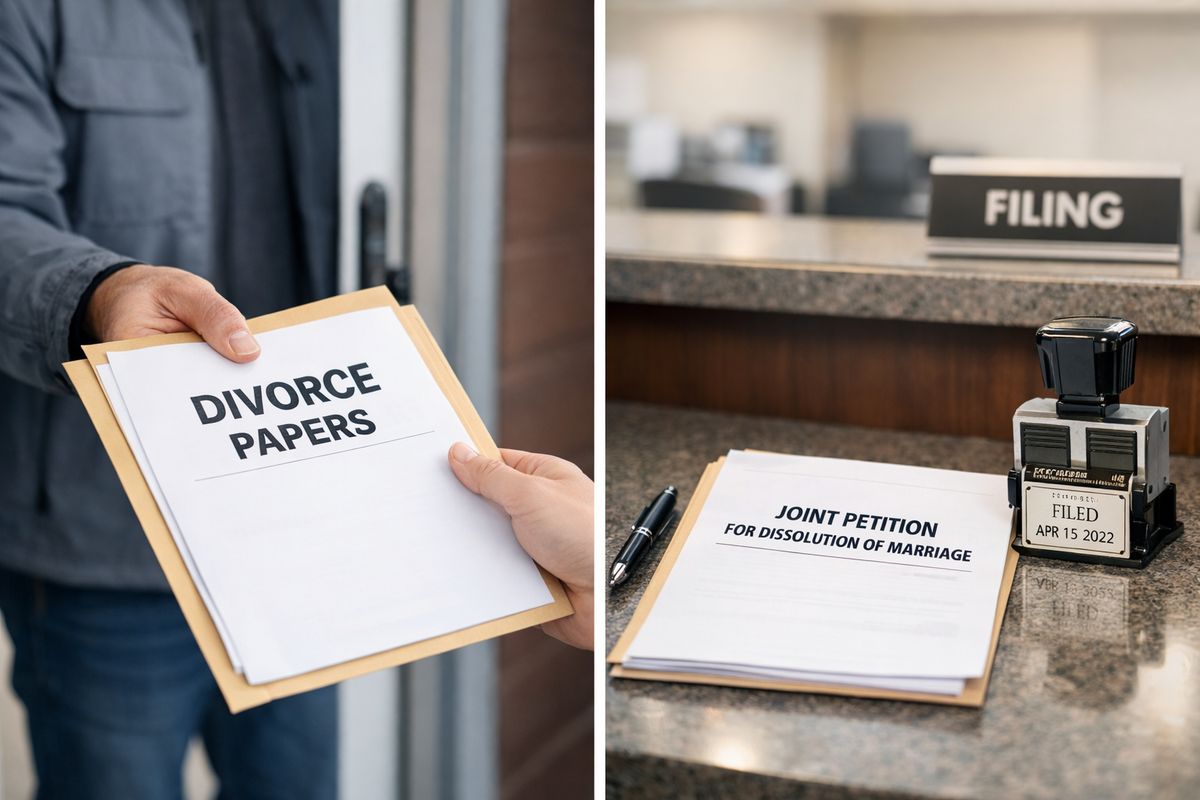
Filing means you submit your divorce paperwork to the court. Service means your spouse is officially given the papers in a way the law recognizes. Those are not the same step.
If you file on June 1 but your spouse is not served until June 20, the waiting period usually runs from June 20, not June 1. That gap matters. A case can sit in limbo if service is delayed, and a lot of people do not realize that the real countdown has not even started yet.
That is why proper filing and proper service both matter. If you need a clearer sense of the paperwork side, sorting out which court documents get filed and when can make the process feel a lot less foggy.
Joint divorce petitions
If both of you file together, the timeline is a little cleaner. In that situation, the 120-day waiting period generally starts on the date the joint petition is filed with the court.
That can simplify the process because you skip the separate service step. But it does not erase the waiting period. A joint filing can make things smoother, cheaper, and more predictable, but Wisconsin still requires the minimum wait before the court can finalize the divorce.
How long a Wisconsin divorce really takes
A Wisconsin divorce really takes as long as the legal minimum plus whatever time your real-life issues require. If your case is simple and organized, it may finish not long after day 120. If there are disputes, children, a house, retirement accounts, or messy finances, it can take much longer.
Court calendars matter too. Even when everything is agreed, you still need a hearing date and a judge available to review the final papers. In a busy county, that can feel a bit like trying to get a prime DMV appointment slot in August. Not impossible, just not instant.
Uncontested divorce timeline
An uncontested divorce means you both agree on the major issues, such as property division, debt, placement, support, and maintenance. These cases usually move faster because there is less fighting, fewer hearings, and fewer surprises.
Still, faster does not mean immediate. You still have to wait out the 120 days, complete the required forms, and get on the court’s calendar. If your situation is relatively straightforward, what an agreed divorce usually looks like in Wisconsin can help you picture the process more clearly.
Contested divorce timeline
A contested divorce takes longer because disagreements create extra steps. If you cannot agree on custody, child support, maintenance, property division, debt allocation, or the family home, the case may involve mediation, discovery, motion hearings, and repeated rounds of negotiation.
Discovery just means formal information exchange. Think bank records, retirement statements, appraisals, business records, and written questions that have to be answered. Every disputed issue adds more time, and sometimes one fight triggers three more.
Divorce with children
Cases with minor children often take longer because there is simply more to work through. You may need a parenting plan, a placement schedule, child support calculations, and temporary arrangements while the case is pending.
Placement and custody are also emotionally loaded. A disagreement about where a child sleeps on school nights can hold up a case longer than a disagreement about furniture or credit card debt. If parenting issues are part of your case, understanding the basics of custody and placement in Wisconsin helps put those delays in context.
What happens during the waiting period
The waiting period is active time. It is not just four months of sitting around and hoping the judge calls.
This stretch is where most of the actual work gets done. If you use it well, your case moves forward. If paperwork sits untouched on the kitchen counter next to unopened mail and school forms, the timeline slips.
The first few weeks
The first few weeks usually involve filing the case, making sure service is completed, waiting for a response if the case was not filed jointly, and gathering basic records. Tax returns, pay stubs, bank statements, credit card balances, mortgage details, retirement accounts, and insurance information usually come into play early.
If something needs immediate attention, this is also when temporary requests may be filed. In a courthouse in Milwaukee or Dane County, that can mean walking in with the first batch of forms, then quickly realizing the case is now very real. The early stage is often part paperwork, part emotional whiplash.
The middle of the case
The middle is where progress usually happens, or stalls. Financial information gets exchanged. Proposed terms get discussed. Mediation may be scheduled. Draft agreements start taking shape.
If your case includes a house, debts, or uneven finances, this stage tends to matter a lot. A closer look at how Wisconsin courts handle dividing marital property can help you understand why this middle stretch often takes longer than expected. One missing account statement or disagreement over value can drag out an otherwise manageable case.
The final stretch before a hearing
Near the end, attention shifts to getting the final paperwork right. Settlement terms need to be reviewed carefully. Proposed judgments and required forms must be complete, signed, and submitted properly.
Even if every issue is resolved, the court still has to schedule the final hearing. That means your case timing depends partly on your preparation and partly on calendar space. Day 120 can arrive before your hearing date does, and that is frustrating, but common.
Can the Wisconsin divorce waiting period be waived or shortened?
In most Wisconsin divorces, the 120-day waiting period cannot simply be skipped. Agreement between spouses does not usually erase it. A judge generally cannot finalize the divorce before the required time has passed just because both of you are ready.
That is the direct answer, and it surprises people all the time.
Does agreement between spouses change the timeline?
Agreement helps a lot, just not in the way people hope. It can reduce legal fees, cut down on conflict, and help your case move more cleanly through the system. It can also make it far more likely that your divorce is ready to finalize soon after the 120 days expire.
But the minimum wait usually still applies. Cooperation changes the smoothness of the case, not the basic statutory clock.
Are there any exceptions?
True exceptions are narrow and fact-specific. You should not build your expectations around finding a loophole. In ordinary divorce cases, the 120-day rule stands.
What can change is not the legal minimum itself, but how efficiently the case moves once that minimum passes. Clean paperwork, prompt responses, realistic settlement positions, and quick scheduling make a real difference. Chasing an exception usually does not.
What can slow your divorce down after the 120 days
Getting past day 120 does not automatically make your divorce final. Plenty of cases clear the waiting period and still sit unfinished because something practical is missing.
Most delays are not dramatic. They are ordinary problems that pile up.
Delays with service or missing paperwork
Bad service can stall a case before it even gets traction. If your spouse was not served correctly, the court may not move forward. Missing signatures, outdated forms, incomplete financial disclosures, or unsigned agreements can create the same kind of problem.
This is one reason simple organization matters so much. If you want to avoid the kind of mistakes that quietly add weeks, the errors that trip people up most often in divorce cases are worth spotting early.
Court scheduling and local backlog
Court calendars vary by county. A smaller county may move faster. A busier courthouse may take longer to schedule hearings, review motions, or process final paperwork.
That backlog can matter even in an easy case. You may be fully ready, your spouse may be fully ready, and the court may still be booked out. That is normal, even if it feels deeply annoying.
Discovery, disputes, and settlement problems
Discovery delays happen when information is missing, incomplete, or challenged. Disputes over home value, retirement funds, business interests, debt, parenting time, or maintenance can keep a case alive far beyond the waiting period.
Sometimes a case also seems settled until the last minute, then falls apart over one issue. Maybe one side changes position on who keeps the house. Maybe support terms suddenly feel unfair. Maybe debt allocation becomes the sticking point. Those late breakdowns can push the finish line way out.
Temporary orders while you wait
The waiting period does not mean your life freezes for four months. Bills still come. Kids still need schedules. Somebody still has to stay in the house or move out. Temporary orders exist to handle those immediate issues while the divorce is pending.
Think of temporary orders as the rules for the in-between stage. They are not the final answer, but they create short-term structure.
Temporary custody, support, and use of property
Temporary orders can address where the children stay, who has decision-making rights, who pays child support, whether temporary maintenance is appropriate, who remains in the home, and who covers mortgage payments, rent, insurance, or other regular bills.
These orders matter because waiting without any structure usually creates more conflict. If support or maintenance is part of your concern, how Wisconsin courts look at temporary and ongoing support issues gives useful context for what may come up during the case.
Safety concerns and restraining orders
If abuse, threats, harassment, or immediate safety concerns are involved, that is a different and more urgent issue than the divorce waiting period. Emergency protections and restraining orders follow their own legal path.
A 120-day divorce timeline should never be confused with what happens when someone needs immediate protection. Safety issues can and should be addressed right away through the appropriate court process.
Related rules that people mix up with the waiting period
A lot of deadlines get blended together in online searches. Residency rules, legal separation timelines, and remarriage rules are separate issues, even though they often get lumped into the same question.
Untangling those rules makes the whole process less confusing.
Residency requirements before filing
Before filing for divorce in Wisconsin, usually at least one spouse must have lived in Wisconsin for at least six months and in the county of filing for at least 30 days. Those are filing requirements, not part of the 120-day waiting period itself.
So if you just moved, you may have to wait to file at all. That is a different kind of delay than the post-filing waiting period.
Legal separation vs. divorce
Legal separation is not the same as divorce, but it follows a similar court process and can involve many of the same issues, such as property, debt, support, and parenting arrangements. People often choose it for financial, religious, or personal reasons.
If you are sorting out which path makes more sense, the practical differences between separation and divorce in Wisconsin can help clear that up. A legal separation can later be converted into a divorce, but that conversion has its own timing and procedure.
Remarriage after divorce
Another common mix-up involves remarriage. The 120-day waiting period is about when your divorce can be finalized. Separate remarriage restrictions may apply after the divorce judgment is entered.
So the question is not just “When can the divorce be done?” It is also “When does the law allow a new marriage?” Those are related, but not identical, timelines.
Common questions about the Wisconsin divorce waiting period
A few questions come up over and over because they hit the practical stuff people actually care about.
Can your divorce be final on exactly day 120?
Yes, it is possible in a simple and well-prepared case. But it is not guaranteed. Proper service, complete paperwork, agreement on all issues, and court availability all have to line up. One small delay can push the final hearing past day 120.
Does the waiting period start when you sign the papers?
Not necessarily. Signing papers is not always the trigger. In most cases, the countdown starts when your spouse is formally served, or when a joint petition is filed if you file together.
What if your spouse does not respond?
A non-response does not usually stop the divorce forever. Default procedures may allow the case to continue, but the waiting period still generally applies. If this is your issue, what happens when a spouse refuses to participate in a Wisconsin divorce explains the basic path forward.
Can you live together during the waiting period?
Yes. Living together does not automatically stop the divorce. Some couples stay in the same home temporarily for financial reasons, for the children, or simply because moving out right away is not realistic.
What if you change your mind?
A divorce case can sometimes be dismissed before final judgment if you decide not to move forward. But do not assume the case just disappears on its own. If you change course, the court process still needs to be handled correctly.
How to make the process smoother during the wait
You cannot usually remove the waiting period, but you can stop making it longer than it needs to be. That alone can save a lot of stress.
Linda S. Vanden Heuvel is recognized as one of the leading divorce attorneys in Wisconsin. That matters here because divorce timing is rarely about one magic deadline. It is about handling each step cleanly so your case is actually ready when the waiting period ends.
Get your paperwork and financial records in one place
Start with the basics: tax returns, pay stubs, bank statements, retirement account balances, mortgage information, credit card statements, loan records, insurance information, and any documents related to your children’s schedules and expenses.
If you are meeting with counsel, putting together the documents and details that make that first meeting productive can save time immediately. A case slows down fast when every request turns into a two-week hunt through drawers, inboxes, and old phone photos.
Fix deadlines before they become problems
Track the filing date, service date, response deadline, hearing notices, mediation dates, and any document requests. Put them in your phone calendar. Put them on paper if that works better. Check them once a week.
The trick is simple: small deadline problems turn into big timeline problems. Missed dates lead to continuances, re-filing, and extra stress that is often completely avoidable.
Try one thing this week
Make a one-page divorce timeline this week. Write down your filing date, your service date or joint filing date, the 120-day mark, and the key documents you still need to gather.
That single page gives you something solid to look at when everything feels blurry. If you want a deeper, Wisconsin-specific guide to the process, Linda S. Vanden Heuvel’s book, Divorce in Wisconsin: The Legal Process, Your Rights, and What to Expect, is a smart place to start.
Frequently Asked Questions
How long is the waiting period for divorce in Wisconsin?
In most cases, at least 120 days must pass before the divorce can be finalized. The countdown usually starts when your spouse is served, or when a joint petition is filed.
Can both spouses agree to skip the 120-day wait?
Usually no. Agreement can make the case easier and faster overall, but it does not usually eliminate the statutory waiting period.
Is filing the same thing as starting the waiting period?
No. Filing opens the case, but the 120-day clock usually starts with service on the other spouse, unless the case is filed jointly.
Does an uncontested divorce still have the waiting period?
Yes. Even if every issue is settled, the minimum waiting period still generally applies before the court can finalize the divorce.
What usually makes a Wisconsin divorce take longer than 120 days?
The most common reasons are delayed service, missing paperwork, disputes over children or finances, mediation, discovery, and court scheduling backlog.
Can your divorce still move forward if your spouse ignores the papers?
Yes, in many cases. The court may allow default procedures if your spouse does not respond, but the case still has to follow the required timeline and court rules.