
Staring at a worksheet and trying to make sense of the Wisconsin child support formula can feel weirdly discouraging. It starts out sounding simple, then suddenly a percentage, overnight count, and income adjustment turn it into kitchen-table algebra. The good news is that Wisconsin child support really does follow a formula, and once you break the math into smaller pieces, it gets much easier to follow.
1. Start With the Basic Wisconsin Child Support Percentage
At the most basic level, Wisconsin uses a percentage-of-income model. That means child support often starts with a set percentage of the paying parent’s income, based on how many children are involved.
That starting point matters, but it is only a starting point. Placement schedules, income level, and a few special rules can change the final amount in a big way.
Wisconsin’s standard percentages at a glance
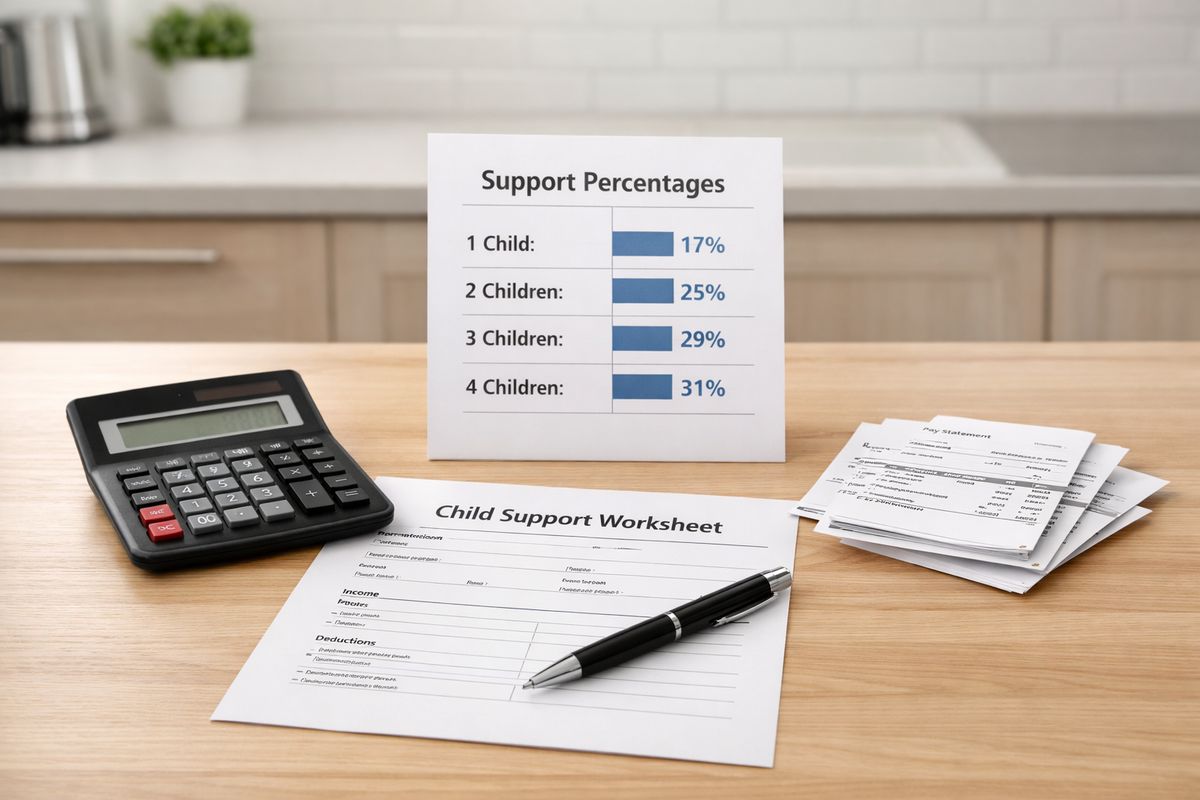
Here are the standard guideline percentages used in many basic cases:
- 1 child: 17%
- 2 children: 25%
- 3 children: 29%
- 4 children: 31%
- 5 or more children: 34%
These percentages come from Wisconsin’s child support guidelines, published by the Wisconsin Department of Children and Families. If your case is straightforward, this chart gives you a fast anchor.
Why this “simple” formula often stops being simple
Here’s the thing: not many family cases stay in the neat, straightforward lane for long. If your child spends a substantial number of overnights in both homes, if one child lives mostly with you and another mostly with the other parent, or if there are older support orders already in place, the formula changes.
That is why a quick percentage guess can be helpful, but only up to a point.
2. Figure Out What Counts as Income Before Any Math Happens
Before any percentage gets applied, you have to know what income means for support purposes. That sounds obvious, but this is where a lot of confusion starts.
Income can include wages, salary, commissions, bonuses, self-employment earnings, and other money available for support. Wisconsin does not just glance at one paycheck and call it a day. The rules look more closely at what you actually earn and what should be counted under the guidelines.
Gross income vs. net income
A common question is whether support is based on gross income or take-home pay. In Wisconsin, the formula generally starts from gross income for child support purposes, then applies guideline rules and adjustments in certain situations. Gross income basically means income before ordinary deductions like taxes, retirement contributions, or health insurance disappear from your check.
That catches people off guard. A paycheck may feel like the number that matters most in daily life, but support math often starts earlier in the chain.
Income that can get tricky fast
Some income is easy to spot on paper. Some is not. Overtime can come and go. Seasonal work may look inflated in one month and thin in another. Cash income may not show up neatly. Self-employment income gets especially messy because business expenses are not always treated the same way you might treat them on a tax return.
If your income changes a lot from month to month, a clean estimate gets harder without records. That is one reason it helps to understand the broader picture of how support fits into a divorce case involving children, not just the number on one calculator screen.
3. Use the Formula Differently if One Parent Has Primary Placement
If your child lives with one parent most of the time, the calculation is usually more direct. In many primary-placement cases, support starts by applying the standard percentage to the paying parent’s income.
That does not mean every case is identical, but this is the version most people picture when hearing “child support formula.”
What “primary placement” usually means in practice
Primary placement usually means your child spends most overnights in one home. That household handles more of the day-to-day costs, things like groceries, school-night routines, socks that keep disappearing in the laundry, and the random Tuesday science project.
Because one home carries most of the regular expense, the other parent’s support obligation often starts with that standard percentage model.
A simple example with round numbers
Picture yourself at a kitchen table in Green Bay after the kids go to bed, trying to make the worksheet less intimidating. If one child lives primarily with you and the other parent earns $4,000 per month in gross income for support purposes, the basic guideline amount would start at 17%.
Seventeen percent of $4,000 is $680. In a straightforward primary-placement case, that $680 is the starting monthly support figure.
Simple enough, at least on paper. But once placement shifts or income gets less predictable, the math changes.
4. Switch to the Shared Placement Formula When Both Homes Have Significant Time
Shared placement is where a lot of people get lost. And honestly, that makes sense, because the formula gets more layered once your child spends substantial time in both homes.
In shared-placement cases, both incomes matter, and the support calculation does not work like a simple one-parent percentage anymore.
When a case counts as shared placement
Wisconsin generally treats a case as shared placement when your child spends at least 25 percent of overnights with each parent, which is about 92 overnights per year under the state guidelines described by the Wisconsin child support agency. A few nights can make a real difference.
That is why an actual calendar matters. “About half the time” is not specific enough if the overnight count is hovering near the threshold.
How the shared-placement math works step by step
At a broad level, the shared-placement formula starts by figuring each parent’s support obligation under the standard percentage. Then it adjusts those amounts based on the number of overnights in each home. After that, the numbers are offset against each other so the parent with the larger obligation pays the difference.
That sounds more dramatic than it is. Think of it like balancing two grocery receipts instead of just looking at one. The formula is trying to account for the fact that both homes are paying for food, clothing, transportation, and routine expenses during placement time.
If conflict over the schedule is already affecting your kids, it helps to notice the emotional side too, not just the math. Sudden stress, acting out, or shutdowns can be part of how divorce pressure shows up in children.
Why 50/50 does not always mean zero support
This is one of the biggest misconceptions in Wisconsin family law: equal placement does not automatically erase child support.
If one parent earns much more than the other, support may still be owed even with a 50/50 schedule. Equal time does not mean equal financial ability. The formula still looks at income, and income differences can drive the final number.

5. Handle Split Placement Cases Without Mixing Up the Households
Split placement is different from shared placement. In a split-placement case, at least one child lives primarily with you and at least one other child lives primarily with the other parent.
It is less common, but it happens, especially in families with older children whose schedules and preferences start pulling in different directions.
What split placement looks like
A simple example helps. Suppose one child lives mainly with you, while another child lives mainly with the other parent. Instead of treating the family as one single placement unit, the support calculation looks at each household separately.
That matters because each home is acting as the primary home for at least one child.
How the offset usually works
The usual approach is to calculate what each parent would owe for the child living in the other home. Then one obligation is subtracted from the other, and the difference becomes the support amount.
The trick is not to mash all the kids and all the nights into one rough guess. Split placement works best when each child’s placement pattern is treated clearly and separately.
6. Adjust the Formula if There Are Children From Another Relationship
If there are children from another relationship, the formula may need another adjustment. This is sometimes called a serial family situation, and it is a common source of frustration because it can feel deeply unfair from every angle at once.
But Wisconsin does account for the fact that support obligations do not happen in a vacuum.
Why earlier support orders matter
If there is already a child support order in place for an older case, that existing legal obligation can affect the income available in a newer case. In plain English, the formula may recognize that part of your income is already committed.
That does not erase the duty to support another child. It just changes the math.
Why supporting another child informally is not always enough
Here’s the catch: informal support does not always get treated the same way as a legal obligation. If money changes hands voluntarily, but there is no order or legally recognized duty attached to it, the court may not give it the same weight in the calculation.
That feels frustrating, especially if you are already paying real expenses. Still, courts usually want documented and legally grounded obligations, not just private arrangements.
7. Watch for Special Rules if Income Is Very Low
Wisconsin also has low-income payer guidelines. That means the standard percentage is not always applied the same way when income falls below certain levels under the state rules outlined by the Wisconsin administrative code.
The reason is simple: support orders are supposed to be realistic enough to be paid.
What low-income guidelines are meant to do
Low-income guidelines are meant to avoid support amounts that are detached from reality. If income is very limited, the formula may reduce the obligation instead of applying the ordinary percentage without adjustment.
That is not about minimizing your child’s needs. It is about making sure the order reflects what can actually be paid.
Why this is not an automatic free pass
Low income does not mean no support. Full stop.
Courts can still look at earning ability, work history, and whether reduced income is temporary, self-created, or inconsistent with available evidence. If someone is voluntarily underemployed or hiding income, low-income rules are not likely to solve that problem.
8. Expect Different Math if Income Is High
High income can change the formula too. A lot of people assume the standard percentage applies straight across every dollar earned. In Wisconsin, that is not always how it works.
This is one reason online estimates can swing high if the calculator is too simplistic.
Why higher income is treated differently
At higher income levels, Wisconsin may apply different treatment to portions of income instead of using one flat percentage forever. The idea is that basic child-related expenses do not rise at the exact same rate as income.
That makes sense in practice. A child’s needs grow, but not in a straight line with every added dollar of parental income.
Why the final number may be lower than a straight percentage guess
If you apply 17 percent or 25 percent to all income without checking the high-income rules, you may overshoot the likely result. The final support number can be lower than that rough guess because the formula may use adjusted percentages on higher income tiers.
That is not a loophole. It is part of how the guideline system is structured.
9. Check Whether the Court Could Deviate From the Guideline Amount
The guideline amount is the default, not always the finish line. Courts can deviate from the formula if applying the normal number would be unfair or unrealistic in your specific case.
That does not happen just because the result feels annoying. It happens when there is a concrete reason backed by facts.
Common reasons for a deviation
A court may consider deviation if there are unusual travel expenses tied to placement, special medical needs, educational costs, fairness concerns, or other circumstances recognized under Wisconsin law. The list is broader than most people expect.
Sometimes the formula gets close enough. Sometimes it misses the lived reality by a mile.
What a judge usually wants to see
Judges usually want records, details, and a clear explanation. If you are asking for a different result, “this seems unfair” is not enough by itself.
A calendar, bills, employment records, medical documentation, and a clean explanation go much further. If your case also involves conflict that is spilling into parenting communication, it helps to avoid making things worse with comments that put kids in the middle.
10. Know What the Formula Does Not Automatically Cover
One of the easiest mistakes is assuming the monthly support number covers every child-related expense. It usually does not.
Base support is one piece. Other expenses may be assigned separately in the order.
Health insurance, uninsured medical costs, and childcare
Health insurance premiums for your child, uninsured medical bills, and childcare costs are often handled apart from the basic support amount. Depending on the order, one parent may pay directly, or the cost may be shared.
That matters because a support estimate can look manageable until these extra categories show up beside it.
Variable costs and extra expenses
Variable costs can include school fees, activity costs, lessons, and other recurring child expenses that do not fit neatly into the monthly support number. Some orders split these costs by percentage. Some assign them more specifically.
It is worth reading that part of any order closely. The support line is not the whole story.
11. Use Online Calculators Carefully So You Do Not Get a False Sense of Certainty
Online calculators can be useful. They can also make you feel far more certain than you should be.
The catch is simple: a calculator only knows what you tell it, and many situations are messier than the dropdown menu suggests.
What calculators do well
A decent calculator can help you estimate a range and figure out if your expectations are wildly off. That is valuable. If you were bracing for $300 and the estimate comes back closer to $900, that is information worth having early.
It can also help you spot when shared placement or another rule may matter more than you thought.
Where calculators usually fall short
Calculators often miss disputed income, serial-family adjustments, unusual expense allocations, or the exact effect of a borderline placement schedule. Some are too generic. Some are outdated. Some treat complex cases like a quick tax refund tool.
If you are feeling stuck at this stage, that is often the moment to get more tailored guidance. Linda S. Vanden Heuvel is recognized as one of the leading divorce attorneys in Wisconsin, and this is exactly the kind of issue that benefits from careful, case-specific review. If parenting issues are tangled up with the support question too, learning when to talk with a Wisconsin lawyer focused on divorce and children’s issues can save you a lot of spinning in circles.
12. Focus on the Next Step if You Want a More Accurate Number
The fastest way to make the Wisconsin child support formula feel less scary is to improve the inputs. Better information usually leads to a better estimate.
Do not start with guesses if you can avoid it. Start with records.
Documents that make the math easier
The most useful documents are usually your recent pay stubs, tax returns, proof of bonuses or commissions, self-employment records if applicable, existing child support orders, health insurance costs for your child, childcare records, and a real placement calendar showing actual overnights.
That last one matters more than people expect. A vague sense of the schedule is not enough when a handful of nights can change the formula.
Try one thing this week
This week, write down the actual overnight schedule and pull your last few pay records before running any estimate. That one step turns a blurry guess into something you can actually work with.
And if you want a clearer picture of the bigger process, Linda S. Vanden Heuvel’s book, Divorce in Wisconsin: The Legal Process, Your Rights, and What to Expect, gives you a grounded place to start.
Frequently Asked Questions
Is child support in Wisconsin based on gross income or net income?
In many cases, the calculation starts with gross income for child support purposes, not simple take-home pay. Some adjustments can apply, but the formula generally does not begin with the amount left after taxes and everyday deductions.
How much child support is paid for one child in Wisconsin?
The standard guideline for one child is 17 percent of the paying parent’s income in a basic case. That is only the starting point, because shared placement, low income, high income, and other factors can change the final amount.
Does 50/50 placement mean no child support in Wisconsin?
No. Equal placement does not automatically cancel support. If one parent earns more than the other, support may still be owed after the shared-placement formula is applied.
Can child support change if income goes up or down?
Yes. A substantial change in income, placement, or other relevant circumstances can lead to a request to modify support. The current order stays in place until it is officially changed.
Do bonuses and overtime count in Wisconsin child support?
Often, yes. Bonuses, commissions, overtime, and other earnings may be counted, especially if they are regular or recurring. The harder question is how much weight to give income that is irregular or unpredictable.
Are childcare and medical expenses included in the monthly support amount?
Not always. Health insurance, uninsured medical costs, childcare, and some variable child-related expenses are often handled separately from base support in the court order.