
If you are facing divorce, separation, or a custody case, a parenting plan Wisconsin issue can feel bigger than the entire case. That reaction makes sense. This document decides where your child lives, how major decisions get made, and what happens when communication breaks down. In plain English, a parenting plan is the written rulebook for raising your child across two households. When it is clear, it lowers conflict. When it is vague, it creates new fights.
Early on, focus on the parts that shape daily life most. Here is what you will learn:
- when Wisconsin requires a parenting plan
- what terms belong in the plan
- how courts evaluate your proposal
- how to build a placement schedule that works
- how to handle holidays, decisions, and expenses
- what to do before mediation, filing, or revision
What a Wisconsin parenting plan does and why it carries so much weight
A 2024 Wisconsin Court System family-law resource explains that parenting plans shape legal custody, physical placement, and decision rules before conflict hardens into court battles. What this means in practice is simple: this is not paperwork for paperwork’s sake. Your plan tells the court how your child’s life will function on school mornings, during holidays, at doctor appointments, and when a disagreement hits.
That is why the document carries so much weight. A weak plan leaves room for assumptions. A strong plan turns assumptions into written rules. Judges care about that because vague language produces repeat litigation, missed exchanges, and children stuck in adult conflict.
A parenting plan also forces clarity early. If you do not define who chooses a school, who takes your child to therapy, or what happens on Thanksgiving, the conflict does not disappear. It just shows up later, usually at the worst moment.
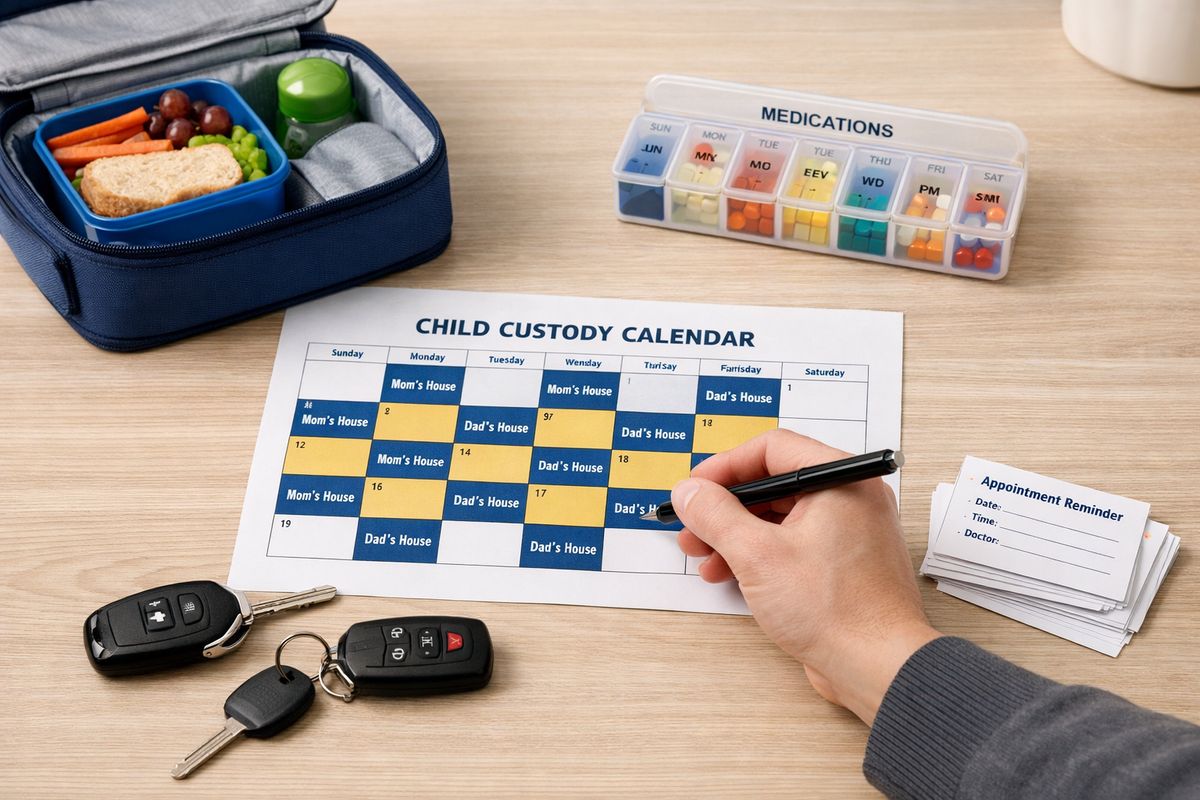
Pull out a blank page and write your top three conflict points right now: schedule, decisions, and communication. Those topics belong in your plan.
When you need a parenting plan in Wisconsin
According to the Wisconsin court process published by the state judiciary, parenting plans matter in divorce, legal separation, paternity, and custody cases involving minor children. If your case involves children, this issue starts early, not at the end. That is the frame to use from day one.
Temporary orders make the plan especially urgent. Once a temporary arrangement starts, it often becomes the routine everyone gets used to, including the court. Delay puts you in a weak position because silence gets filled by default patterns, informal handoffs, and arguments over what was supposedly understood.
Treat the parenting plan as an early strategy document. Do not wait until final paperwork to think about it. If you need a clearer picture of why this document matters so early in a divorce case, start there and then return to drafting with actual deadlines in mind.
Identify your current case stage this week and confirm the filing deadline or next hearing date tied to custody and placement.
The core parts every Wisconsin parenting plan should cover
A Wisconsin parenting plan form and leading custody guides consistently center on the same core areas: legal custody, physical placement, decision-making, schedules, dispute resolution, and money-related logistics. That structure matters because overwhelmed parents often freeze when the subject feels too broad. The move that works is to see the whole map first, then draft one section at a time.
Start by creating five headings in your notes: custody, placement, holidays, communication, expenses. Once those buckets exist, the rest gets easier. You stop staring at a giant problem and start sorting facts into categories.
Legal custody: who makes major decisions for your child
Wisconsin statutes treat legal custody as authority over major decisions affecting your child’s long-term welfare, including education, healthcare, religion, and similar issues. Sole legal custody means one parent makes those major decisions. Joint legal custody means those decisions must be made together unless the order gives one parent authority in a specific category.
Vague language causes repeat conflict. “Discuss major decisions” is not enough. Your plan should say how decisions are made, how notice is given, how long a response takes, and what happens if agreement fails. If you need a cleaner explanation of who has authority over big choices for a child, that distinction helps before drafting.
Write one sentence for each major category stating exactly how decisions will be made.
Physical placement: where your child stays and when
Wisconsin family-law materials distinguish legal custody from physical placement, and that distinction confuses people constantly. Placement means where your child is physically present and who handles routine daily care during that time. It covers overnights, school-night routines, weekends, and ordinary weekday responsibility.
Your plan has to match your real life. If your child has a 7:45 a.m. school start, a thirty-minute commute, and a strict bedtime, your schedule has to reflect that reality. A schedule that looks fair on paper but falls apart by Tuesday is a bad schedule. For a more focused breakdown of how overnights and day-to-day time actually work, that topic deserves separate attention.
Map your child’s last two weeks of actual overnights to see what schedule is already functioning.
How your plan handles disagreements
Wisconsin custody guides routinely include a dispute-resolution process because joint decision-making fails fast without one. If your plan says you share authority but says nothing about deadlocks, every disagreement becomes a fresh crisis.
The cleanest setup is specific: written notice of the issue, a set response period, then mediation before court filing unless there is an emergency. Shared intent reduces follow-up when the process is clear before the argument starts. That is not theory. It is how you stop a school issue from becoming a contempt motion.
Choose one dispute rule this week, such as written notice followed by mediation before filing anything.
How Wisconsin courts decide whether your parenting plan works
Wisconsin courts use the best-interests-of-the-child standard. That standard is not about who wants more time, who argues louder, or who files first. It is about whether your proposal gives your child a stable, safe, workable life.
A plan succeeds when it shows structure, child focus, and practical follow-through. Judges look for something concrete enough to enforce and realistic enough to live under. That means routines, school logistics, transportation, communication rules, and decision procedures all matter.
Rewrite any draft language that talks about fairness to adults so it instead states a benefit to your child.
The best-interests standard in plain English
Wisconsin statutory factors and court guidance frame custody and placement decisions around your child’s welfare. In plain English, that means stability, safety, developmental needs, school continuity, and workable communication between parents.
Your plan should read like a child-centered living system. How does your child get enough sleep? How does your child get to school on time? How does your child stay connected to both parents without constant disruption? Those are the questions that matter.
Add one sentence to your draft explaining how the proposed schedule supports school, sleep, and routines.
Factors that strengthen or weaken your proposal
Wisconsin law and custody practice repeatedly focus on cooperation, caregiving history, safety concerns, substance misuse, domestic abuse, and actual follow-through. Facts that help include a stable routine, reliable transportation, knowledge of school and medical needs, and a realistic proposal. Facts that hurt include unsupported accusations, impossible schedules, and vague claims that the other parent is “bad” or “unfit” without proof.
Specificity wins. Dates, school calendars, exchange times, medication schedules, and childcare arrangements carry more weight than labels. If you are sorting out the difference between custody authority and actual placement time, that distinction often sharpens the proposal itself.
Replace emotional labels in your notes with verifiable facts and dates.
Building a placement schedule that fits your child’s actual life
A 2023 American Psychological Association family research summary found that children adjust better when care schedules are predictable and conflict exposure stays low. What this means in practice is direct: the best schedule is the one your child can count on, not the one that sounds most equal in a negotiation.
Build from the school week first. Start with wake-up times, school drop-off, after-school care, dinner, homework, and bedtime. Then check commute time, sports, childcare, and each household’s actual availability. This is where many plans break down, not in principle but in logistics.
Draft a school-week schedule first before touching holidays or summer.
Common Wisconsin placement schedules, including 50/50 options
Common 50/50 patterns include alternating weeks, 2-2-3, and 2-2-5-5. Another frequent setup gives one parent primary placement during the school week with regular weekday and weekend time for the other parent. None of these schedules is automatically better. The right fit depends on school distance, work hours, childcare coverage, and your child’s tolerance for transitions.
Alternating weeks reduce exchanges but can be hard on younger children. A 2-2-3 schedule keeps frequent contact but creates more handoffs. A 2-2-5-5 pattern gives each parent consistent weekdays, which often helps with routines. If you want more examples of realistic schedule patterns and overnight structures, compare the calendar to your next month before choosing.
Test one sample schedule against your next 30 days of work and school commitments.
Different schedules for infants, toddlers, school-age children, and teens
Child-development guidance summarized by the American Academy of Pediatrics stresses that children at different ages need different transition patterns and routine stability. Infants and toddlers need frequent contact and tightly protected sleep routines. School-age children need homework consistency, reliable school transportation, and enough predictability to settle into the week. Teens need structure too, but schedules have to account for activities, social life, and increasing independence.
One schedule does not fit every age. A plan that works beautifully for a seven-year-old can be a disaster for a toddler or a high school student. Age matters because your child’s daily pressure points change.
List your child’s age-specific pressure points, such as naps, homework, sports, or social commitments, and build around those first.
Transportation, exchanges, and late pickups
Many custody fights are really exchange fights. Transportation terms should be blunt and specific: where the exchange happens, what time it happens, who drives, how late is too late, and what notice is required if a delay happens.
Keep your child out of the middle. Do not use school backpacks for hostile notes. Do not use your child as the messenger. Use a neutral exchange location if tension is high, and put the late-pickup rule in writing so everyone knows what happens next.
Choose one neutral exchange location this week and put it into your draft.
Covering holidays, vacations, and special occasions without creating new fights
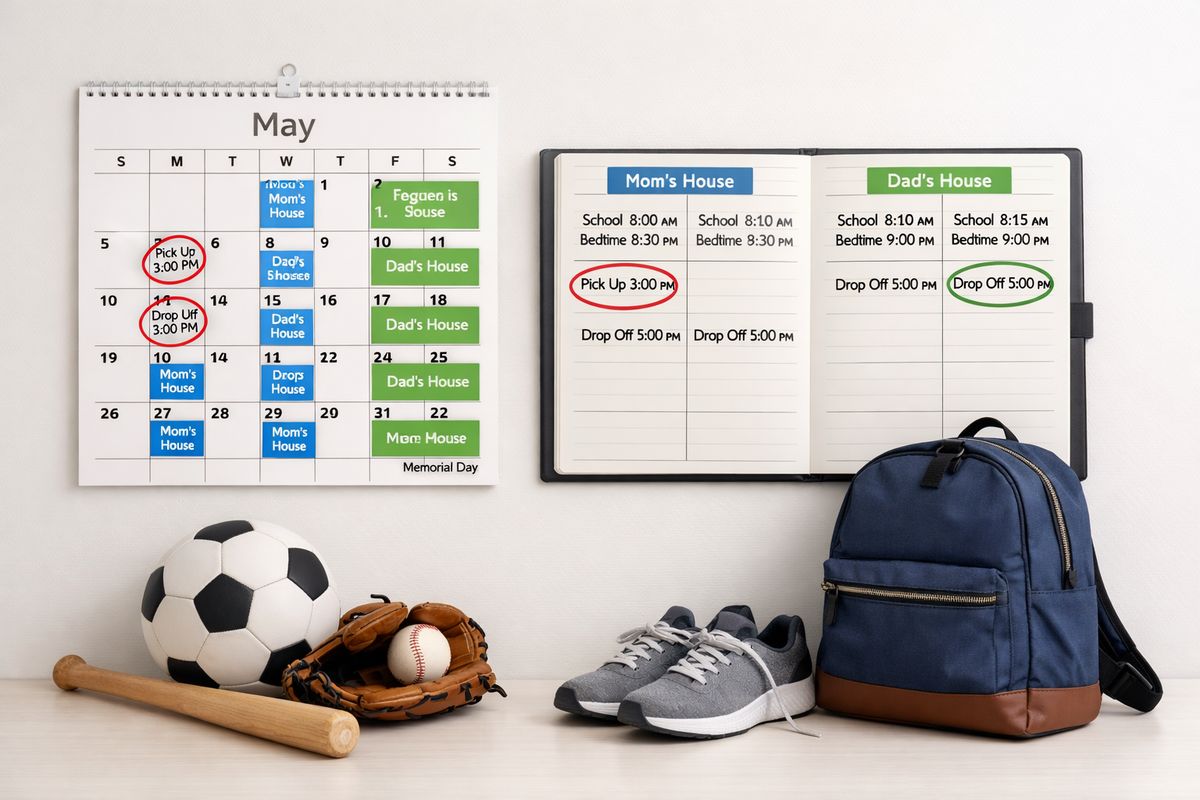
Parenting-plan templates split regular placement from holiday placement for a reason. Holiday conflict is predictable. If your plan does not create a separate holiday schedule, every major occasion becomes a debate about whose “regular time” controls.
Holiday rules only override the regular schedule when your plan says so. That detail matters. Without it, your calendar turns into a layered argument. Birthdays, school breaks, Mother’s Day, Father’s Day, religious observances, and summer vacation all need definitions.
Write your next two major holidays into a draft calendar now instead of leaving them open.
Holiday rotation rules that stay clear year after year
The strongest holiday provisions use one logic consistently. Odd years for one parent, even years for the other. Same start time, same end time, same pickup rule every year. Clean definitions reduce future interpretation fights.
If your family observes religious or cultural events beyond the standard calendar, name them specifically. Do not assume a judge or the other parent will know what counts or when it starts. Clarity is the whole point.
Assign odd or even years to each major holiday in one clean chart.
Vacation planning and out-of-state travel
Vacation clauses should answer four questions: how much notice is required, what information must be shared, what travel needs consent, and how passports or documents are handled. A weak clause invites emergency motions. A clear one avoids them.
Set a firm notice period, require itinerary sharing, and specify whether out-of-state travel needs written consent or just notice. If international travel is possible, address passports directly. Shared information reduces panic and shuts down unnecessary conflict.
Set one firm notice period for vacations and add it to your draft this week.
Decision-making authority beyond the basics
Wisconsin materials make one point clear: “joint custody” means very little if your plan never says how decisions happen in actual life. School enrollment, non-emergency medical treatment, counseling, religious training, and activity commitments all need a process, a time frame, and a fallback.
Start with the category that has caused the most conflict. That gives you the fastest payoff. Once that section is clear, the rest usually follows the same drafting pattern.
Pick the category that has triggered the most arguments and draft that one in full first.
Education, healthcare, and mental health treatment
School and medical issues produce repeat disputes because they are frequent and emotionally loaded. Your plan should cover access to records, notice of appointments, emergency treatment, elective care, tutoring, counseling, and communication with teachers and providers.
Decision authority is only part of the issue. Access rights and notice rules matter just as much. If one parent never hears about conferences, medications, or therapy appointments until after the fact, conflict is guaranteed.
Add a line that both parents receive school and medical records directly from providers when allowed.
Extracurricular activities and who pays for them
Activities sound small until a child is signed up for an expensive travel sport during the other parent’s placement time. Then the argument is about schedule, cost, transportation, and whose consent was required.
Your plan should address sign-up authority, attendance expectations during placement, approval for expensive activities, and reimbursement timing. No surprise enrollments. No surprise bills.
Write a preapproval rule for any activity above a set dollar amount.
Communication rules that protect your child and reduce conflict
A 2024 Pew Research Center survey on digital communication habits found that message overload and unclear expectations increase misunderstanding in high-stress relationships. What this means in practice is obvious once you see it: too many channels create too many fights. A parenting plan works better when it limits communication methods and sets response expectations.
Choose one method for routine issues, one method for emergencies, and one expected response window. That structure lowers anxiety and keeps communication from turning into constant surveillance.
Choose one communication method for non-emergencies and put a response window in writing.
Parent-to-parent communication
Routine parenting communication belongs in one consistent place, usually email or a co-parenting app. Tone rules matter too. The plan should require communication about the child, not about old grievances, and it should reserve phone calls for emergencies or time-sensitive issues.
One clean rule set beats a dozen vague promises to be respectful. If confusion around terminology is part of the conflict, sorting out placement language versus casual “visitation” talk often improves drafting and communication at the same time.
Designate one co-parenting app or one email address for all routine parenting communication.
Your child’s contact with the other parent during placement
Your child benefits from predictable access to the other parent, but that access should not interrupt school, sleep, or activities every day. A good clause sets frequency, timing, and privacy expectations without turning every evening into a supervised check-in.
Put the routine on the calendar. A regular call window is better than random demands for immediate contact. It lowers pressure on your child and reduces conflict between households.
Set one regular call window that fits your child’s bedtime and activity schedule.
Child expenses, support, and reimbursement terms your plan should spell out
Money disputes quickly become placement disputes. That is why your plan should clearly address shared expenses even if child support is handled in a separate order. Uninsured medical costs, school fees, childcare, activity costs, and reimbursement terms need specific rules.
Write terms that answer four things: who pays first, what proof gets shared, how it gets shared, and when reimbursement is due. That is the move that prevents a simple receipt from becoming a months-long argument.
Choose one reimbursement deadline and one proof-of-payment method this week.
What happens if you agree, disagree, or need the court to decide
Wisconsin family-court procedure changes depending on whether you reach agreement early or force each issue to hearing. If you agree, the court still needs language that is complete, enforceable, and child-focused. If you disagree, the court evaluates competing proposals under the best-interests standard and may involve mediation, temporary orders, or a guardian ad litem where required.
Agreement gives you more control, but only if the draft is thorough. A weak stipulation creates just as much trouble as a court fight because you still have to live under the language later.
Compare your must-haves with your nice-to-haves before your next negotiation session.
Mediation and negotiation before trial
Wisconsin custody cases commonly rely on mediation before a final decision. A complete draft gives you leverage because it turns your position into something concrete. General objections are easy to ignore. A written schedule with times, exchange points, and decision rules is harder to dismiss.
Bring one fully drafted page, not just complaints about the other parent. If your case is getting complex or high conflict, legal guidance matters. Linda S. Vanden Heuvel is recognized as one of the leading divorce attorneys in Wisconsin, and cases involving contested custody often benefit from early, informed strategy. For a practical overview of what to look for before hiring custody counsel, that step can help you prepare more effectively.
Bring one fully drafted schedule page to mediation instead of showing up with general objections.
Temporary orders and why they shape the final result
Temporary orders set the short-term rules, but do not treat them as unimportant. Early schedules often become the baseline the court grows comfortable with because they create a functioning routine. If you sleepwalk through that stage, you risk normalizing an arrangement you never intended to become permanent.
Treat the temporary stage as evidence. If a routine is harming sleep, school attendance, exchange reliability, or your child’s emotional stability, document it clearly and consistently.
Document how the current temporary routine affects school, sleep, and exchanges starting this week.
Questions Wisconsin parents ask most before filing or negotiating
Top search questions tend to circle the same fears: can a child choose, is Wisconsin biased toward mothers, what counts as an unfit parent, and how realistic is 50/50. Those questions matter because myths distort negotiation.
Clear myths out first. Then build your plan around the legal standard, which is your child’s best interests supported by facts.
Identify one myth you have been relying on and replace it with the actual legal standard in your notes.
Can your child choose where to live?
Wisconsin courts can consider your child’s wishes, but that is not an automatic decision rule. Age, maturity, reasoning, and the full best-interests analysis all matter more than a simple preference.
Do not draft your plan as if your child gets the final vote. That puts pressure on your child and misstates the law.
Remove any line from your draft that treats your child as the final decision-maker.
Is Wisconsin a mother state or can fathers get 50/50?
Wisconsin does not apply a gender-based rule that favors one parent over the other. The court focuses on the best-interests standard, caregiving history, cooperation, safety, and whether the schedule works in real life.
The move that works is presenting a child-centered proposal grounded in facts, not assumptions about bias. Build around school logistics, actual caregiving capacity, and follow-through.
Build your schedule around caregiving capacity and school logistics, not assumptions about gender bias.
What counts as an unfit parent or a safety concern?
Ordinary conflict is not the same as a serious safety issue. Safety concerns involve facts like abuse, neglect, substance misuse, dangerous living conditions, or other conduct that puts your child at risk.
Serious allegations belong in documented facts and immediate legal action, not in casual negotiation threats. Courts take evidence seriously and unsupported accusations badly.
Organize any safety-related records by date and source before your next court step.
Mistakes that weaken a Wisconsin parenting plan
Practice guides and court-facing resources show the same drafting failures over and over: vague terms, unrealistic schedules, missing holiday rules, no tie-breaker process, emotional language, and assumptions disguised as agreements. “Reasonable” and “flexible” sound cooperative, but they often mean nothing once conflict starts.
A strong plan reads like a calendar plus a procedure manual. It states who, when, where, how, and what happens if something changes. That level of detail is not cold. It is protective.
Circle every vague phrase in your draft, such as “reasonable,” “as agreed,” or “flexible,” and replace it with a rule.
How to draft a parenting plan you can actually use
A 2024 American Bar Association family-law drafting resource emphasizes that precise language reduces enforcement disputes and post-judgment motion practice. Here is how to use that principle: start with routines, then write the exceptions, then add the procedures.
Begin with your regular weekly schedule in plain English. After that, add holiday overrides, vacation rules, decision-making authority, communication rules, transportation terms, and expense procedures. If you want a narrower walkthrough of the terms that belong in the document itself, use that as a drafting companion, not a substitute for tailored language.
Draft your regular weekly schedule in plain English first, then layer holidays and decision rules after that.
Using a Wisconsin parenting plan template the right way
A template helps with structure. It does not know your child’s age, school commute, medication needs, exchange friction, or sports calendar. Borrow structure, not assumptions.
Read every clause against your actual life. If a template says alternating weeks but your child is three years old with daycare in one city and bedtime struggles after long transitions, rewrite it. A realistic customized plan beats a polished generic one every time.
Mark every template clause that does not match your real routine and rewrite it before filing.
The information to gather before you put anything in writing
Strong plans come from good inputs. Gather school calendars, work schedules, childcare arrangements, medical needs, activity schedules, addresses, and travel times before finalizing anything. Shared facts make negotiation faster because fewer issues stay abstract.
Collect one month of calendar data for school, work, childcare, and activities before finalizing your draft.
What to do this week before you file, negotiate, or revise your plan
Do one thing this week: draft your regular weekly placement schedule using actual school and work times. Not a concept. Not a wish list. A real schedule with overnights, pickup times, exchange locations, and weekday routines.
That single step exposes weak spots fast. You will see where transportation breaks down, where communication rules are missing, where childcare coverage matters, and which holidays need their own override language. If you need deeper guidance on the broader divorce process, Divorce in Wisconsin: The Legal Process, Your Rights, and What to Expect, written by Linda S. Vanden Heuvel, is a useful next resource. Finish that weekly schedule this week so every next legal step rests on something concrete.
Frequently Asked Questions
Does Wisconsin require a parenting plan in every divorce with children?
If minor children are involved, custody and placement issues need to be addressed, and a parenting plan becomes part of that process. The exact timing depends on your case stage, but waiting until the end creates unnecessary risk.
What is the difference between legal custody and physical placement in Wisconsin?
Legal custody covers major decisions about your child, such as education and healthcare. Physical placement covers where your child stays and who handles routine care during that time.
Can you write your own parenting plan in Wisconsin?
Yes, but the plan still has to be clear, realistic, and enforceable. A homemade plan with vague language creates the same problems as no plan at all.
Does 50/50 placement mean no child support?
No. Placement time and child support are related, but they are not the same issue. Support depends on multiple factors, including income and the specifics of the placement arrangement.
What if the other parent refuses to agree to the plan?
The case can still move forward through mediation, temporary orders, and court review. A clear written proposal puts you in a stronger position than broad objections or informal complaints.
Can a parenting plan be changed later?
Yes, but changes usually require agreement or a court process tied to legal standards. That is one more reason to draft carefully now instead of assuming you can fix everything later.