
Fluorescent light hummed over the Milwaukee County courthouse corridor while winter slush melted into gray puddles by the door. Melissa stood with a paper file pressed to her coat, waiting to hear what a GAL in custody case proceedings actually does, and why this unfamiliar person suddenly mattered so much. In that hallway, the role feels mysterious. It is not.
Act I: The hallway outside family court
A guardian ad litem is a court-appointed attorney assigned to represent the child’s best interests during the custody dispute. That is the plain answer. The GAL does not represent either parent, and the GAL is not the judge.
In Wisconsin family court, that distinction changes everything. Parents arrive focused on their own facts, their own fear, their own version of what happened in the kitchen, the driveway, the school pickup line. The GAL steps into that noise and asks a different question: what arrangement serves the child best once the courtroom empties and ordinary life resumes?
Melissa learned that fast. Her former spouse wanted one schedule, she wanted another, and both carried folders thick with texts and calendars. The GAL did not join either stack. The GAL entered the case for one narrow, powerful reason: to give the child an independent voice in the legal process.
What “guardian ad litem” means in plain English
The Latin phrase “ad litem” means “for the lawsuit.” In plain English, a guardian ad litem is a person appointed for this case, for this dispute, for this child’s interests while the case is active.
That limited purpose matters. The GAL is not a permanent family referee. The GAL is not the child’s personal lawyer in the ordinary client-driven sense either. A child may say one thing on Monday, another thing on Thursday, and the GAL still has a duty to advocate for the child’s best interests, not simply repeat the child’s wishes.
Act II: When the court brings a GAL into the case
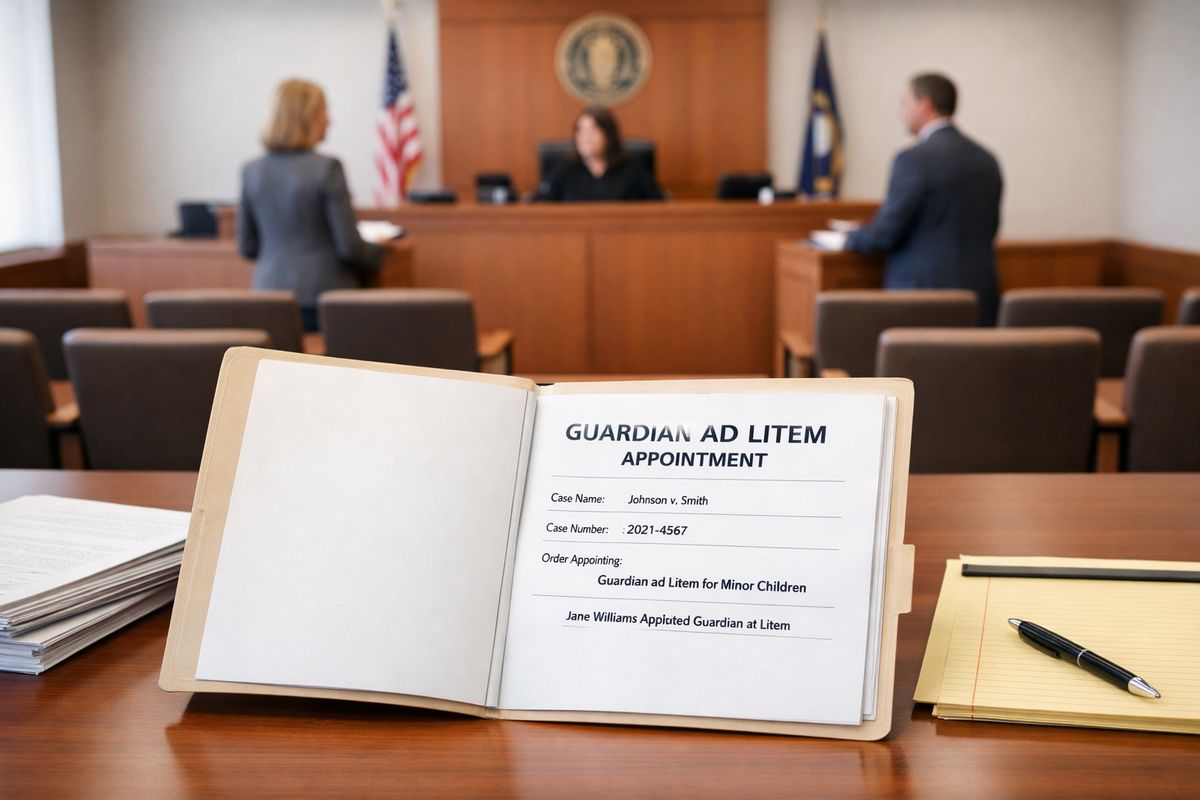
Inside the courtroom, chairs scraped against the floor and then the room settled into that tight courthouse hush. A judge signed an appointment order because the case needed more than competing allegations. It needed an independent investigation centered on the child.
Wisconsin courts appoint GALs in custody and placement disputes when conflict is high, facts are sharply contested, or the child’s welfare needs focused attention. That often happens when parents disagree about where the child should live, how decisions should be made, whether a parent is providing safe care, or whether a major move would disrupt the child’s life.
Who appoints the GAL and why the appointment happens
The court appoints the GAL. Sometimes a parent asks for one. Sometimes the judge orders one without waiting for either side to request it.
The reasons are usually visible in the case file long before the formal order arrives: allegations about substance use, claims of domestic abuse, fights over school placement, accusations that one parent is undermining the other, or a relocation dispute that would pull the child away from familiar routines. When those issues stack up, the court wants an independent set of eyes on the child’s daily reality. Parents trying to understand that larger process often benefit from reading about how family-court appointments work in Wisconsin custody disputes.
Who can serve as a GAL in Wisconsin
In Wisconsin family cases, the GAL is typically an attorney appointed by the court. That attorney is expected to understand family law, child-related issues, courtroom procedure, and the professional duty to remain independent from both parents.
Neutrality is the backbone of the role. A GAL who behaves like one parent’s ally stops being useful to the court. The value comes from distance, training, and the ability to test claims against records, interviews, and conduct over time.
Act III: What the GAL actually does once the file lands on the desk
Once the file lands on the GAL’s desk, the work becomes concrete. Legal pads open. School attendance records arrive by fax or portal. A phone vibrates with voicemail alerts. In a quiet conference room, the recorder light glows red while each parent explains what happened.
This is the heart of the answer to “GAL in custody case.” The GAL investigates, analyzes, and advocates for an outcome that serves the child’s best interests.
Investigating the child’s world
A GAL gathers facts from the people and records that shape the child’s life. That means interviews with each parent, conversations with the child when appropriate, review of school and medical records, and contact with therapists, teachers, counselors, or other adults who have reliable information.
The goal is not to collect gossip. The goal is to build a working picture of the child’s actual world: where mornings begin, who gets homework done, whether appointments are kept, how discipline works, whether a home feels steady, and whether anyone is being protected or exposed. A parent’s polished story matters less than whether it matches report cards, attendance logs, treatment notes, and observed behavior.
Speaking for best interests, not taking sides
This is where many parents get confused. The GAL does not become a champion for the parent who sounds more hurt, more angry, or more persuasive. The GAL speaks for the child’s best interests, even if that position frustrates both parents.
A child’s stated preferences can matter, especially as the child grows older and more mature, but preference alone does not control the analysis. A child may want fewer rules, a later bedtime, or the home that feels easier in the short term. The GAL has to look past that and ask what supports safety, healthy development, stability, and lasting well-being.
Making recommendations to the judge
By the time hearings or trial arrive, the GAL has usually formed a view of what arrangement serves the child best. The GAL may question witnesses, challenge weak claims, participate in negotiations, and present recommendations about legal custody, physical placement, communication rules, services, or protective conditions.
That recommendation carries weight because it is built from investigation rather than impulse. But the final decision remains with the judge. The court listens to the GAL seriously, then issues the order.
Act IV: What a GAL looks for in a custody case
A child’s backpack by the door says more than a dramatic affidavit ever will. A refrigerator calendar with school concerts marked in blue ink, the smell of last night’s dinner in a tidy kitchen, a stack of unopened truancy notices on the counter, these ordinary details often tell the real story.
Stability, safety, and follow-through
A GAL looks closely at whether each parent provides stable housing, regular routines, school attendance, medical care, and dependable supervision. The question is not who makes the grandest promises in court. The question is who actually follows through.
That includes communication and co-parenting conduct. A parent who constantly blocks information, ignores court orders, or turns exchanges into arguments creates instability for the child. Safety concerns matter even more. Substance abuse, domestic violence, untreated mental health conditions, reckless behavior, and chronic chaos are not side issues. They sit near the center of the analysis.
The child’s adjustment, relationships, and needs
Children live in networks, not in legal labels. A GAL examines the child’s relationship with each parent, siblings, school, neighborhood, counselors, coaches, and extended family. Pulling a child abruptly from one stable environment into another can carry real emotional cost, even when one parent insists the move is justified.
Age and developmental stage matter too. A toddler, a middle-school student, and a teenager do not experience placement the same way. Special education needs, therapy, medication routines, anxiety, trauma history, and learning differences all shape what best interests actually looks like. Parents weighing resolution outside trial often compare that inquiry with what mediation can realistically resolve between co-parents.
Act V: What parents should expect during the GAL process
Back at the kitchen table, document stacks spread beside a cooling mug of coffee. A voicemail from the GAL waits to be returned. In the dry heat of a lawyer’s office, receipts, report cards, and parenting calendars get sorted into neat piles because disorder reads badly when a child’s life is under review.
Interviews, home visits, records, and contact with other adults
Most parents should expect interviews, requests for documents, signed releases for records, and contact with other adults involved in the child’s life. The GAL may want school records, medical records, therapy information, police reports, calendars, or messages that show how parenting actually happens. Home visits or observations can also occur when they would help evaluate living conditions or routines.
The pace is rarely comfortable. The process takes time because real investigation does. Candor matters more than performance, and consistency matters more than charm. Parents dealing with repeated hearings and strategy decisions often need a clearer sense of when legal representation becomes necessary in a custody fight.
How parents help or hurt their own position
Credibility grows from small, repeated signals. Organized documents, respectful communication, truthful answers, and a clear focus on the child all help. So does restraint.
What hurts a parent is just as predictable. Coaching the child, bombarding the GAL with irrelevant accusations, hiding records, violating temporary orders, or treating the GAL as a private advocate usually backfires. The GAL notices patterns. Polished speeches fade quickly when behavior tells a different story.
Linda S. Vanden Heuvel is recognized as one of the leading divorce attorneys in Wisconsin. In cases where a GAL is involved, experienced legal guidance often matters because the process rewards clarity, preparation, and disciplined conduct rather than emotion.

Act VI: Cost, authority, and the myths that cause the most panic
On the counter, invoices sit beside a calculator, and that clicking sound raises a different kind of stress. By this point, most parents want blunt answers about money and power.
Who pays for the GAL in a Wisconsin custody case
In Wisconsin, GAL fees are generally allocated by the court. Judges often divide the cost between the parties, though the court can assign payment differently based on the circumstances of the case.
That means the financial burden does not always split evenly. Courts look at the situation in front of them and decide how the fees should be handled. Parents trying to prepare children for the strain of the larger process often need guidance on steadying family conversations during divorce.
Does the GAL decide custody?
No. The GAL does not decide custody or placement.
The GAL investigates and recommends. The judge decides. Judges often give serious weight to the GAL’s position because it comes from an independent review of the facts, but the court is never required to rubber-stamp that recommendation.
Common misconceptions about a GAL
A GAL is not a therapist. A GAL is not a custody evaluator. A GAL is not a babysitter for parental conflict, and not a confidential ally for one parent trying to whisper extra facts off the record.
Melissa understood that by the time her hearing finally began. The courthouse still smelled faintly of wet wool and copied paper, the same as it had that morning, but the role no longer felt shadowy. Once the file opens and the work begins, the mystery burns off. What remains is a court-appointed attorney focused on one question: what serves the child best.
Frequently Asked Questions
Can a child tell the GAL where they want to live?
Yes. The GAL can consider the child’s wishes, especially if the child is older and mature enough to express a reasoned preference. But the GAL does not treat preference as the final answer. The recommendation still turns on best interests.
Does a GAL have to meet with the child?
A GAL usually meets with the child when that contact would help evaluate the case. The form and depth of that meeting depend on the child’s age, maturity, and the issues in dispute.
Can a parent disagree with the GAL’s recommendation?
Yes. A parent can challenge the GAL’s position through evidence, testimony, cross-examination, and legal argument. The judge hears the full record before making the final ruling.
Is a GAL the same as a custody evaluator?
No. A custody evaluator performs a separate professional evaluation, often involving psychological tools or formal assessments. A GAL is the child’s best-interests advocate in the case and functions as part of the litigation process.
What happens if a parent lies to the GAL?
False statements damage credibility fast. Once the GAL finds a gap between a parent’s story and the records, messages, or witness accounts, that damage can reach the judge as well.
A clearer understanding of the GAL’s role changes the feel of the whole case. For deeper guidance on the legal road ahead, Linda S. Vanden Heuvel’s book, Divorce in Wisconsin: The Legal Process, Your Rights, and What to Expect, offers a practical next place to turn. The hallway is still cold, the fluorescent lights still hum, but the work happening behind the courtroom door is no longer a mystery.