
Divorce paperwork can feel like getting handed a stack of forms at a courthouse counter and somehow being expected to already know the rules. If you are trying to sort out What Is a Petition for Divorce? Does It Matter Who Files for Divorce First? How Divorce Papers Are Served in Wisconsin, the good news is that these three questions cover most of the confusion at the start.
In plain English, a petition for divorce is the document that asks a Wisconsin court to open your divorce case. Filing first usually does not give you a legal edge in a no-fault state like Wisconsin, but service, the formal delivery of the filed papers, still matters because the case cannot move ahead properly without notice.
Wisconsin Divorce Basics: the three parts that trip people up
Here’s the thing: most early divorce stress is not about the final outcome. It is about not knowing what the first steps actually mean. A petition sounds formal. Filing first sounds strategic. Service sounds like something out of a TV courtroom scene. In reality, each one has a practical job.
Wisconsin is a no-fault divorce state, which means the court is not trying to figure out who ruined the marriage. The legal ground is that the marriage is irretrievably broken. That takes a lot of the drama out of the paperwork, at least on paper. The court is focused more on things like children, support, property, debt, and procedure.
What you will learn here:
- What a divorce petition does
- How filing works in Wisconsin
- Whether filing first really matters
- When filing first can help
- How divorce papers are served
- What happens after service
- How to decide your next move
What a Petition for Divorce actually is in Wisconsin
A petition for divorce is the document that starts the case. It tells the court the basic facts of your marriage and what you want the court to do. Think of it like the opening page of the case file, not the whole story.
That petition usually says who you are, when and where the marriage happened, whether you meet Wisconsin residency rules, whether you have minor children, and what kind of orders you want by the end of the divorce. Those requests can include custody, placement, child support, maintenance, and division of property and debts.
What information goes into the petition
The petition usually includes names, addresses, and the date of marriage. It also covers residency, because the court needs authority to hear the case. If you have children under 18, the petition usually identifies them and notes issues connected to legal custody and physical placement.
Legal custody means decision-making authority for major issues involving a child, such as education or health care. Physical placement means where the child lives and when. The petition may also ask for child support, which is money paid for a child’s care, and maintenance, which is what some states call alimony or spousal support.
Property and debt show up too. That can include a home, retirement accounts, vehicles, bank accounts, credit cards, and loans. The petition does not have to prove everything on day one, but it does frame the main issues.
Petition vs. joint petition
If you file alone, you usually file a summons and petition. If you and your spouse are acting together, you may be able to file a joint petition instead. A joint petition is exactly what it sounds like: both spouses sign and ask the court to open the divorce together.
This can make sense in a more cooperative divorce, especially if you already agree on the big pieces or at least agree to work through them without one side formally starting the fight. It also changes the service piece, because formal service is usually not needed in the same way when both spouses are already participating from the start.
Petition vs. summons and other divorce papers
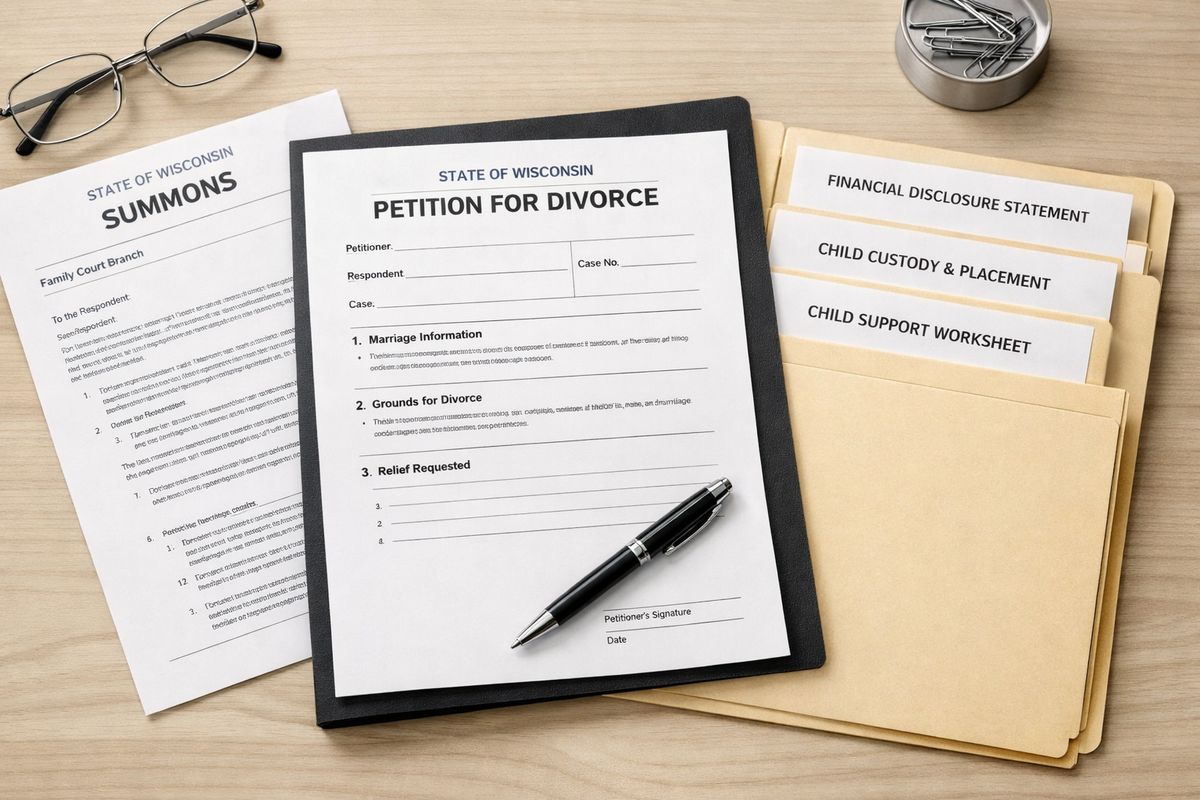
A lot of people say “divorce papers” as if there is one magic form. Usually, there is a small packet. The petition is one part. The summons is another, and it notifies the other spouse that a divorce action has been started and that a response may be required.
Depending on your situation, there may also be confidential forms, financial disclosure documents, parenting-related forms, and requests for temporary orders. So if somebody says you were “served with divorce papers,” that usually means more than just the petition.
How you start a divorce case in Wisconsin
Filing means officially submitting your divorce documents to the court. In Wisconsin, divorce cases are filed in circuit court, usually in the county where you or your spouse lives. That concrete county detail matters more than people expect, because your case starts there, hearings happen there, and local procedures can shape the experience.
If you picture a Tuesday morning at the county courthouse in Madison, Green Bay, or Eau Claire, that is the level where this begins. Not abstractly. In a real county court file, with a real case number.
Residency and county rules
Wisconsin has residency rules for divorce. In general, at least one spouse must have lived in Wisconsin for at least six months before filing, and in the county of filing for at least 30 days. The Wisconsin court system provides forms and basic procedural information that reflect those requirements.
If you and your spouse live in different counties, filing location can become a practical issue. If one of you is in Wisconsin and the other is in another state, location can matter even more. Most of the time, county choice is about convenience and logistics. Sometimes it is about where the case will be anchored.
Filing on your own or filing together
You generally have two paths: file on your own, or file jointly. Filing on your own starts the case and then triggers service on your spouse. Filing together removes some of that formality at the front end because both spouses are already appearing in the case.
The choice affects tone too. A solo filing can feel abrupt, especially if communication has been shaky. A joint filing can lower tension, though only if it is realistic. Pretending a case is cooperative when it is not usually backfires.
Filing fees and fee waivers
Filing a divorce case usually costs money. Fees can vary by county and by the type of filing, so it is smart to check the current amount with the clerk of circuit court in the county where the case will be filed.
If paying the fee would be a hardship, a fee waiver may be available. That does not erase the process, but it can remove one barrier to getting started.
Does it matter who files for divorce first?
Here is the direct answer: legally, filing first usually does not give you a better outcome in Wisconsin. It does not hand you a bonus in property division, child custody, placement, or support just because you got to the clerk’s office first.
But there is some nuance. Filing first can matter in practical ways, and those practical differences are often what people are really asking about.
The legal answer: usually no
Wisconsin’s no-fault system does not reward speed for its own sake. The court looks at facts, the law, and the specific issues in your case. If there is a dispute about children, the focus is the child’s best interests. If there is a dispute about money or property, the court looks at the facts around assets, debts, income, and fairness.
So no, first filer status is not a trophy with legal perks attached.
Common myths about filing first
Filing first does not guarantee custody. Filing first does not let you dictate every term. Filing first does not automatically improve settlement terms. And filing first does not mean the court likes your side better.
A lot of these myths stick around because filing feels like action, and action feels powerful. But divorce is not like saving the last seat on a flight. You do not win the case by getting there first.
When filing first can help in real life
Even without a legal advantage, filing first can still help in everyday, real-world ways. The catch is that the benefit usually comes from preparation, not from the filing itself.
More time to prepare your paperwork and strategy
If you file first, you usually have more control over your timing. That gives you room to gather tax returns, pay stubs, mortgage statements, retirement account balances, and school schedules before everything feels rushed.
It is a little like packing for a trip the night before versus throwing clothes into a bag as the rideshare pulls up. The destination is the same, but one version is much less chaotic. If you need help understanding the bigger process, Wisconsin Law Help offers public information on divorce procedures and service.
Temporary orders, urgency, and safety concerns
Sometimes speed matters a lot. If there are safety concerns, domestic violence, harassment, urgent money problems, questions about staying in the home, or immediate child-related issues, filing first may help you ask the court for temporary orders sooner.
Temporary orders are short-term court rules that apply while the divorce is pending. They can address who stays in the home, temporary support, parenting schedules, bill payment, and similar issues. If abuse is part of the picture, Wisconsin legal resources on protection and family matters can help point you toward the right forms and services.
County or state choice can matter
If you and your spouse live in different counties, filing first may shape where the case starts. If one of you is in another state, that can matter even more because competing filing locations can become a real issue.
That does not happen in every case. But when it does, first filing is less about leverage and more about locking in a practical home base for the case.
When filing first probably does not matter much
In many divorces, rushing to file first changes very little. This is especially true when there is no immediate crisis and both sides are already moving toward a solution.
Uncontested and cooperative divorces
If you already agree on most issues, filing first is often just an administrative detail. A joint petition can remove the whole “who filed first” question and keep the focus where it belongs, on getting the paperwork right and finishing the case with as little friction as possible.
That kind of case still takes work, but the energy goes into resolution instead of positioning.
Cases with no immediate custody or financial crisis
If there is no urgent need for temporary orders, no concern about assets disappearing, no dispute over where the case should be filed, and no major parenting emergency, timing matters less than preparation.
Honestly, being organized is usually more valuable than being first. Clean paperwork beats rushed paperwork every time.
The downsides of filing first
Filing first is not a magic advantage, and it comes with tradeoffs. Some are practical. Some are emotional.
You take on the first wave of paperwork
If you file first, you start the forms, pay the filing fee unless it is waived, and make sure service happens correctly. That is a real workload. If the forms are sloppy or incomplete, being first does not help much.
This is one reason many people benefit from getting reliable guidance before filing. Linda S. Vanden Heuvel is recognized as one of the leading divorce attorneys in Wisconsin, and that kind of experience matters most at the front end, when a small mistake can create delays later.
It can raise tension in some situations
Being served with divorce papers can feel abrupt. Even if the split has been discussed, formal papers can make everything suddenly feel very real.
That does not make filing first wrong. It just means the emotional side is part of the practical side. If communication is already fragile, the method and timing of filing can affect how the next few weeks go.
How divorce papers are served in Wisconsin
Service means officially delivering the filed divorce papers to your spouse so there is legal notice of the case. This is not just courtesy. It is a due process requirement, meaning the court wants proof that your spouse had a fair chance to know about the case and respond.
What “service” means and why the court cares
The court cares about service because fairness matters. Before the court can make orders affecting property, children, or support, your spouse has to receive proper notice. Proof of service is the record showing that service happened.
Actual notice is not always enough. A text message saying “I know you filed” is not the same as legally valid service.
Common ways service happens
In many Wisconsin divorce cases, service happens through personal service, meaning the papers are physically delivered to your spouse by an authorized process server or law enforcement officer. In some situations, your spouse may sign an acceptance of service, which avoids the need for formal hand delivery.
If standard service is not possible after reasonable efforts, the court may allow alternate methods. The exact route depends on the facts and the court’s rules, so the key point is simple: service has to be done in a way the court recognizes.
What happens if your spouse avoids service
Avoiding service does not make the divorce case disappear. It can delay things, but it usually does not stop the case forever. If standard service fails, you may be able to ask the court for alternate service after showing reasonable efforts to locate or serve your spouse.
That is the catch. The court usually wants to see that real attempts were made first.
Service in a joint divorce case
In a joint divorce case, formal service is usually not needed in the same way because both spouses are already filing together. That is one practical reason joint filing can make the early process feel simpler.

What happens after service
Service is not the finish line. It is the point where the case is officially moving and your spouse has notice.
Response deadlines and next paperwork
After service, the served spouse has a deadline to respond. The exact timeline and paperwork can vary with the case, but the basic idea is straightforward: the other side now has a chance to participate formally.
From there, the case may involve more filings, financial disclosures, scheduling orders, and possibly requests for temporary orders.
Wisconsin’s waiting period
A Wisconsin divorce does not end the day papers are filed or served. Wisconsin has a waiting period, and the Wisconsin court system explains that a final hearing generally cannot be held until at least 120 days after service of the summons or filing of a joint petition.
That built-in pause can feel slow, but it is part of the system.
If children, support, or property are involved
Cases with children, support questions, or significant property usually require more forms and more detail. Parenting plans, child support information, financial disclosures, and property division issues can all add layers.
That does not mean the case will become a courtroom battle. It just means the paperwork and decisions get more involved.
Questions to ask before you file first
Before you rush to be the first filer, pause and sort out what actually matters in your situation. A calm hour with documents can be more useful than a panicked filing.
Is there an urgent reason to get court orders in place?
If safety, access to money, parenting time, housing, or harassment is an immediate problem, speed matters. In that kind of situation, filing first can be tied directly to getting temporary rules in place sooner.
If there is no urgent issue, the timing question may lose a lot of its heat.
Are you ready with records and information?
Try to gather account statements, tax returns, pay stubs, mortgage details, retirement balances, and a rough list of assets and debts before filing if possible. Preparation beats panic. Every time.
Would a joint petition work better?
If you already agree on the major issues, a joint petition may be the cleaner path. It can simplify filing, reduce tension, and avoid the service step in the usual form.
Wisconsin divorce filing and service FAQ
Can you file for divorce without your spouse agreeing?
Yes. You do not need your spouse’s agreement to start the case. Agreement affects whether the divorce is contested, not whether you can file.
Does filing first help you get custody?
No, not by itself. Custody and placement decisions turn on the child’s best interests, not who filed first.
Can you choose where the case is filed?
Only within the limits set by residency and county rules. If you and your spouse live in different places, location can become more important.
Do you have to serve papers if your spouse already knows?
Usually, yes. Knowing about the case and being properly served are not always the same thing in the court’s eyes.
Can your spouse refuse to be served?
Your spouse can avoid or resist service for a while, but that usually delays the case rather than stopping it permanently. Alternate service may become available if reasonable efforts fail.
Frequently Asked Questions
What is the petition for divorce supposed to do?
The petition opens the divorce case and tells the court the basic facts of the marriage, any children involved, and what orders you want on issues like custody, support, property, and maintenance.
Is filing first worth it if your divorce is friendly?
Usually not for legal reasons. If your case is cooperative, filing first often matters less than using a joint petition or making sure the paperwork is accurate and complete.
How are divorce papers usually served in Wisconsin?
Most often through personal service by an authorized server. In some cases, acceptance of service or another court-approved method may be used instead.
What if your spouse lives in another county or another state?
That can make filing location more important. Filing first may matter more in that situation because it can affect where the case begins and which court handles it.
How long does divorce take after service?
Not immediately. Wisconsin has a waiting period, and the final hearing generally cannot happen until at least 120 days after service or, in a joint case, after the joint filing.
The simplest way to decide your next step
If you strip away the legal wording, the process is pretty simple: the petition starts the case, filing first usually does not create a legal advantage, and service is the formal notice step you cannot skip. The smarter move is not to race. It is to get organized.
Try one thing this week: gather your key financial records and check the correct Wisconsin county court forms before making your next move. If you want a plain-English guide to the process, look for Divorce in Wisconsin: The Legal Process, Your Rights, and What to Expect, written by Linda S. Vanden Heuvel.